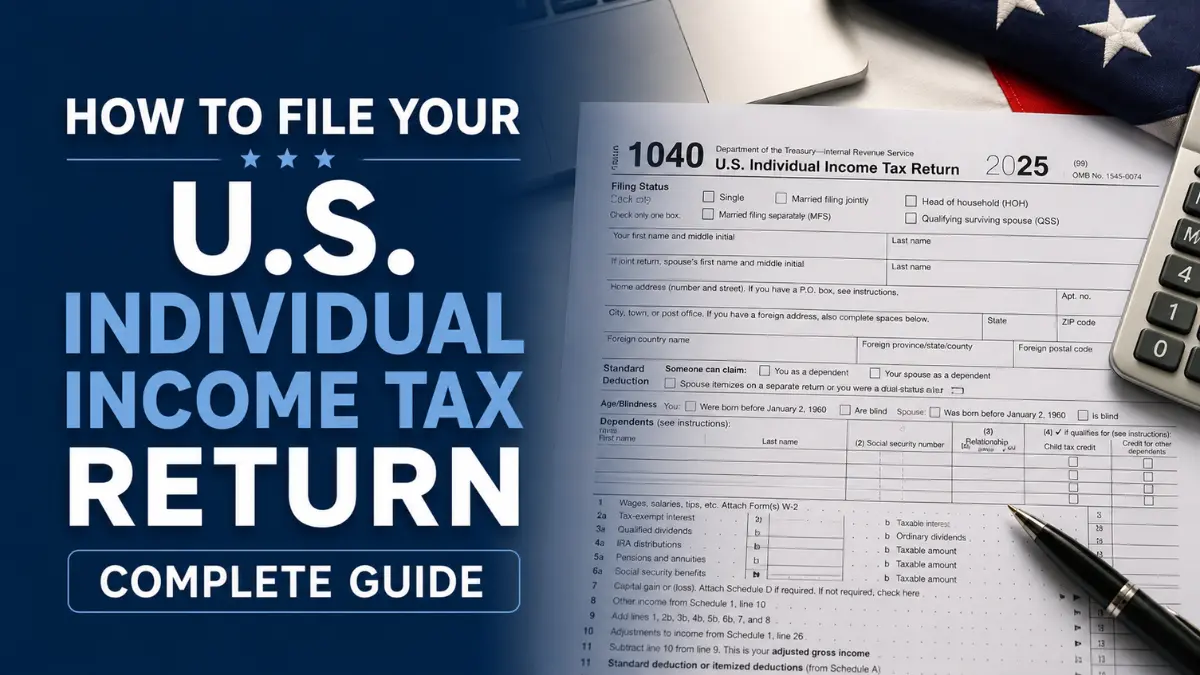
Every working American who earns income above the filing threshold must submit form 1040 2026 — the U.S. Individual Income Tax Return — to the Internal Revenue Service. Whether you are a salaried employee, a freelancer, a retiree, or a small business owner, Form 1040 is the cornerstone of the U.S. tax system. And for the 2025 tax year filed in 2026, there is a genuinely new wrinkle: the IRS introduced Schedule 1-A form 2026, a brand-new schedule that lets millions of tipped workers, overtime earners, car loan payers, and seniors claim above-the-line deductions they have never had access to before.
This guide covers everything from who needs to file, to the new standard deduction amounts, to a complete line-by-line walkthrough of the form, to the four new OBBBA deductions on Schedule 1-A — so you can file confidently, claim every deduction you are entitled to, and avoid costly mistakes.
Also on applicationformportal.us: W-9 Form 2026 — if you earned freelance or contractor income in 2025, you likely received a 1099 tied to a W-9 you submitted. That income is reported on your Form 1040.
What Is Form 1040?
Form 1040, officially titled U.S. Individual Income Tax Return, is the standard federal tax return form used by individuals to report their annual income, calculate their tax liability, claim deductions and credits, and either pay any remaining tax owed or receive a refund. It is issued by the IRS and filed once per year, covering income earned during the prior calendar year.
The form 1040 filing instructions distinguish between three versions of the form:
| Form | Who Should Use It |
|---|---|
| Form 1040 | Most individual taxpayers under age 65 |
| Form 1040-SR | Taxpayers aged 65 or older — same form, larger print, senior-specific deduction lines highlighted |
| Form 1040-NR | Nonresident aliens who have U.S.-sourced income |
📥 Download Form 1040 & All Schedules from the Official IRS Website →
Understanding the 1040 vs 1040-SR difference is straightforward: both forms report the same income and claim the same deductions. The 1040-SR is designed specifically for seniors and features larger text and a built-in standard deduction chart. If you turned 65 on or before January 1, 2026, you may use either form for your 2025 tax year return.
Who Must File Form 1040 in 2026?
You are generally required to file a federal income tax return for tax year 2025 if your gross income exceeds the filing threshold for your age and filing status. For 2025 returns filed in 2026, the general thresholds are:
| Filing Status | Age | 2025 Filing Threshold |
|---|---|---|
| Single | Under 65 | $15,750 |
| Single | 65 or older | $17,400 |
| Married Filing Jointly | Both under 65 | $31,500 |
| Married Filing Jointly | One spouse 65+ | $33,150 |
| Married Filing Jointly | Both 65+ | $34,800 |
| Married Filing Separately | Any age | $5 (effectively everyone must file) |
| Head of Household | Under 65 | $23,625 |
| Head of Household | 65 or older | $25,275 |
| Qualifying Surviving Spouse | Under 65 | $31,500 |
| Qualifying Surviving Spouse | 65 or older | $33,150 |
Even if your income falls below these thresholds, you should still file if federal income tax was withheld from your paycheck (to get a refund), if you qualify for refundable credits such as the Earned Income Tax Credit or Child Tax Credit, or if you made estimated tax payments.
IRS Tax Filing Deadline 2026
The IRS tax filing deadline 2026 for 2025 tax year returns was April 15, 2026 for most individual taxpayers. If you missed that deadline but filed a valid extension request using Form 4868 by April 15, your extended filing deadline is October 15, 2026.
Critical points about the form 1040 extension 2026:
- An extension extends only the time to file — not the time to pay. Any tax owed was still due on April 15, 2026. Taxes paid after that date accrue interest and may be subject to a failure-to-pay penalty of 0.5% per month.
- If you are overseas on the April 15 deadline, you automatically get a 2-month extension to June 15 — but interest on any taxes owed still runs from April 15.
- Members of the military serving in a combat zone get additional time beyond the standard extension.
- Certain federally declared disaster areas receive automatic extensions — check IRS.gov for current disaster relief announcements.
2025 Standard Deduction Amounts (Filed on Form 1040 in 2026)
The 1040 standard deduction 2026 — meaning the standard deduction for tax year 2025 returns filed in 2026 — increased significantly compared to prior years, boosted both by inflation indexing and provisions of the One Big Beautiful Bill Act (OBBBA). Approximately 90% of taxpayers claim the standard deduction rather than itemizing.
| Filing Status | 2025 Standard Deduction | Additional (Age 65+ or Blind) |
|---|---|---|
| Single / Married Filing Separately | $15,750 | +$2,000 per qualifying condition |
| Married Filing Jointly / Qualifying Surviving Spouse | $31,500 | +$1,650 per qualifying spouse per condition |
| Head of Household | $23,625 | +$2,000 per qualifying condition |
New for 2025: Senior Bonus Deduction. Under the OBBBA, taxpayers aged 65 and older may claim an additional $6,000 deduction per qualifying filer (up to $12,000 for a married couple where both spouses qualify), on top of the regular standard deduction and the existing age-65 addition. This deduction is available to both itemizers and standard deduction filers. It phases out at 6% per dollar of modified AGI above $75,000 (single) or $150,000 (joint), and applies for tax years 2025 through 2028.
Non-itemizer charitable deduction: Starting in 2026 (for tax year 2026 returns filed in 2027), taxpayers who take the standard deduction can also deduct up to $1,000 in cash charitable contributions ($2,000 married filing jointly). This does not apply to your 2025 return.
2025 Tax Brackets (Reported on Form 1040 Filed in 2026)
The federal income tax uses a progressive bracket system. The 1040 tax brackets 2026 — that is, the brackets that apply to 2025 income reported on returns filed in 2026 — are:
| Tax Rate | Single Filers | Married Filing Jointly | Head of Household |
|---|---|---|---|
| 10% | $0 – $11,925 | $0 – $23,850 | $0 – $17,000 |
| 12% | $11,926 – $48,475 | $23,851 – $96,950 | $17,001 – $64,850 |
| 22% | $48,476 – $103,350 | $96,951 – $206,700 | $64,851 – $103,350 |
| 24% | $103,351 – $197,300 | $206,701 – $394,600 | $103,351 – $197,300 |
| 32% | $197,301 – $250,525 | $394,601 – $501,050 | $197,301 – $250,500 |
| 35% | $250,526 – $626,350 | $501,051 – $751,600 | $250,501 – $626,350 |
| 37% | Over $626,350 | Over $751,600 | Over $626,350 |
These rates are marginal — only the income within each bracket is taxed at that rate. A single filer earning $60,000 does not pay 22% on the entire $60,000; they pay 10% on the first $11,925, 12% on the next $36,550, and 22% only on the remaining amount above $48,475.
The Biggest 2026 Change: New Schedule 1-A and OBBBA Deductions
The landmark addition to form 1040 2026 is the brand-new Schedule 1-A form 2026, officially titled Additional Deductions, published by the IRS on March 2, 2026. Schedule 1-A implements four new above-the-line deductions created by the One Big Beautiful Bill Act for tax years 2025 through 2028. These deductions are available whether you claim the standard deduction or itemize — you attach Schedule 1-A to your Form 1040 and transfer the total to Line 13b of your return.
Here are the four deductions available on Schedule 1-A:
1. No Tax on Tips — Up to $25,000 Deduction
The no tax on tips 1040 deduction (Schedule 1-A, Part II) allows workers in tipped occupations to deduct up to $25,000 of qualified tip income from federal taxable income ($25,000 per return for both single filers and married couples filing jointly).
- Eligible workers: Employees in occupations that customarily and regularly received tips as of December 31, 2024, as listed at IRS.gov/TippedOccupations. This includes restaurant servers, bartenders, hotel staff, salon workers, taxi and rideshare drivers, and similar workers.
- Income phaseout: The deduction phases out for modified AGI above $150,000 (single) or $300,000 (married filing jointly).
- Documentation: Tips must be reported on a Form W-2, Form 1099, or Form 4137. If your W-2 does not separately report tips, use pay stubs or Form 4070A to calculate the qualifying amount.
- Not eligible: Tips received through a Specified Service Trade or Business (SSTB) do not qualify.
2. No Tax on Overtime — Up to $12,500 Deduction
Workers who earned FLSA-required overtime can deduct up to $12,500 of the overtime premium — the “half” portion of time-and-a-half pay (Schedule 1-A, Part III). Married couples filing jointly may deduct up to $25,000.
- What counts: Only the premium portion of overtime pay qualifies — not the entire overtime paycheck. If your regular rate is $20/hour and your overtime rate is $30/hour, only the extra $10 per overtime hour is the qualifying premium.
- Income phaseout: Same as tips — phases out above $150,000 (single) or $300,000 (married filing jointly).
- Married filers must file jointly to claim this deduction.
- Reporting: Starting with 2026 W-2s (issued January 2027), employers will separately report overtime in Box 12 using code TT. For 2025 returns, use your W-2, pay stubs, or ask your employer for the FLSA overtime premium amount.
3. Qualified Passenger Vehicle Loan Interest — Up to $10,000
Taxpayers who paid interest on a qualifying new vehicle loan in 2025 can deduct up to $10,000 of that interest (Schedule 1-A, Part IV). The vehicle must meet IRS requirements including a U.S. assembly rule, and you must provide the vehicle’s VIN on the form. Income phaseout begins at $100,000 (single) or $200,000 (married filing jointly).
4. Enhanced Senior Deduction — Up to $6,000 Per Qualifying Filer
Taxpayers aged 65 or older can claim an additional $6,000 deduction per qualifying filer through Schedule 1-A, Part V (up to $12,000 for a couple where both spouses are 65+). Each qualifying filer must have a valid Social Security number. Married couples must file jointly. The deduction phases out at 6% per dollar above $75,000 (single) or $150,000 (joint).
The total of all four Schedule 1-A deductions flows to Line 38 of Schedule 1-A, then transfers to Line 13b of Form 1040 (or Line 13c of Form 1040-NR).
How to Fill Out Form 1040: Section-by-Section Guide
Knowing how to fill out form 1040 is straightforward once you understand the flow. The form moves logically from identifying information, to income, to deductions, to tax calculation, to credits, and finally to the amount you owe or your refund. Here is every section:
Filing Information (Top of Page 1)
Enter your legal name, Social Security number, home address, and filing status. If filing jointly, include your spouse’s name and SSN. Check exactly one filing status box — this determines your standard deduction, your tax brackets, and your eligibility for dozens of credits and deductions. List all qualifying dependents in the Dependents section, including each dependent’s name, SSN, and relationship to you. Checking the correct boxes (child tax credit eligible, other dependent credit eligible) unlocks credits worth up to $2,200 per qualifying child in 2025.
Lines 1–8: Income
Report all income sources on Lines 1 through 8. The most common are:
- Line 1a: Total wages, salaries, and tips from your W-2 forms (Box 1 of each W-2)
- Line 1b: Household employee wages not reported on a W-2
- Line 1c: Tip income not reported to your employer (also report on Schedule 1, Line 1)
- Line 1d: Medicaid waiver payments not included in gross income
- Line 1e: Taxable dependent care benefits from Form 2441
- Line 1f: Employer adoption benefits from Form 8839
- Line 1g: Wages from Form 8919 (uncollected Social Security and Medicare tax on wages)
- Line 1h: Other earned income (clergy housing allowance, etc.)
- Line 1z: Total of all Line 1 entries
- Line 2b: Taxable interest income (from 1099-INT forms)
- Line 3b: Ordinary dividends (from 1099-DIV forms)
- Line 4b: Taxable IRA distributions
- Line 5b: Taxable pension and annuity income
- Line 6b: Taxable Social Security benefits
- Line 7: Capital gain or loss (from Schedule D)
- Line 8: Additional income from Schedule 1 (freelance income, rental income, alimony received, etc.)
Add Lines 1z through 8 to get your Total Income on Line 9.
Lines 10–15: Adjusted Gross Income (AGI)
Line 10 carries over adjustments to income from Schedule 1, Part II — these are “above-the-line” deductions that reduce your income before the standard or itemized deduction is applied. Common adjustments include student loan interest, educator expenses, self-employment tax, health insurance premiums for the self-employed, and contributions to a traditional IRA or HSA.
Line 11 is your Adjusted Gross Income (AGI) — Total Income minus adjustments. AGI is one of the most important numbers on your return because it determines your eligibility for dozens of credits and deductions.
Lines 12–15: Taxable Income
Line 12 is your standard deduction or itemized deductions from Schedule A — whichever is larger. Line 13 covers the Qualified Business Income (QBI) deduction for self-employed taxpayers and pass-through business owners (up to 20% of qualified business income), plus the new Schedule 1-A deductions on Line 13b. Line 15 is your Taxable Income — AGI minus your deductions. This is the number your tax is actually calculated on.
Lines 16–24: Tax and Credits
Line 16 is your initial tax liability, calculated from the tax tables in the Form 1040 instructions or using the Qualified Dividends and Capital Gain Tax Worksheet. Lines 17–23 add Alternative Minimum Tax, self-employment tax, and other taxes if applicable. Lines 19–21 subtract non-refundable credits including the Child Tax Credit ($2,200 per qualifying child for 2025) and education credits. Line 24 is your Total Tax.
Lines 25–33: Payments
Lines 25–32 tally all payments already made toward your tax bill: federal withholding from your W-2(s) and 1099(s), estimated tax payments made quarterly, and refundable credits including the Earned Income Tax Credit (EITC), Additional Child Tax Credit, and American Opportunity Credit. Line 33 is your Total Payments.
Lines 34–38: Refund or Amount Owed
If Total Payments (Line 33) exceed Total Tax (Line 24), the difference is your refund (Line 35a). You can direct-deposit your refund by entering your bank routing and account numbers on Lines 35b–35d. If Total Tax exceeds Total Payments, Line 37 shows the amount you owe. Pay at IRS.gov/payments, by check payable to the U.S. Treasury, or by phone.
Signature
Sign and date the return at the bottom of Page 2. Joint returns require both spouses’ signatures. An unsigned Form 1040 is not valid and will be rejected by the IRS. If a paid preparer completed your return, they must also sign and include their PTIN.
Key Schedules That Attach to Form 1040
Most taxpayers need one or more schedules in addition to the main Form 1040. Here is a quick reference to the most commonly used:
| Schedule | What It Covers | Who Needs It |
|---|---|---|
| Schedule 1-A | Tips, overtime, vehicle loan interest, senior deduction | Tipped workers, overtime earners, new vehicle owners, seniors 65+ |
| Schedule 1 | Additional income and above-the-line deductions | Freelancers, rental income earners, student loan interest payers |
| Schedule A | Itemized deductions (mortgage interest, SALT, medical, charitable) | Taxpayers whose itemized deductions exceed the standard deduction |
| Schedule B | Interest and ordinary dividends over $1,500 | Investors with significant interest or dividend income |
| Schedule C | Profit or loss from self-employment / sole proprietorship | Freelancers, gig workers, sole proprietors |
| Schedule D | Capital gains and losses | Anyone who sold stocks, real estate, crypto, or other assets |
| Schedule SE | Self-employment tax calculation | Self-employed individuals with net earnings of $400 or more |
How to File Form 1040 in 2026
You have four main options for filing your form 1040 2026:
- IRS Free File: If your adjusted gross income was $84,000 or less in 2025, you can file for free using IRS-partnered tax software at IRS.gov/freefile. The software guides you through every question, calculates your liability, and e-files directly with the IRS.
- Tax software (paid): Products like TurboTax, H&R Block, TaxAct, and FreeTaxUSA walk you through the return step by step and include built-in guidance for Schedule 1-A and other 2025 changes.
- Tax professional: A CPA, Enrolled Agent, or tax preparer can complete and file the return on your behalf. Required if your situation is complex — business income, foreign assets, prior-year tax issues, or multiple states.
- Paper filing: Download Form 1040 from IRS.gov, complete it manually, and mail to the IRS address for your state listed in the instructions. Paper returns take significantly longer to process (6–8 weeks vs. 21 days for e-filed returns).
Direct deposit tip: E-filed returns with direct deposit receive refunds in as little as 21 days. Paper-filed returns with a paper check can take 6–8 weeks or longer. Always e-file when possible.
Common Form 1040 Mistakes to Avoid
- Wrong Social Security numbers. A single transposed digit can delay your return by weeks and affect dependent-linked credits.
- Missing Schedule 1-A. Millions of tipped workers and overtime earners qualify for new deductions in 2025 but will leave money on the table if they do not attach Schedule 1-A. Review your W-2 and pay stubs carefully.
- Forgetting 1099 income. Freelance income, interest, dividends, and marketplace sales reported on 1099 forms must all be included. The IRS receives copies of every 1099 and cross-checks them against your return.
- Choosing the wrong filing status. Your filing status affects your standard deduction, tax brackets, and credit eligibility. Head of household has significantly better rates than single but has strict qualifying requirements.
- Not signing the return. An unsigned Form 1040 is invalid. Both spouses must sign a joint return.
- Missing the deadline without an extension. The failure-to-file penalty is 5% of unpaid taxes per month (up to 25%). Always file or extend by April 15.
- Entering bank account information incorrectly. A wrong routing or account number can send your refund to the wrong account. Double-check every digit before submitting.
Other Application Forms You May Need
Filing your federal return often connects to other IRS and government forms. Here are two related guides on applicationformportal.us:
- 📄 W-4 Form 2026 — The Employee’s Withholding Certificate tells your employer how much federal income tax to withhold from each paycheck. Accurate W-4 withholding means fewer surprises on your Form 1040.
- 📄 W-9 Form 2026 — If you earned income as a contractor or freelancer, your clients used the W-9 you submitted to generate 1099 forms. That income must be reported on Schedule C and your Form 1040.
Frequently Asked Questions About Form 1040 2026
What is the difference between Form 1040 and Form 1040-SR?
The 1040 vs 1040-SR difference is purely cosmetic and eligibility-based. Form 1040-SR is available to taxpayers who are 65 or older and features larger text and a built-in standard deduction chart that highlights the senior additions. Both forms report the same income, claim the same deductions, and produce identical tax calculations. If you turned 65 on or before January 1, 2026, you may use either form.
What is the 2025 standard deduction for Form 1040?
The 1040 standard deduction 2026 (for 2025 tax year returns) is $15,750 for single filers and married individuals filing separately, $31,500 for married couples filing jointly, and $23,625 for heads of household. Taxpayers 65 or older or blind get an additional $1,650–$2,000 on top. Seniors may also claim the new $6,000 OBBBA senior deduction via Schedule 1-A.
What is Schedule 1-A and do I need it?
The Schedule 1-A form 2026 is a new IRS schedule attached to Form 1040 that allows eligible taxpayers to claim four OBBBA deductions: tips (up to $25,000), overtime (up to $12,500), vehicle loan interest (up to $10,000), and the senior deduction ($6,000 per qualifying filer). You need it if you received any of these types of income or qualify for the senior deduction in tax year 2025.
What is the filing deadline for Form 1040 in 2026?
The IRS tax filing deadline 2026 for 2025 tax year returns was April 15, 2026. With a Form 4868 extension filed by that date, the extended deadline is October 15, 2026. Extensions apply only to filing — any taxes owed were due April 15 regardless.
Can I deduct tips and overtime on my 2025 Form 1040?
Yes — this is one of the most significant changes in years. The no tax on tips 1040 deduction and the overtime deduction are both available for tax year 2025 via Schedule 1-A. Tipped workers in qualifying occupations can deduct up to $25,000 in tips. Workers with FLSA overtime can deduct up to $12,500 of the premium portion. Both deductions phase out for incomes above $150,000 (single) or $300,000 (married filing jointly).
How do I get a filing extension for Form 1040?
File Form 4868 (Application for Automatic Extension of Time to File) by April 15, 2026. You can file Form 4868 electronically through tax software or IRS Free File, or mail a paper copy. The form 1040 extension 2026 is automatic — no explanation required. However, you must estimate and pay any taxes owed by April 15 to avoid interest and failure-to-pay penalties.
Where can I download Form 1040 for 2026?
Download the current Form 1040 and all schedules — including the new Schedule 1-A — for free at IRS.gov/forms-pubs/about-form-1040. You can also access and file through IRS Free File at IRS.gov/freefile if your AGI is $84,000 or less.
Official Form 1040 Resources
- 🟢 About Form 1040 — IRS.gov
- 🟢 Schedule 1-A: What to Know — IRS.gov
- 🟢 IRS Free File — File Free if AGI ≤$84,000
- 🟢 IRS Payments Portal — Pay Tax Owed Online
- 🟢 One Big Beautiful Bill Act Tax Provisions — IRS.gov
Disclaimer: This guide is for general informational purposes only and does not constitute tax, legal, or financial advice. Tax laws change annually. Always refer to the official IRS website at irs.gov or consult a qualified tax professional for advice specific to your situation.
2 thoughts on “Form 1040 2026: How to File Your U.S. Individual Income Tax Return — Complete Guide”