If you are living in the United States without a green card and you need to work legally, Form I-765 is the application that gets you there. Officially called the Application for Employment Authorization, this USCIS form is used by hundreds of thousands of noncitizens every year to obtain an Employment Authorization Document — the physical card that proves to any U.S. employer that you are legally permitted to work. Without it, you cannot be lawfully hired, and working without authorization can have serious, long-lasting immigration consequences.
Whether you are researching what an EAD work permit actually covers, figuring out exactly how to apply for EAD online or by mail, sorting through the dozens of I-765 eligibility categories to find yours, preparing an EAD renewal 2026 filing before your current card expires, checking the latest I-765 processing time 2026 by category, understanding the H-4 EAD application process for dependent spouses, learning about the special rules that apply to OPT work authorization for F-1 students, or calculating the exact I-765 filing fee for your situation — this guide covers every step in plain language, including the major 2026 policy changes every applicant needs to know before filing.
What Is Form I-765?
Form I-765, issued by U.S. Citizenship and Immigration Services (USCIS), is the standard application for an Employment Authorization Document (EAD) — commonly called a work permit. It is filed by noncitizens who are not inherently work-authorized by their immigration status and need separate permission from the federal government to work for any U.S. employer.
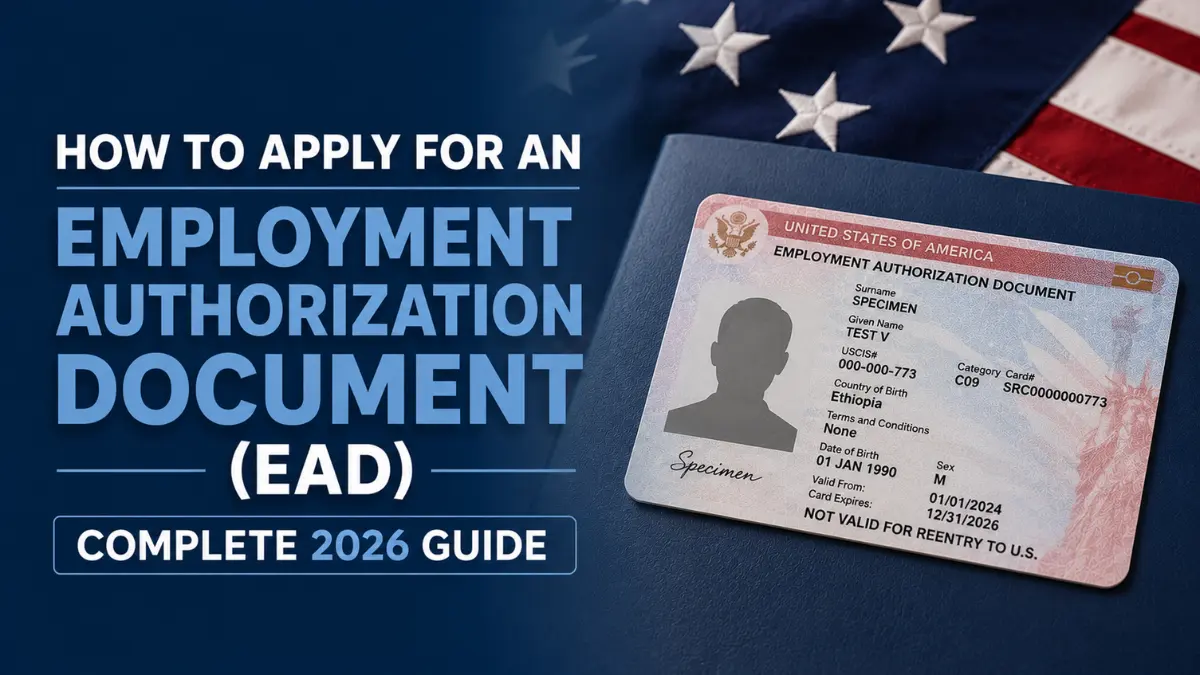
An approved I-765 results in a physical EAD card — officially Form I-766 — that includes the holder’s name, photo, Alien Registration Number (A-Number), eligibility category code, and validity dates. Employers use the EAD as a List A document during I-9 employment eligibility verification. Unlike visa-based work authorization that ties you to a specific employer (such as an H-1B), an EAD issued through most categories provides open-market work authorization — you can work for any employer in the United States while it is valid.
Not every noncitizen needs an I-765. Some immigration statuses carry work authorization incident to status — for example, H-1B workers are authorized to work for their sponsoring employer without a separate EAD, and L-2 spouses became work-authorized incident to status following a 2022 USCIS policy update. If your status already includes work authorization, check whether you genuinely need an EAD before filing and paying the fee.
📥 Access Form I-765 on the Official USCIS Website →
2026 Update — Critical Changes Every Applicant Must Know
Four major changes took effect in late 2025 and early 2026 that directly affect every I-765 applicant. Read this section before filing.
1. Automatic extensions eliminated for most renewal categories (October 30, 2025): Under a DHS Interim Final Rule effective October 30, 2025, the automatic 540-day extension of work authorization for timely-filed EAD renewals was eliminated for most eligibility categories. Renewals filed on or after that date do not receive any automatic extension — if your new EAD is not approved before your current card expires, you must stop working until the new card arrives. The only categories that still benefit from automatic extensions are those covered by separate law or Federal Register notice (primarily certain TPS designations) and F-1 STEM OPT applicants, who continue to receive a 180-day automatic extension under separate regulations. This makes filing your renewal as early as possible — at least 180 days before expiration — more critical than ever.
2. Maximum EAD validity reduced to 18 months (December 5, 2025): For several key categories — including adjustment of status applicants (c)(9), refugees, and asylees — the maximum EAD validity period was cut from five years to 18 months. Existing cards issued before this date remain valid until their printed expiration date. New EADs issued after this date in these categories will be valid for a maximum of 18 months, meaning more frequent renewals going forward.
3. New form edition required (March 5, 2026): As of March 5, 2026, USCIS accepts only the 08/21/25 edition of Form I-765. USCIS will reject applications submitted on older versions. Always download the form from uscis.gov immediately before filing.
4. New photo and biometrics procedure (December 12, 2025): USCIS now collects photos for the EAD card through biometrics appointments rather than from photos submitted with the application. However, certain categories — including OPT and STEM OPT — still require two passport-style photos to be submitted with the form. Check the I-765 instructions for your specific category.
Documents You Need — Complete Checklist
The exact documents required vary by eligibility category. The following are required for nearly all I-765 applicants:
Identity Documents (All Applicants)
- Copy of the biographical page of your current passport
- Copy of your most recent Form I-94 Arrival/Departure Record (print from cbp.gov/i94)
- Copy of your current EAD card (front and back) — if you have one and are renewing
- Two passport-style photos (2×2 inches, white background) — required for certain categories including OPT and STEM OPT; check instructions for your category
Category-Specific Documents
- Pending I-485 applicants (c)(9): Copy of your Form I-485 receipt notice (Form I-797C). If filing concurrently with I-485, no separate receipt notice is needed.
- F-1 OPT students (c)(3)(A)/(B): Form I-20 with DSO endorsement recommending OPT, copy of current I-20, and copies of all previous I-20s. Two passport-style photos required.
- F-1 STEM OPT extension (c)(3)(C): I-20 with DSO STEM OPT recommendation, copy of degree conferral, employer’s Form I-983 Training Plan signed by both employer and student.
- H-4 spouses (c)(26): Copy of H-4 visa stamp or I-94, copy of principal H-1B spouse’s approved Form I-140, and evidence H-1B status is valid.
- Asylum applicants (c)(8): Copy of your asylum application receipt or acknowledgment showing 150+ days have passed since filing with no denial.
- TPS holders (a)(12): Copy of current TPS approval notice and any Federal Register notice extending your country’s TPS designation.
- DACA recipients (c)(33): Must file I-765 together with Form I-821D; copy of current DACA approval notice.
Am I Eligible to File Form I-765?
Eligibility for Form I-765 is determined entirely by your immigration status or pending application category. USCIS maintains an extensive list of eligible categories in the official I-765 instructions. The most commonly filed categories in 2026 are:
Adjustment of Status Applicants
Category (c)(9) covers noncitizens with a pending Form I-485 (Application to Register Permanent Residence). This is one of the most-filed I-765 categories. The EAD allows you to work for any employer while waiting for your green card. In many cases, you can file the I-765 and Form I-131 (Advance Parole) concurrently with your I-485 as a combined package, often called a “combo card,” with no additional filing fee when submitted together.
F-1 Students: OPT and STEM OPT
F-1 students completing a degree at a U.S. institution can apply for Optional Practical Training (OPT) — category (c)(3)(A) for pre-completion OPT or (c)(3)(B) for post-completion OPT — which grants 12 months of work authorization related to the student’s field of study. Students who earned a degree in a STEM field from a USCIS-designated program can apply for a 24-month STEM OPT extension under category (c)(3)(C), giving up to 36 months of work authorization total. OPT applications must be filed within a strict window — up to 90 days before the program end date listed on Form I-20, and the OPT start date must be within 60 days of program completion.
H-4 Dependent Spouses
Spouses of H-1B workers may apply for an EAD under category (c)(26) if the H-1B principal has an approved Form I-140 (Immigrant Petition for Alien Workers). The H-4 EAD provides open-market work authorization, unlike the H-1B which is employer-specific. Following the October 30, 2025 rule change, H-4 EAD holders lost automatic extension protection — if a renewal is not approved before the current card expires, work must stop.
Asylum Applicants and Refugees
Pending asylum applicants under category (c)(8) may file for an EAD after their asylum application has been pending for 150 days with no denial. Granted asylees use category (a)(5) and refugees use category (a)(3) — both of which carry work authorization incident to status, but many apply for the physical EAD card for I-9 convenience. As of December 2025, EAD validity for asylum applicants is now capped at 18 months.
Temporary Protected Status (TPS) Holders
Nationals of countries designated for TPS by DHS file under category (a)(12). TPS EADs are filed and renewed as part of TPS registration. TPS holders are among the few remaining categories that may still receive automatic extensions of work authorization during re-registration periods, if announced via Federal Register notice.
DACA Recipients
Deferred Action for Childhood Arrivals (DACA) recipients file under category (c)(33). As of 2026, USCIS is processing renewals for current DACA holders but is not processing initial DACA requests due to an ongoing federal court injunction. DACA recipients must file Form I-765 together with Form I-821D for each renewal.
Who Does Not Need Form I-765
- U.S. citizens and lawful permanent residents (green card holders) — already unrestricted work-authorized
- H-1B, O-1, TN, and most other nonimmigrant workers — authorized to work for their specific sponsoring employer without a separate EAD
- L-2 spouses and certain E-category spouses — work-authorized incident to status with an annotated I-94 (though many still obtain the EAD card for employer convenience)
- F-1 students on Curricular Practical Training (CPT) — authorized through the school’s Designated School Official, not USCIS
Form I-765 Fee Breakdown (2026)
| Filing Method / Situation | Fee | Notes |
|---|---|---|
| Online filing (myUSCIS) | $470 | Recommended — $50 cheaper than paper, faster tracking |
| Paper filing (by mail) | $520 | Required for some categories that cannot file online |
| Filed concurrently with Form I-485 | $0 | No I-765 fee when submitted as part of an I-485 package |
| Asylum applicants (c)(8) | $0 | Fee waived for asylum-based EAD applications |
| Premium processing (OPT/STEM OPT only) | $1,780 additional | Guarantees a decision within 30 business days; filed via Form I-907 |
Always verify the current fee at uscis.gov/forms/filing-fees before filing. Fees are non-refundable regardless of outcome. Payment is made by credit card (Form G-1450) or bank transfer (Form G-1650) for paper filings; online filers pay by credit or debit card through myUSCIS.
How to Apply — Step-by-Step Instructions
Step 1 — Confirm Your Eligibility Category Code
The single most critical field on Form I-765 is the eligibility category code. An incorrect category code causes USCIS to reject or deny the application. Locate your category by reviewing the official Form I-765 instructions at uscis.gov — the instructions contain a complete list of every eligible category, its letter-number code, and the qualifying conditions for each. If you are unsure which category applies to your immigration status, consult an immigration attorney before filing.
Step 2 — Download the Correct Form Edition
Download the 08/21/25 edition of Form I-765 from uscis.gov/i-765 — the only version USCIS accepts as of March 5, 2026. The edition date appears in the bottom left corner of the form. To file online, log in to myUSCIS at my.uscis.gov and select “Apply for Employment Authorization.”
Step 3 — Complete Part 1: Reason for Applying
Check one box to indicate whether you are requesting an initial EAD, a replacement EAD, or a renewal of an existing EAD. Renewals require that you file before your current EAD expires — given the elimination of automatic extensions for most categories, do not wait until the last month.
Step 4 — Complete Parts 2 and 3: Personal Information
Enter your full legal name exactly as it appears on your passport, your A-Number (if any), date of birth, country of birth, Social Security Number (if you have one), and current U.S. mailing address. Answer every question — write “N/A” rather than leaving fields blank. Name or date of birth mismatches with USCIS records trigger delays.
Step 5 — Complete Part 4: Eligibility Category
Enter your eligibility category code from the I-765 instructions. This is not optional and must match your actual immigration status. For renewals, the category code on your new application must match the code printed on your current EAD card. A mismatch between the two codes is a common reason for denial.
Step 6 — Complete Remaining Parts and Sign
Subsequent parts cover additional background information, interpreter certification (if someone helped you complete the form in a language other than English), and preparer information. Sign and date the form personally — USCIS will reject unsigned applications. For online filers, the signature is electronic.
Step 7 — Assemble Your Filing Package
Compile your completed Form I-765, all category-specific supporting documents from the checklist above, passport-style photos if required for your category, and your filing fee payment. Photocopy or scan the complete package before mailing. Never send original documents — always send legible copies. For online filers, upload supporting documents as PDF or JPEG files through the myUSCIS portal.
Step 8 — Submit to the Correct USCIS Lockbox or File Online
Mailing addresses vary by eligibility category and the state where you live. Verify the current address for your specific category at uscis.gov/i-765-addresses immediately before mailing — addresses change without notice. If filing online, submit through myUSCIS and save your confirmation number. Online filing is $50 cheaper and produces a faster receipt notice.
Step 9 — Save Your Receipt Notice and Track Your Case
Within 2 to 4 weeks of filing, USCIS mails a receipt notice (Form I-797C) with your 10-digit receipt number. Track your case at egov.uscis.gov. Do not work before receiving your physical EAD card — because automatic extensions are eliminated for most categories, a receipt notice alone no longer extends work authorization for renewals filed after October 30, 2025.
What Happens After You File?
Stage 1 — Receipt and Biometrics
USCIS sends a receipt notice within 2 to 4 weeks. For categories that require biometrics, USCIS then schedules an appointment at a local Application Support Center (ASC) to collect fingerprints and a photograph for card production. Missing a biometrics appointment can significantly delay or jeopardize your application — reschedule immediately if you cannot attend.
Stage 2 — Adjudication and Card Production
USCIS reviews your application, supporting documents, and background check results. If the application is approvable, USCIS produces the physical EAD card and mails it to the address on the application. If USCIS needs additional information, they issue a Request for Evidence (RFE) with a deadline to respond. Respond to every RFE completely and on time — failing to respond results in denial.
Stage 3 — Receiving and Using Your EAD
Once approved, USCIS mails the EAD card to your address on file. You may begin working for any employer as soon as you have the physical card in hand — not before. Present the EAD to your employer during the Form I-9 verification process as a List A document. The card is valid until the printed expiration date; begin your renewal at least 180 days before that date to avoid any gap in authorization.
I-765 Processing Times in 2026
Processing times vary significantly by eligibility category, USCIS service center, and application volume. The table below reflects conditions as of June 2026.
| Eligibility Category | Estimated Processing Time (2026) |
|---|---|
| Adjustment of Status (c)(9) — concurrent with I-485 | 3–8 months |
| F-1 OPT (c)(3)(A)/(B) | 3–5 months (premium: 30 business days) |
| F-1 STEM OPT Extension (c)(3)(C) | 3–5 months (180-day auto-extension applies) |
| H-4 EAD (c)(26) | 5–12 months (surging in 2026) |
| L-2 EAD | 4–10 months |
| Asylum-based (c)(8) | Variable; proposed rule changes pending Feb 2026 |
| TPS-based (a)(12) | 3–6 months; auto-extensions may apply per FR notice |
| DACA renewal (c)(33) | 3–6 months |
Always check current processing times for your specific category and service center at egov.uscis.gov/processing-times. Given the elimination of automatic extensions, understanding your exact processing timeline is now more critical than ever.
Other Application Forms You May Need
Depending on your situation, you may also need to complete other official U.S. government application forms. Here are some of the most-searched forms on our site to help you stay prepared:
- 📋 Form I-485 — Application to Register Permanent Residence (Green Card)
Many I-765 applicants file under category (c)(9) because they have a pending I-485. Form I-485 is the adjustment of status application that green card applicants already in the U.S. file to obtain permanent residence — and filing it often comes with a free concurrent EAD. - 📋 Form I-130 — Petition for Alien Relative
For those in family-based immigration cases, the I-130 is the petition that kicks off the green card process. Once an I-130 is approved and an I-485 is filed, the accompanying I-765 EAD application allows the beneficiary to work while the case is pending.
Frequently Asked Questions About Form I-765
Can I work while my I-765 renewal is pending?
For most categories — no. Since the October 30, 2025 rule change eliminated automatic extensions for renewals filed on or after that date, you must stop working if your EAD expires before the new one arrives. The only exceptions are F-1 STEM OPT applicants (who still receive a 180-day automatic extension under separate rules) and categories covered by specific TPS Federal Register notices. This makes filing your renewal 180 days early non-negotiable for most EAD holders.
What happens if I use the wrong eligibility category code?
USCIS will typically reject or deny the application. The eligibility category code is the most critical field on the form — it determines what evidence USCIS expects, how long your EAD will be valid, whether you owe a fee, and which service center handles your case. If you are unsure which code applies to your situation, review the official I-765 instructions carefully or consult an immigration attorney before filing.
Is there a fee waiver for Form I-765?
Yes, for certain categories. The I-765 filing fee is waived entirely for asylum applicants under category (c)(8) and for applications filed concurrently with Form I-485. Other applicants may request a fee waiver using Form I-912 (Request for Fee Waiver) if they demonstrate financial hardship, receive a means-tested benefit, or have income at or below 150% of the federal poverty guidelines. Fee waivers are not guaranteed and must be approved before your application is processed.
How early should I file my EAD renewal?
USCIS recommends filing 180 days before your current EAD expires — and given the elimination of automatic extensions for most categories, filing even earlier is advisable if your category permits it. Do not wait until 90 days before expiration. If processing runs long and your card expires before the new one arrives, you must stop working immediately. Track your expiration date carefully and set a calendar reminder at the 180-day mark.
Can I travel outside the U.S. while my I-765 is pending?
It depends on your underlying immigration status and whether you have Advance Parole. If you filed I-765 as a standalone application (not concurrently with I-485), traveling outside the U.S. while it is pending does not generally affect the application. However, if your I-765 was filed concurrently with a pending I-485, leaving the U.S. without an approved Advance Parole document (Form I-131) will be deemed an abandonment of your I-485, which would also terminate the pending I-765. Consult an attorney before traveling with a pending I-485-based EAD application.
What is premium processing for I-765 and who qualifies?
Premium processing guarantees USCIS will issue a decision within 30 business days (approximately 6 weeks) for an additional fee of $1,780, paid by filing Form I-907. As of 2026, premium processing is available only for certain F-1 student OPT and STEM OPT categories — specifically (c)(3)(A), (c)(3)(B), and (c)(3)(C). It is not available for adjustment-based EADs, H-4 EADs, asylum-based EADs, DACA renewals, or most other categories. If premium processing is available for your category, it is generally worth the fee when your employment start date is imminent.
Can I request an expedite of my I-765 application?
USCIS considers expedite requests in very limited circumstances: severe financial loss to you or your employer, an emergency or urgent humanitarian reason, a nonprofit organization whose work is in the national interest, or a USCIS error. Approval is discretionary and rare. For categories where premium processing is available, USCIS will generally not consider an expedite request — the premium processing fee is the proper mechanism for faster service in those cases. Submit an expedite request through your myUSCIS account or by calling the USCIS Contact Center.
Official Links — Form I-765 Resources
- 🏡 Form I-765 — Official USCIS Page (Download, Instructions, Filing Addresses)
- 💰 USCIS Fee Schedule — Confirm Current I-765 Filing Fees
- 📊 USCIS Processing Times Tool — Check Times by Category and Service Center
- 📝 Direct Filing Addresses for Form I-765 — Find the Correct Mailing Address
- 🔍 USCIS Case Status Online — Track Your I-765 with Your Receipt Number
- 📄 CBP I-94 Lookup — Print Your Most Recent Arrival/Departure Record
Disclaimer
ApplicationFormPortal.us is not affiliated with, endorsed by, or operated by U.S. Citizenship and Immigration Services (USCIS), the Department of Homeland Security, or any other U.S. government agency. This guide is provided for general informational purposes only and does not constitute legal advice. Immigration laws and USCIS procedures change frequently — always verify current requirements, fees, form editions, and processing times directly at uscis.gov before filing. For advice specific to your immigration situation, consult a qualified immigration attorney or USCIS-accredited representative.
1 thought on “Form I-765: How to Apply for an Employment Authorization Document (EAD) — Complete 2026 Guide”