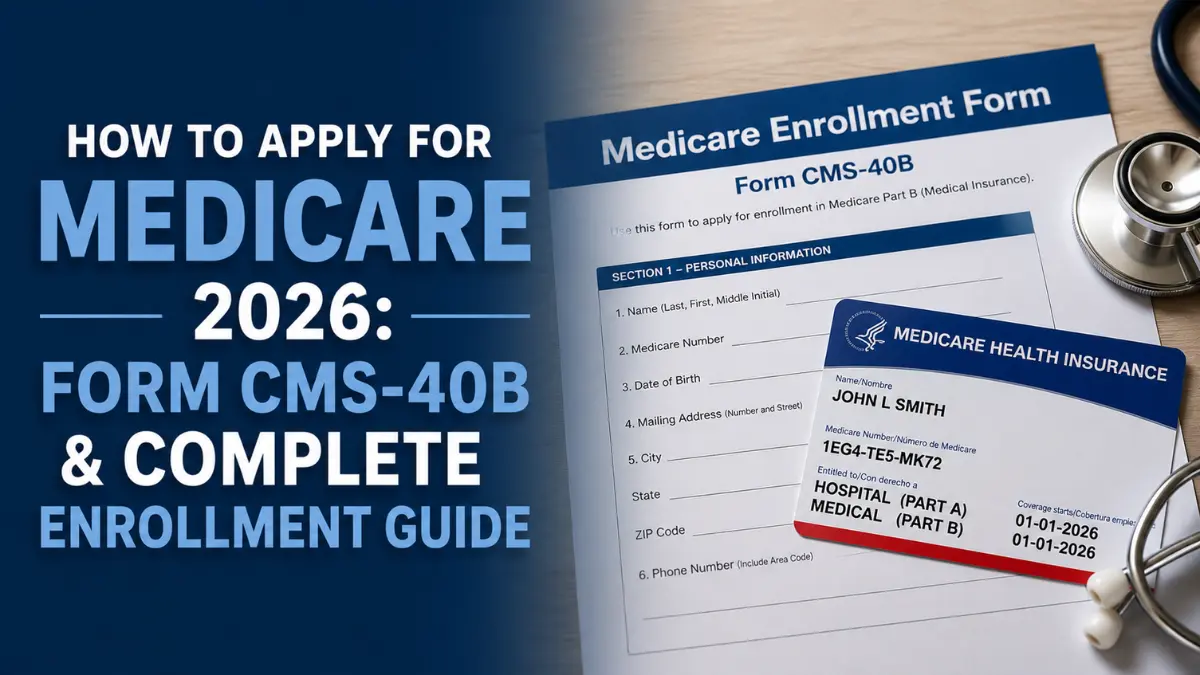
Every month, thousands of Americans turn 65 and become eligible for Medicare for the first time. If that is you — or it will be soon — knowing exactly how to apply for Medicare 2026 can save you from a lifetime of higher premiums, coverage gaps, and unnecessary confusion. This guide covers everything: what Medicare is, who qualifies, when to sign up, how to use form CMS-40B 2026 to enroll in Part B, and what happens if you miss your window.
Medicare has four parts — A, B, C, and D — and each has its own enrollment rules. The most common question new enrollees ask is not just “how do I sign up?” but “when?” because the timing of your enrollment directly affects what you pay for the rest of your life. Read this guide before you miss a deadline that costs you money every month, forever.
Also on applicationformportal.us: SS-5 Form: How to Apply for a Social Security Card — you will need an active Social Security number and record to enroll in Medicare.
What Is Medicare? A Quick Overview
Medicare is the federal health insurance program administered by the Centers for Medicare & Medicaid Services (CMS) for people aged 65 and older and for certain younger people with qualifying disabilities or conditions. It is divided into four parts:
| Part | What It Covers | 2026 Cost |
|---|---|---|
| Part A (Hospital Insurance) | Inpatient hospital stays, skilled nursing facility care, hospice, some home health care | Free for most people (paid Medicare taxes for 40+ quarters); up to $565/month if not |
| Part B (Medical Insurance) | Doctor visits, outpatient care, preventive services, durable medical equipment | $202.90/month standard premium in 2026 |
| Part C (Medicare Advantage) | Combines Parts A and B through a private insurer; often includes Part D | Varies by plan |
| Part D (Prescription Drug Coverage) | Prescription medications through private insurers | Varies; national base beneficiary premium $38.99/month in 2026 |
📥 Download Form CMS-40B from the Official CMS Website →
When people ask how to apply for Medicare online, they are most often asking about Parts A and B together — known as Original Medicare — which is the foundation upon which all other Medicare coverage is built.
Medicare Eligibility Age 2026: Who Qualifies?
Understanding Medicare eligibility age 2026 is the first step. You are eligible for Medicare if you meet any of the following:
- Age 65 or older and a U.S. citizen or lawful permanent resident who has lived in the U.S. for at least 5 continuous years
- Under 65 with a qualifying disability who has received Social Security Disability Insurance (SSDI) benefits for 24 months
- Any age with End-Stage Renal Disease (ESRD) — permanent kidney failure requiring dialysis or a transplant
- Any age with Amyotrophic Lateral Sclerosis (ALS) — also called Lou Gehrig’s disease; Medicare begins the same month disability benefits start
For Part A specifically, most people qualify for premium-free Part A if they or their spouse paid Medicare taxes through payroll deductions for at least 40 quarters (10 years) of work. If you did not reach 40 quarters, you can still buy into Part A — but you will pay a monthly premium of up to $565 in 2026.
Medicare Enrollment Periods 2026: When to Sign Up
Knowing the Medicare enrollment periods 2026 is the single most important thing you can do to protect yourself from lifelong premium penalties. There are four main windows:
1. Initial Enrollment Period (IEP) — Your First and Best Window
The Medicare Initial Enrollment Period is a 7-month window that surrounds your 65th birthday. It begins 3 months before the month you turn 65, includes your birthday month, and ends 3 months after. For example, if you turn 65 in September 2026, your IEP runs from June 1 through December 31, 2026.
This is the ideal time to enroll. There are no late enrollment penalties and no waiting periods during the IEP. When your coverage starts depends on which month within your IEP you sign up:
| When You Sign Up Within IEP | When Part B Coverage Starts |
|---|---|
| 1–3 months before your birthday month | Your birthday month (or month before if birthday is on the 1st) |
| Your birthday month | 1 month after you sign up |
| 1 month after your birthday month | 1 month after you sign up |
| 2–3 months after your birthday month | 2–3 months after you sign up |
Pro tip: Sign up in the 3 months before your birthday month to ensure your coverage starts on time without any gap.
2. Special Enrollment Period (SEP) — If You Have Employer Coverage
The Medicare Special Enrollment Period is the safety valve for people who delay Medicare because they are still covered by an employer group health plan (their own or a spouse’s) based on active employment. If this applies to you, you can delay Part B without penalty and enroll during an 8-month SEP that begins the month after the employment or employer coverage ends — whichever comes first.
Important SEP rules to know:
- COBRA coverage and retiree health plans do not count as active employer coverage — they do not qualify you for a SEP
- You must sign up during the SEP itself; waiting for the next General Enrollment Period after your SEP ends will trigger late enrollment penalties
- You can use Form CMS-40B together with Form CMS-L564 (Request for Employment Information) to enroll during a SEP
3. General Enrollment Period (GEP) — If You Missed Your IEP
If you missed both your IEP and do not qualify for a SEP, you can enroll during the General Enrollment Period, which runs January 1 through March 31 every year. Coverage under the GEP begins the month after you sign up. However, enrolling through the GEP almost always means you will pay a Medicare late enrollment penalty 2026 — a permanent premium increase that follows you for life.
4. Annual Enrollment Period (AEP) — For Medicare Advantage and Part D Changes
The Annual Enrollment Period runs October 15 through December 7 every year and applies specifically to Medicare Advantage (Part C) and Part D prescription drug plans. During AEP you can switch plans, drop coverage, or add a drug plan. Changes made during AEP take effect January 1 of the following year. The AEP does not apply to Original Medicare Parts A and B.
The Medicare Late Enrollment Penalty 2026: What It Costs You
The Medicare late enrollment penalty 2026 is one of the most misunderstood and financially damaging aspects of Medicare. Unlike most penalties, this one is permanent — you pay it every single month for as long as you have Medicare. Here is exactly how it works for each part:
Part B Late Enrollment Penalty
For each full 12-month period you were eligible for Part B but did not enroll (and did not have qualifying employer coverage), your Medicare Part B premium 2026 increases by 10%. The standard Part B premium in 2026 is $202.90 per month. Here is what the penalty looks like in practice:
| Years Delayed | Penalty % | Monthly Premium with Penalty (2026) | Extra Cost Per Year |
|---|---|---|---|
| 1 year | 10% | $223.19 | +$243.48 |
| 2 years | 20% | $243.48 | +$486.96 |
| 5 years | 50% | $304.35 | +$1,217.40 |
| 7 years | 70% | $344.93 | +$1,704.36 |
These higher premiums apply every month for life. Signing up on time during your IEP or SEP completely eliminates this penalty.
Part A Late Enrollment Penalty
Most people get premium-free Part A and face no penalty. If you have to pay a Part A premium and enroll late, your premium increases by 10% for twice the number of years you delayed. In 2026, premium Part A costs between $311 and $565 per month depending on your work history.
Part D Late Enrollment Penalty
If you go 63 or more consecutive days without Medicare drug coverage or other creditable prescription coverage after you first become eligible, you will pay a Part D penalty of 1% of the national base beneficiary premium ($38.99 in 2026) for every month you were without coverage. This penalty is also permanent.
What Is Form CMS-40B?
The Medicare Part B application form is officially called Form CMS-40B, titled Application for Enrollment in Medicare Part B (Medical Insurance). It is issued by the Centers for Medicare & Medicaid Services and processed by the Social Security Administration (SSA).
You use Form CMS-40B when:
- You already have Medicare Part A and want to add Part B
- You live in Puerto Rico and are in your Initial Enrollment Period (residents of Puerto Rico are not automatically enrolled in Part B)
- You are enrolling during a Special Enrollment Period and need to document your employment-based coverage
- You previously declined Part B and now want to enroll during the General Enrollment Period
Do not use Form CMS-40B if you do not yet have Part A. In that case, contact Social Security directly to apply for Medicare for the first time — you will go through the SSA application process, not the CMS-40B form.
How to Apply for Medicare Online: Step-by-Step Guide
The fastest and most convenient way to enroll is to apply how to apply for Medicare online through the Social Security Administration’s website. The SSA manages Medicare enrollment even though Medicare itself is run by CMS. Here is the complete process:
Step 1: Determine What You Are Applying For
Before starting, decide which parts you need:
- Turning 65, not yet on Social Security: Apply for Medicare Parts A and B together at ssa.gov. You will automatically get Part A; you must actively elect Part B during the application.
- Already receiving Social Security benefits: You are automatically enrolled in both Parts A and B starting the month you turn 65. You will receive your red, white, and blue Medicare card in the mail. No application needed unless you want to decline Part B.
- Have Part A, want to add Part B: Use Form CMS-40B (online upload or paper).
- Enrolling during a SEP: Use Form CMS-40B plus Form CMS-L564 to document employer coverage.
Step 2: Go to SSA.gov and Start Your Application
Visit ssa.gov/medicare and select “Apply for Medicare Only” if you are not yet claiming Social Security retirement benefits. You will need:
- Your Social Security number
- Your date and place of birth
- Citizenship or immigration status
- Current health insurance information (insurer name, policy number, effective dates)
- Employment information if applying under a SEP
- A valid email address (required for electronic signature)
Step 3: Complete the Online Application or Form CMS-40B
The online SSA application walks you through every question step by step. When asked whether you want to enroll in Medicare Part B, answer Yes. If you want your Part B to start on a specific date, state clearly in the Remarks section: “I want Part B coverage to begin [MM/YY].”
If you are submitting the paper form CMS-40B 2026, here is what to complete on the form:
- Item 1: Your Social Security Claim Number and BIC (Beneficiary Identification Code) — or your Social Security number if you do not yet have a Medicare number
- Item 2: Select “YES — Part B Only” to enroll in medical insurance
- Items 3–5: Your full name, mailing address (check the box if this is a new address), and telephone number
- Remarks section: Note the specific month and year you want Part B to start, especially during a SEP
- Signature: Sign and date the form. Have a witness sign if you are unable to sign yourself.
Step 4: Submit Your Application
You have three ways to submit your Medicare Part B application form:
- Online: Upload your completed CMS-40B directly through your my Social Security account at ssa.gov/myaccount. Select “Upload Documents,” choose “SSA Form,” and select CMS-40B from the drop-down menu.
- By fax: Fax the completed, signed form (and Form CMS-L564 if applicable) to your local Social Security office.
- By mail or in person: Mail or hand-deliver the form to your local Social Security office. Find your nearest office at SSA.gov/locator.
Step 5: Receive Your Medicare Card
After your enrollment is processed, you will receive your Medicare card in the mail. Keep it in a safe place — it shows your Medicare number, the parts you are enrolled in, and your coverage start dates. If your card is ever lost or stolen, you can request a replacement through your my Social Security account at ssa.gov/myaccount or by calling 1-800-772-1213.
Are You Automatically Enrolled in Medicare?
Many people approaching 65 wonder whether they even need to apply. The answer depends on whether you are already receiving Social Security or Railroad Retirement Board (RRB) benefits:
- Already receiving Social Security or RRB benefits at least 4 months before turning 65: You are automatically enrolled in both premium-free Part A and Part B. Your Medicare card arrives in the mail about 3 months before your 65th birthday. You can choose to decline Part B if you have qualifying employer coverage, but you must actively opt out.
- Not yet receiving Social Security benefits at 65: You are NOT automatically enrolled. You must actively apply for Medicare during your Initial Enrollment Period.
- Living in Puerto Rico: You are automatically enrolled in Part A only. You must actively apply for Part B using Form CMS-40B.
Medicare Part B Premium 2026: What You Will Pay
The standard Medicare Part B premium 2026 is $202.90 per month for most enrollees. However, higher-income beneficiaries pay more through the Income-Related Monthly Adjustment Amount (IRMAA). IRMAA is based on your income from 2 years prior (so your 2024 tax return determines your 2026 premium):
| 2024 Individual Income | 2024 Joint Income | 2026 Part B Monthly Premium |
|---|---|---|
| $106,000 or less | $212,000 or less | $202.90 (standard) |
| $106,001 – $133,000 | $212,001 – $266,000 | $285.00 |
| $133,001 – $167,000 | $266,001 – $334,000 | $363.00 |
| $167,001 – $200,000 | $334,001 – $400,000 | $446.10 |
| $200,001 – $500,000 | $400,001 – $750,000 | $529.00 |
| Above $500,000 | Above $750,000 | $594.00 |
Part B premiums are typically deducted automatically from your Social Security benefit payment each month if you are receiving Social Security. If you are not yet receiving Social Security, you will receive a quarterly bill from Medicare.
Where to Download Form CMS-40B
The official form CMS-40B 2026 (revised July 2025) is available free from the Centers for Medicare & Medicaid Services at cms.gov. A Spanish-language version (Formulario CMS-40B) is also available from the same page. Always download the current version of the form — outdated editions may be rejected by the Social Security Administration.
You can also call Social Security at 1-800-772-1213 (TTY: 1-800-325-0778) Monday through Friday to request a paper form by mail, ask questions about your enrollment, or schedule an in-person appointment at your local SSA office.
Other Application Forms You May Need
Enrolling in Medicare often goes hand in hand with other government applications. Here are two commonly needed forms:
- 📄 SS-5 Form — The Social Security card application. A valid Social Security number is required to enroll in Medicare. If you need a new or replacement card before applying, start here.
- 📄 SNAP Benefits Application — Many Medicare enrollees on fixed incomes also qualify for SNAP food assistance. Income eligibility thresholds are separate from Medicare and worth checking.
Frequently Asked Questions About Medicare Enrollment 2026
When should I apply for Medicare if I am turning 65?
Apply during the 3 months before the month you turn 65, which is within your Medicare Initial Enrollment Period. This ensures your Part B coverage starts on your birthday month with no gap. If you wait until your birthday month or after, coverage is delayed by one to three months.
Can I delay Part B if I still have employer health insurance?
Yes — if the coverage is through active employment (yours or your spouse’s). You qualify for a Medicare Special Enrollment Period and can delay Part B without penalty. COBRA and retiree health insurance do not count as active employer coverage and do not qualify you for a SEP. The moment active employment or the employer coverage ends, your 8-month SEP begins — sign up promptly.
What is Form CMS-40B used for?
The Medicare Part B application form CMS-40B is used by people who already have Part A and want to enroll in Part B. It is not used for first-time Medicare applications from scratch — those go through the SSA online application. The CMS-40B is most commonly used by Puerto Rico residents, people enrolling during a SEP, and people who previously declined Part B and now want it.
How much does Medicare Part B cost in 2026?
The standard Medicare Part B premium 2026 is $202.90 per month. Higher-income enrollees pay more through IRMAA — up to $594.00 per month if individual income exceeds $500,000. Premiums are typically deducted from your monthly Social Security payment automatically.
What happens if I miss my Medicare Initial Enrollment Period?
If you miss your IEP and do not qualify for a SEP, you must wait for the General Enrollment Period (January 1 – March 31 each year) to sign up. You will almost certainly face the Medicare late enrollment penalty 2026 — a permanent 10% premium increase for every 12 months you delayed. This penalty never goes away.
Do I need Medicare if I already have private insurance?
It depends on the source of your private insurance. If it is through active employment at a company with 20 or more employees, you can delay Medicare without penalty. If it is individual market insurance (bought through a marketplace or privately), a small employer plan (under 20 employees), COBRA, or retiree coverage, enrolling in Medicare on time is strongly recommended — those plans become secondary to Medicare once you are eligible, and delays will trigger the late enrollment penalty.
How do I apply for Medicare if I am under 65 with a disability?
If you have received Social Security Disability Insurance (SSDI) benefits for 24 months, you are automatically enrolled in Medicare Parts A and B. You do not need to apply separately. Your Medicare enrollment periods 2026 follow a slightly different IEP structure tied to your 25th month of disability benefits rather than a birthday.
Official Medicare Resources
- 🟢 Get Started with Medicare — Medicare.gov
- 🟢 Apply for Medicare Online — SSA.gov
- 🟢 Download Form CMS-40B — CMS.gov
- 🟢 How to Avoid Late Enrollment Penalties — Medicare.gov
- 🟢 Find Your Local Social Security Office — SSA.gov
Disclaimer: This guide is for general informational purposes only and does not constitute legal, medical, or financial advice. Medicare rules and premiums are updated annually. Always verify current information at medicare.gov or ssa.gov, or call 1-800-MEDICARE (1-800-633-4227) for personalized guidance.