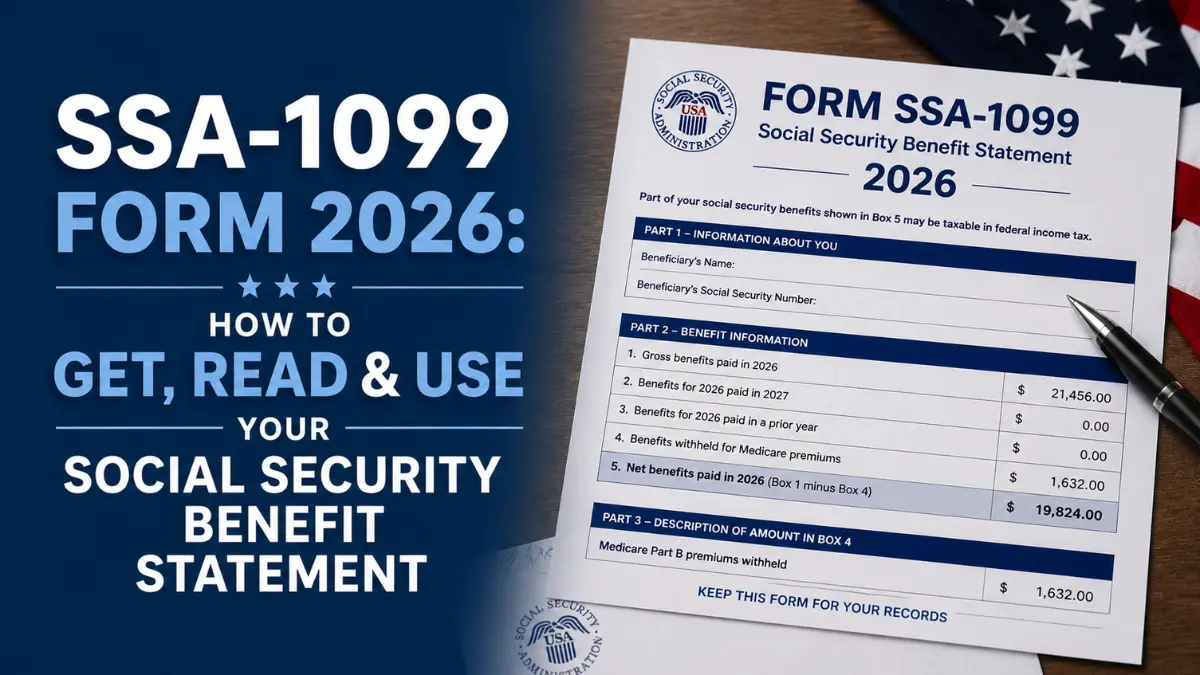
Every January, the Social Security Administration (SSA) mails a SSA-1099 form 2026 — officially called the Social Security Benefit Statement — to every person who received Social Security benefits in the prior year. This single document tells you and the IRS exactly how much you received in benefits, how much was withheld for taxes or Medicare premiums, and how much — if any — of your benefits are subject to federal income tax. If you never received it, lost it, or are not sure what to do with it, this guide covers everything.
The Social Security benefit statement 2026 covering tax year 2025 income was mailed in January 2026 and has been available for download online since February 1, 2026. Whether you need to file your taxes, confirm your benefit amount, or understand why some of your Social Security is taxable, here is your complete reference.
Also on applicationformportal.us: SS-5 Form 2026 — the application for a Social Security card or replacement card. A valid Social Security number is required to receive benefits and the SSA-1099.
What Is Form SSA-1099?
📥 Download Your SSA-1099 from the Official Social Security Administration Website →
Form SSA-1099, officially titled the Social Security Benefit Statement, is a tax form issued by the Social Security Administration each January to every U.S. citizen or resident who received Social Security retirement, disability (SSDI), or survivor benefits during the previous calendar year. The form reports your total benefits received and is used to calculate how much — if any — of your Social Security income must be reported on your federal Form 1040.
The SSA-1099 is not a bill and it is not proof of income for loan or housing purposes (that requires a Benefit Verification Letter, available separately through your my Social Security account). It is strictly a tax reporting document — the Social Security equivalent of a W-2 or 1099-INT.
Who Receives an SSA-1099?
You will receive a SSA-1099 form 2026 if you received any of the following in 2025:
- Social Security retirement benefits
- Social Security Disability Insurance (SSDI) benefits
- Social Security survivor benefits
- Medicare premium refunds or adjustments
You will not receive an SSA-1099 if the only payment you received from Social Security was Supplemental Security Income (SSI). SSI is not taxable and is not reported on a tax form. If SSI is your only Social Security payment, no SSA-1099 will be issued to you.
SSA-1099 vs SSA-1042S: What Is the Difference?
Understanding the SSA-1099 vs SSA-1042S difference is important if you are a non-U.S. citizen or live outside the United States:
| Form | Who Receives It | Purpose |
|---|---|---|
| SSA-1099 | U.S. citizens and U.S. residents who received Social Security benefits | Reports benefits for U.S. federal income tax filing |
| SSA-1042S | Noncitizens living outside the U.S. who received or repaid Social Security benefits | Reports benefits subject to U.S. nonresident withholding tax (typically 30% flat rate, reduced by tax treaty) |
If you are a noncitizen who received benefits in 2025, the SSA will send you an SSA-1042S instead of an SSA-1099. Both forms are available for replacement through your my Social Security account or by calling SSA directly. If you live abroad and cannot access your online account, contact your nearest Federal Benefits Unit.
How to Read the SSA-1099 Form: Box-by-Box Guide
Knowing how to read SSA-1099 form boxes is essential to filing your taxes correctly. Here is what every line and box on the form means:
| Box / Line | What It Shows | Where It Goes on Form 1040 |
|---|---|---|
| Box 3 — Benefits Paid in 2025 | Total gross Social Security benefits paid to you during 2025, before any deductions | Used to calculate Line 6a of Form 1040 |
| Box 4 — Benefits Repaid to SSA in 2025 | Any amount you repaid to SSA in 2025 (e.g., overpayment recovery) | Subtracted from Box 3 to calculate net benefits |
| Box 5 — Net Benefits for 2025 | Box 3 minus Box 4 — this is the key number. Enter Box 5 on Line 6a of Form 1040 | Line 6a of Form 1040 (total SS benefits); taxable portion goes to Line 6b |
| Box 6 — Voluntary Federal Income Tax Withheld | Federal income tax you elected to withhold from your benefits during 2025 | Line 25b of Form 1040 (federal tax withheld) |
| Box 7 — Address | Your mailing address on file with SSA | Verify this matches your current address; update via my Social Security if wrong |
| Medicare Premium Deductions | Part B, Part D, or Medicare Advantage premiums deducted from your benefit checks | May be deductible on Schedule A if you itemize medical expenses |
The most important number: Box 5 (Net Benefits for 2025) is what you use for your tax return. Enter this amount on Line 6a of Form 1040. The IRS Social Security worksheet (in the Form 1040 instructions or IRS Publication 915) then determines how much of that amount is taxable and flows to Line 6b.
Is Social Security Income Taxable in 2026?
This is the most common question attached to the SSA-1099: is Social Security income taxable 2026? The answer is: it depends on your “combined income.” Not everyone pays federal tax on Social Security benefits — but millions of retirees do, often more than they expect.
Step 1: Calculate Your Combined Income
The IRS uses a specific formula called combined income (also called provisional income) to determine whether your Social Security benefits are taxable. The formula is:
Combined Income = Adjusted Gross Income (excluding Social Security) + Tax-Exempt Interest + 50% of Your Social Security Benefits
Two important points about this formula that catch retirees off guard:
- Tax-exempt interest counts. Municipal bond interest is income-tax-free — but it still counts toward your combined income for Social Security taxation purposes. Many retirees are surprised by this.
- Only half of your benefits count. You add 50% of your gross Social Security benefits (Box 5 of SSA-1099), not the full amount, to calculate combined income.
Step 2: Compare to the IRS Thresholds
Once you have your combined income, compare it to the Social Security combined income threshold for your filing status. These thresholds have not changed since 1993 and are not adjusted for inflation:
| Filing Status | Combined Income | Taxable Portion of Benefits |
|---|---|---|
| Single, Head of Household, Qualifying Surviving Spouse | Below $25,000 | 0% — benefits not taxable |
| Single, Head of Household, Qualifying Surviving Spouse | $25,000 – $34,000 | Up to 50% of benefits may be taxable |
| Single, Head of Household, Qualifying Surviving Spouse | Above $34,000 | Up to 85% of benefits may be taxable |
| Married Filing Jointly | Below $32,000 | 0% — benefits not taxable |
| Married Filing Jointly | $32,000 – $44,000 | Up to 50% of benefits may be taxable |
| Married Filing Jointly | Above $44,000 | Up to 85% of benefits may be taxable |
| Married Filing Separately (lived with spouse) | Any amount | Up to 85% taxable — regardless of income |
Understanding the Social Security Tax 85 Percent Rule
The Social Security tax 85 percent rule confuses many retirees. It does not mean you pay an 85% tax on your Social Security benefits. It means a maximum of 85% of your benefits can be counted as taxable income — and that taxable amount is then taxed at your ordinary income tax rate (10%, 12%, 22%, etc.). The remaining 15% of your benefits is always tax-free at the federal level, no matter how high your income.
Example: A single retiree with $20,000 in Social Security benefits and $30,000 in other income has combined income of $10,000 + $30,000 = $40,000. This is above the $34,000 upper threshold, so up to 85% of the $20,000 benefits ($17,000) may be taxable income. If that retiree is in the 12% tax bracket, the federal tax on that $17,000 is approximately $2,040 — not 85% of $20,000.
New for 2025: OBBBA Senior Deduction Reduces Effective Taxation
While the Social Security taxation thresholds themselves have not changed, the One Big Beautiful Bill Act (OBBBA) introduced a new $6,000 above-the-line deduction for taxpayers aged 65 or older (up to $12,000 for couples where both qualify). This deduction reduces your AGI, which in turn can lower your combined income and reduce — or eliminate — the portion of your Social Security benefits that is taxable. Claim this deduction via Schedule 1-A on your Form 1040.
How to Get Your SSA-1099 Online in 2026
Knowing how to get SSA-1099 online is the fastest and most reliable way to access your Benefit Statement. The SSA makes the process entirely digital through your my Social Security account. Here is the step-by-step process:
- Go to ssa.gov/myaccount and sign in to your personal my Social Security account. If you do not have one, you can create one in minutes using your Social Security number, email address, and a valid ID verification method (driver’s license or ID.me credential).
- Select “Replace Your Tax Form SSA-1099/SSA-1042S” from your account dashboard or the Replacement Documents section.
- Choose the tax year from the “Choose a year” dropdown menu. The current tax year (2025) has been available since February 1, 2026. You can also access SSA-1099 forms for any of the past 6 years.
- Select “Download” to instantly view, save, or print your SSA-1099 as a PDF. The form is available 24 hours a day, 7 days a week, in both English and Spanish.
The online replacement is immediate — there is no waiting period, no appointment needed, and no phone hold time. It is the SSA’s recommended method for obtaining your Benefit Statement.
How to Replace SSA-1099 Form: All Methods
If you need to replace SSA-1099 form and cannot access it online, you have two additional options:
| Method | How | Availability | Timeframe |
|---|---|---|---|
| Online (my Social Security) | Sign in at ssa.gov/myaccount, select Replace Tax Form | 24/7, English & Spanish | Instant download |
| By Phone | Call SSA automated line at 1-800-772-1213 (TTY: 1-800-325-0778) | Automated line: 24/7; Live agent: Mon–Fri 8am–7pm | Mailed copy: 7–14 days |
| Local SSA Office | Visit your nearest SSA office (appointments recommended as of 2026) | Mon–Fri, office hours vary | Same day if walk-in accepted; otherwise mailed |
| If Living Abroad | Create my Social Security account with ID.me credential, or contact your Federal Benefits Unit | Online: 24/7; FBU: business hours | Online: instant; FBU: varies |
Important note on SSA office walk-ins: As of early 2026, many SSA offices have moved to appointment-preferred or appointment-required models for non-urgent requests including SSA-1099 replacements. Before visiting in person, call your local office or check ssa.gov/locator to confirm walk-in availability. For most people, the online method is significantly faster.
SSA-1099 Not Received: What to Do
If your SSA-1099 not received what to do situation applies to you, here is the right sequence of steps:
- Wait until February. SSA mails forms in January but delivery can run into early February. The online replacement is available from February 1 — do not panic if it has not arrived by mid-January.
- Check your mailing address. Log into your my Social Security account and confirm SSA has your current mailing address on file. If you moved recently and did not update SSA, the form may have gone to your old address.
- Download it online. If it is February 1 or later and you have not received your form, the fastest resolution is to download it immediately from your my Social Security account. The replacement PDF is identical to the mailed original and is accepted by all tax software and preparers.
- Call SSA if you cannot go online. Call 1-800-772-1213 (Monday through Friday, 8am to 7pm) to request a replacement be mailed to you. Allow 7–14 days for delivery.
Never delay filing your taxes because you are waiting for a physical SSA-1099 in the mail. The online replacement is legally equivalent and available immediately from February 1.
State Income Tax on Social Security Benefits in 2026
Federal taxation of Social Security gets most of the attention, but your state may also tax benefits. As of 2026, the majority of states do not tax Social Security income at all. The following states may partially tax Social Security benefits — each has its own income thresholds and exemptions:
- Colorado, Connecticut, Minnesota, Montana, New Mexico, Rhode Island, Utah, Vermont — may tax benefits above state-specific income thresholds
- West Virginia — phasing out Social Security taxation through 2026; check current status with the WV Tax Division
- Kansas, Missouri, Nebraska — have been phasing out state SS taxation; verify current rules with your state revenue department
All other states — including Florida, Texas, California, New York, Illinois, Pennsylvania, and most others — do not tax Social Security benefits at the state level regardless of income.
How to Have Federal Tax Withheld from Social Security
If you regularly owe federal income tax on your Social Security benefits, you can ask SSA to withhold federal income tax directly from your monthly payments — similar to how an employer withholds from a paycheck. This avoids the need to make quarterly estimated tax payments.
To request voluntary withholding, complete Form W-4V (Voluntary Withholding Request) and submit it to your local Social Security office. You can choose to withhold 7%, 10%, 12%, or 22% of your monthly benefit. Any amount withheld appears in Box 6 of your SSA-1099 and is reported on Line 25b of your Form 1040 as federal tax paid.
Other Application Forms You May Need
The SSA-1099 connects directly to both Social Security and federal tax filing. Here are two related guides on applicationformportal.us:
- 📄 W-4 Form 2026 — If your SSA-1099 shows you owed taxes on your benefits last year, consider filing Form W-4V to start voluntary withholding, or update your W-4 if you still have employment income.
- 📄 Form 1040 2026 — Your SSA-1099 Box 5 amount goes on Line 6a of Form 1040. The IRS worksheet in the 1040 instructions determines how much of your benefits (Line 6b) is actually taxable.
Frequently Asked Questions About the SSA-1099 Form 2026
When will my SSA-1099 arrive in 2026?
SSA mails the Social Security benefit statement 2026 covering tax year 2025 income every January. Most recipients receive their mailed copy by late January or early February. The online replacement through your my Social Security account has been available since February 1, 2026, and can be downloaded instantly at any time.
How do I get my SSA-1099 online?
Sign in to your my Social Security account at ssa.gov/myaccount, select “Replace Your Tax Form SSA-1099/SSA-1042S,” choose the tax year from the dropdown, and download the PDF. If you do not have an account, you can create one at the same address. The form is available 24/7 and covers the past 6 tax years.
Do I have to pay taxes on my Social Security benefits?
It depends on your combined income. If your combined income (AGI + tax-exempt interest + 50% of benefits) is below $25,000 (single) or $32,000 (married filing jointly), your benefits are not federally taxable. Between those amounts and $34,000/$44,000, up to 50% may be taxable. Above those upper thresholds, up to 85% may be taxable. The Social Security tax 85 percent rule means at most 85% of benefits count as taxable income — not that you pay an 85% tax rate.
What is the difference between SSA-1099 and SSA-1042S?
The SSA-1099 vs SSA-1042S difference is based on residency and citizenship. SSA-1099 goes to U.S. citizens and U.S. residents. SSA-1042S goes to noncitizens who live outside the United States and received or repaid Social Security benefits. Both forms report the same benefit information but serve different tax purposes.
What if I received SSI — will I get an SSA-1099?
No. Supplemental Security Income (SSI) is not taxable and SSA does not issue an SSA-1099 for SSI payments. If the only Social Security payment you received in 2025 was SSI, you will not receive a Benefit Statement and do not need one to file your taxes.
Can I get SSA-1099 forms from previous years?
Yes. Through your my Social Security account, you can access and download SSA-1099 form 2026 replacements for any of the past 6 tax years. Select the desired year from the dropdown menu on the replacement form page. Forms for years beyond 6 years must be requested by calling SSA directly at 1-800-772-1213.
What box on the SSA-1099 do I use for my tax return?
Box 5 (Net Benefits for 2025) is the key number for your tax return. Enter this amount on Line 6a of Form 1040. The IRS Social Security worksheet — found in the Form 1040 instructions or IRS Publication 915 — then calculates how much of that amount is taxable (Line 6b). Any amount in Box 6 (federal tax withheld) goes on Line 25b of Form 1040.
Official SSA-1099 Resources
- 🟩 Get Your SSA-1099 Tax Form — SSA.gov
- 🟩 Sign In to my Social Security Account — SSA.gov/myaccount
- 🟩 How to Get a Replacement SSA-1099/1042S — SSA FAQ
- 🟩 IRS Publication 915: Social Security and Equivalent Railroad Retirement Benefits (PDF)
- 🟩 Find Your Local Social Security Office — SSA.gov/locator
Disclaimer: This guide is for general informational purposes only and does not constitute tax, legal, or financial advice. Social Security rules and IRS tax thresholds can change. Always verify current information at ssa.gov or irs.gov, or consult a qualified tax professional for advice specific to your situation.