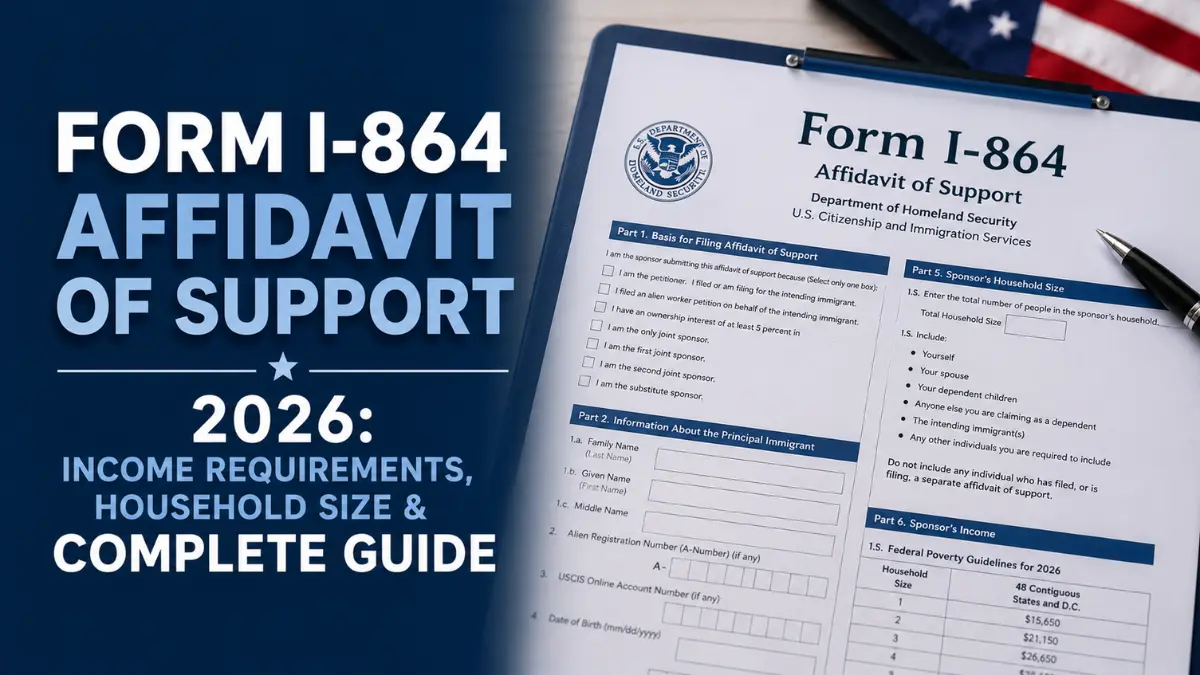
If you are sponsoring a family member for a U.S. green card, you will need to file the I-864 form affidavit of support 2026 — one of the most consequential documents in the entire immigration process. Form I-864 is not just a government form. It is a legally binding contract between you and the U.S. government in which you promise to financially support the immigrant you are sponsoring and ensure they do not become dependent on public assistance. Sign it, and the obligation follows you for years. This guide explains exactly what it requires, what the 2026 income thresholds are, how household size is calculated, what to do if your income falls short, and how long your legal responsibility actually lasts.
The I-864 income requirements 2026 and the affidavit of support income threshold 2026 are both based on the Federal Poverty Guidelines published by the U.S. Department of Health and Human Services in January 2026 and adopted by USCIS on March 1, 2026. These numbers apply to all I-864 submissions filed on or after that date.
Also on applicationformportal.us: Form I-485 — the Application to Register Permanent Residence that is filed together with Form I-864 for adjustment of status cases inside the United States. And Form I-130 — the Petition for Alien Relative that must be approved before Form I-864 can be submitted.
What Is Form I-864?
📥 Download Form I-864 from the Official USCIS Website →
The I-864 form affidavit of support 2026, officially titled Affidavit of Support Under Section 213A of the INA, is a form issued by USCIS and required for nearly every family-based green card application. When you sign Form I-864, you become the immigrant’s financial sponsor — legally agreeing to support them at an income level of at least 125% of the Federal Poverty Guidelines if they are unable to support themselves.
The Affidavit of Support is required because the U.S. immigration system is designed to ensure that incoming immigrants will not rely on means-tested public benefits such as Medicaid, SNAP, SSI, or Temporary Assistance for Needy Families (TANF). By signing the I-864, the sponsor accepts personal financial responsibility for the immigrant as a substitute guarantee to the government.
Is Form I-864 Required for Every Green Card?
Form I-864 is required for:
- All family-based immigrant visa cases (IR-1, CR-1, F1, F2, F3, F4 preference categories)
- Some employment-based immigrant visa cases where a family member filed the underlying petition
- Diversity Visa (DV) lottery winners who have a qualifying family member petitioner
Form I-864 is not required for:
- Refugees and asylees adjusting status
- Special immigrant juveniles
- Certain self-petitioning immigrants (VAWA, certain employment categories)
- Immigrants who have already worked 40 qualifying quarters of Social Security coverage
I-864 vs I-864EZ: Which Form Do You Use?
Understanding the I-864 vs I-864EZ difference can save you significant time — and filing the wrong version means starting over with USCIS. Form I-864EZ is a shorter, simplified version of the Affidavit of Support that is available to sponsors who meet all of the following conditions:
- You are the only sponsor (no joint sponsor, no I-864A household member income)
- You are only sponsoring one immigrant on this I-864
- Your income comes entirely from salary or pension (reported on W-2 forms) — no self-employment, business income, or other complex income sources
If all three conditions apply, use I-864EZ. It asks for the same essential information as the full I-864 but in a compressed, easier-to-complete format. If you have multiple immigrants to sponsor, need a joint sponsor, or have self-employment income, you must use the full Form I-864.
I-864 Income Requirements 2026: The 125% Rule
The core requirement of the affidavit of support income threshold 2026 is that the sponsor’s household income must be at least 125% of the Federal Poverty Guidelines for their household size. Active-duty U.S. military members sponsoring a spouse or unmarried child need only reach 100% of the guidelines.
The 2026 income thresholds (effective March 1, 2026) for sponsors in the 48 contiguous states and Washington, D.C. are:
| Household Size | 100% FPG (Military Only) | 125% FPG (Most Sponsors) |
|---|---|---|
| 2 | $21,640 | $27,050 |
| 3 | $27,320 | $34,150 |
| 4 | $33,000 | $41,250 |
| 5 | $38,680 | $48,350 |
| 6 | $44,360 | $55,450 |
| 7 | $50,040 | $62,550 |
| 8 | $55,720 | $69,650 |
| Each additional person | +$5,680 | +$7,100 |
Alaska and Hawaii have higher thresholds. Sponsors in Alaska and Hawaii must use the higher state-specific poverty guidelines published on Form I-864P. Alaska sponsors at 125% for a household of 2 need approximately $33,813; Hawaii sponsors need approximately $31,138. Always verify the exact figures for your state at uscis.gov/i-864p before filing.
How to Calculate Your Household Size for Form I-864
The I-864 household size calculation is one of the most commonly misunderstood parts of the form — and getting it wrong triggers Requests for Evidence (RFEs). Your household size for Form I-864 purposes includes all of the following people, regardless of whether they live with you:
- Yourself (the sponsor)
- Your spouse (if married, even if living separately)
- All your dependent children under 21 or those you claim as dependents on your federal tax return
- Anyone else you claimed as a dependent on your most recent federal tax return, even if not related to you
- Any immigrants you have previously sponsored using Form I-864, if that legal obligation is still active (meaning they have not yet become a U.S. citizen, worked 40 qualifying quarters, died, or permanently left the U.S.)
- The intending immigrant(s) you are currently sponsoring — always included, even though they are not yet in the U.S.
Example: You are sponsoring your spouse (immigrant). You have two children aged 10 and 14 living with you. You previously sponsored a sibling who became a citizen last year. Your household size is: you (1) + spouse being sponsored (1) + two children (2) = 4 people. The previously sponsored sibling does not count because their obligation ended when they became a citizen. Your minimum income requirement is $41,250.
What Income Counts Toward the I-864 Requirement?
USCIS counts the following as qualifying income for the I-864 income requirements 2026:
- Wages and salaries from employment (W-2 income)
- Self-employment income (net profit from Schedule C, Schedule F)
- Dividends and interest
- Rental income (net, after expenses)
- Pension and retirement income
- Alimony received (if court-ordered and documented)
- Social Security benefits (retirement, disability)
- Military allowances for housing and subsistence (for active-duty sponsors)
The following do not count as income for I-864 purposes:
- Public benefits (SNAP, Medicaid, SSI, TANF, housing vouchers)
- Unemployment compensation
- Child support received
- Informal or cash income that is not verifiable through tax returns or documentation
Critical 2026 tip: If you are filing your I-864 after April 15, 2026, USCIS expects you to submit your 2025 tax return (or transcript). If your 2025 return shows lower income than required but your current income is now sufficient, you must provide recent pay stubs and a current employer letter to demonstrate the improvement. USCIS looks at both your most recent tax return and your current income.
What If Your Income Is Not Enough? Three Options
Option 1: Use a Joint Sponsor (Form I-864)
A I-864 joint sponsor requirements check involves a separate, qualifying person who agrees to be an additional financial sponsor. The joint sponsor must:
- Be a U.S. citizen or lawful permanent resident aged 18 or older
- Be domiciled in the United States
- Meet the 125% FPG threshold on their own income — for their own household size (not combined with the primary sponsor’s household)
- Complete a separate, fully independent Form I-864 with their own supporting documents
The joint sponsor takes on the same legally binding obligation as the primary sponsor. Both I-864 forms are submitted together with the immigrant visa or adjustment of status application. A joint sponsor does not need to be related to you or the immigrant — any qualifying person who is willing to accept the legal obligation may serve as joint sponsor.
Option 2: Add Household Member Income (Form I-864A)
If another member of your household has income that, combined with yours, meets the 125% threshold, that person can complete Form I-864A, the Contract Between Sponsor and Household Member. To use I-864A:
- The household member must actually live in your home (or be your dependent)
- The household member must be at least 18 years old
- The household member’s income is added to the sponsor’s to reach the combined threshold
- The household member signs I-864A, accepting legal co-responsibility
Common I-864A situations include a working spouse, an adult child living at home, or a parent who lives with the sponsor. The intending immigrant can also contribute their own income via I-864A if they are already living in the U.S. (for adjustment of status cases).
Option 3: Use Assets to Make Up the Shortfall
If your income falls short and you do not have a joint sponsor, the I-864 assets to qualify green card option allows the sponsor to substitute qualifying assets for the income gap. The rules for assets are:
- Asset value required: The total net value of assets must equal five times the difference between the sponsor’s income and the 125% FPG threshold — for most family categories. (For sponsors of spouses and children of U.S. citizens, the multiplier is three times the shortfall.)
- Qualifying assets include: Savings and checking accounts, stocks and bonds, mutual funds, certificates of deposit, and real estate equity (net of liens)
- Excluded assets: Retirement accounts that are not accessible without penalty, life insurance cash value, and personal property (cars, jewelry) are generally not counted
- Documentation required: Bank statements showing 12 months of balances, brokerage statements, mortgage statements showing equity, or property appraisals
Asset calculation example: Your income is $20,000 but the 125% threshold for your household of 3 is $34,150. The shortfall is $14,150. For a U.S. citizen sponsoring a sibling (non-immediate relative), you need assets worth 5 × $14,150 = $70,750. For a U.S. citizen sponsoring a spouse, the multiplier is 3, so you need assets worth 3 × $14,150 = $42,450.
How to Fill Out Form I-864: Part-by-Part Guide
Knowing how to fill out form I-864 correctly is essential — and understanding each part before you sit down to complete it makes the process far less intimidating — errors or missing information are the leading cause of RFEs in adjustment of status cases. Here is what each part requires:
Part 1 — Basis for Filing
Check the box that describes your relationship to the intending immigrant and your basis for filing: you filed the immigrant petition (most common), you are a joint sponsor, or you are a substitute sponsor. Only one box applies.
Part 2 — Information About the Principal Immigrant
Enter the intending immigrant’s full legal name, date of birth, country of birth, country of citizenship, A-Number (if any), and visa case or USCIS receipt number. List any derivative immigrants (spouse or children immigrating in the same application) in the continuation pages.
Part 3 — Information About the Sponsor
Enter your full legal name, date of birth, Social Security number, home address, telephone number, and immigration status (U.S. citizen or LPR). You must have a U.S. domicile — meaning your primary home is in the United States. U.S. citizens living abroad who intend to domicile in the U.S. upon the immigrant’s arrival may still qualify; those with no intent to return generally do not.
Part 4 — Eligibility to Sponsor
Confirm your status (U.S. citizen or LPR) and provide evidence. U.S. citizens provide a passport, birth certificate, Certificate of Naturalization, or Certificate of Citizenship. LPRs provide a copy of their Permanent Resident Card (green card).
Part 5 — Household Size
This is where the I-864 household size calculation from earlier in this guide is applied to the form itself. Calculate and enter your household size using the rules described above. List each person counted in your household size. This is the number USCIS uses to determine which row of Form I-864P applies to your case.
Part 6 — Sponsor’s Income and Employment
Enter your current individual annual income from all sources. Provide your employer’s name and address, or describe your self-employment. This is the number USCIS compares first against the 125% FPG threshold for your household size.
Part 7 — Use of Assets to Supplement Income
If using assets to supplement income, enter the total value of qualifying assets, the shortfall between your income and the threshold, and whether you are listing the immigrant’s assets as well. Assets must be documented with supporting evidence submitted alongside the form.
Parts 8–10 — Sponsor’s Contract, Contact Information, and Signature
Read the sponsor’s contract statement carefully in Part 8 — this is the legally binding obligation you are accepting. Sign and date in Part 10. An unsigned I-864 will be rejected. If a preparer or interpreter helped you, they complete Parts 11–12.
Required Documents for Form I-864
Submit the following documents with your completed Form I-864:
- Federal tax return or IRS tax transcript for the most recent tax year. USCIS prefers the IRS tax transcript (requested via Form 4506-T) over a copy of your filed return. If you filed after April 15, 2026, include your 2025 return. Prior to that date, include your 2024 return.
- W-2s and/or 1099s from the most recent tax year to support the income reported on your return.
- Recent pay stubs (last 2–3 months) showing current income, especially if your tax return income was lower than your current income.
- Proof of U.S. citizenship or LPR status for the sponsor (passport, birth certificate, naturalization certificate, or green card).
- Form I-864A (the I-864A contract household member form) and supporting documents for each household member whose income you are including.
- Asset documentation if using assets to supplement income (bank statements, brokerage statements, property appraisals).
- Employment verification letter from your current employer if your income has increased significantly since your most recent tax return.
Where and How to File Form I-864
Form I-864 is never filed alone — it is always submitted as part of a larger application package. There are two filing paths depending on where the immigration processing takes place:
| Processing Path | Where Filed | How Submitted | Fee |
|---|---|---|---|
| Adjustment of Status (inside U.S.) | USCIS lockbox with Form I-485 package | Paper only — mailed to USCIS lockbox for your state | No separate fee; included in I-485 fee ($1,440 for adults in 2026) |
| Consular Processing (outside U.S.) | National Visa Center (NVC) via CEAC portal | Electronic upload through the CEAC online portal | $120 NVC processing fee for the I-864 affidavit package |
How Long Does the I-864 Obligation Last?
The I-864 legally binding how long question is one of the most important for sponsors to understand before signing. The obligation is not temporary — it is one of the most durable legal contracts in U.S. immigration law. Your financial responsibility as a sponsor ends only when one of the following occurs:
- The sponsored immigrant becomes a U.S. citizen
- The immigrant is credited with 40 quarters of Social Security-covered work (approximately 10 years)
- The immigrant permanently leaves the United States and abandons their permanent resident status
- The immigrant dies
- You die (your estate may still have obligations in some circumstances)
Divorce does not end the obligation. If you sponsor your spouse and later divorce, your legal financial responsibility under Form I-864 continues until one of the terminating events above occurs. This is one of the most critical facts for sponsors in marriage-based green card cases to understand before filing.
The obligation is enforceable. Government agencies that provide means-tested benefits to the sponsored immigrant can sue the sponsor to recover the cost of those benefits. The immigrant themselves can also sue the sponsor for support if their income falls below 125% of the poverty level.
Common I-864 Mistakes That Trigger RFEs
- Wrong household size. Forgetting to include previously sponsored immigrants still under obligation, or failing to include the intending immigrant themselves, are the two most common household size errors.
- Missing the most recent tax return. The I-864 income requirements 2026 mandate the most recent year’s return. If you filed after April 15, 2026, submit your 2025 return. Do not substitute a 2024 return after that date without explanation.
- Submitting a copy of your return instead of a transcript. USCIS strongly prefers the IRS tax transcript. Use Form 4506-T or download your transcript instantly at IRS.gov/GetTranscript.
- Failing to include W-2s. Even when providing a tax return, USCIS expects supporting W-2s and/or 1099s for the same year.
- Leaving Part 6 income blank or understating it. Your current annual income in Part 6 should reflect your present earning rate, not just what your tax return showed. Include current pay stubs and an employer letter if your income has grown.
- Not submitting a separate I-864 for each joint sponsor. Each joint sponsor completes and signs their own complete, independent Form I-864 with their own supporting documents.
- Signing with an old edition of the form. Always use the current edition from USCIS.gov. Outdated editions are rejected.
Other Application Forms You May Need
Form I-864 is filed as part of a larger immigration application. Here are the two forms most commonly filed alongside or before it:
- 📄 Form I-485 — The Application to Register Permanent Residence (Adjustment of Status). For cases processed inside the U.S., Form I-864 is submitted together with Form I-485 in the same mailed package.
- 📄 Form I-130 — The Petition for Alien Relative that establishes the qualifying family relationship. USCIS must approve Form I-130 before the I-864 stage of the process is reached.
Frequently Asked Questions About Form I-864 2026
What is the minimum income to sponsor an immigrant in 2026?
The affidavit of support income threshold 2026 requires sponsors to earn at least 125% of the Federal Poverty Guidelines for their household size. For the most common scenario — a U.S. citizen sponsoring a spouse with no other dependents (household of 2) — the minimum is $27,050 per year in the 48 contiguous states. Active-duty military sponsoring a spouse or child need only meet 100% FPG, which is $21,640 for a household of 2.
Can I use a joint sponsor if my income is too low?
Yes. A joint sponsor is a separate U.S. citizen or LPR who files their own complete Form I-864 and meets the 125% FPG threshold based on their own household size and income. The I-864 joint sponsor requirements include being 18 or older, U.S.-domiciled, and financially qualifying independently. Joint sponsors accept the same legally binding obligation as the primary sponsor.
What is the difference between I-864 and I-864EZ?
The I-864 vs I-864EZ difference is scope and complexity. I-864EZ is a shorter form available only to sponsors with W-2 or pension income who are sponsoring a single immigrant without joint sponsors or household member income. If your income includes self-employment, multiple income sources, or you need a joint sponsor or I-864A, use the full Form I-864.
Does divorce end my I-864 obligation?
No. Divorce does not terminate the I-864 legally binding how long obligation. Your responsibility continues until the sponsored immigrant becomes a U.S. citizen, completes 40 qualifying quarters of Social Security work, permanently leaves the U.S., or dies. This is a critical consideration for sponsors in marriage-based green card cases.
Can I use assets instead of income to qualify?
Yes. The I-864 assets to qualify green card rule allows sponsors to supplement insufficient income with qualifying assets. The net value of assets must equal 5 times the income shortfall for most family categories, or 3 times the shortfall for immediate relatives (spouses and children of U.S. citizens). Assets must be documented with bank statements, brokerage statements, or property appraisals.
What is Form I-864A?
The I-864A contract household member form is used when the sponsor wants to count a household member’s income toward the 125% threshold. The household member must live in the sponsor’s home (or be a dependent), be at least 18, and sign the I-864A accepting legal co-responsibility for supporting the immigrant. It is filed together with the primary sponsor’s I-864.
Is there a filing fee for Form I-864?
The I-864 form affidavit of support 2026 itself has no separate USCIS filing fee. For adjustment of status cases, the cost is included in the Form I-485 filing fee ($1,440 for adults in 2026). For consular processing cases, the National Visa Center charges $120 to process the I-864 affidavit package.
Official Form I-864 Resources
- 🟩 Form I-864 — Official USCIS Page & Download
- 🟩 Affidavit of Support Overview — USCIS.gov
- 🟩 I-864 FAQs for Consular Processing — State.gov
- 🟩 Form I-864P: 2026 Poverty Guidelines for Sponsors — USCIS.gov
Disclaimer: This guide is for general informational purposes only and does not constitute legal or immigration advice. Immigration laws and USCIS requirements can change. Always verify current information at uscis.gov or consult a qualified immigration attorney for advice specific to your situation.