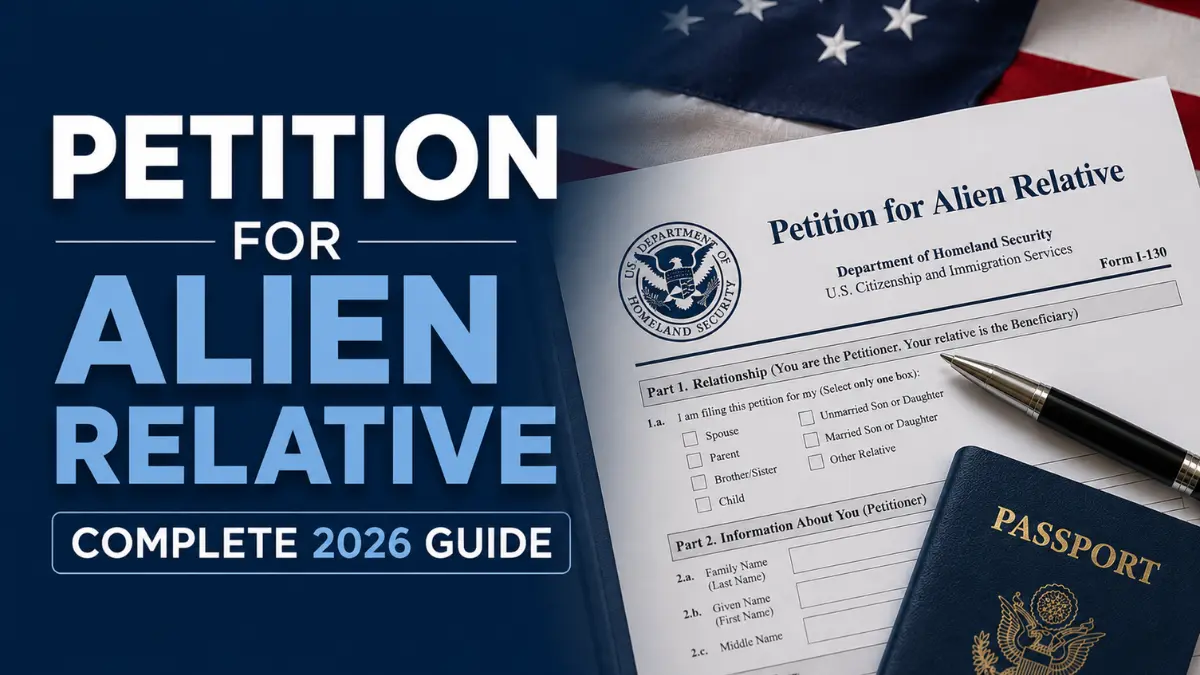
If you are a U.S. citizen or green card holder who wants to bring a family member to live permanently in the United States, the form I-130 is where the journey begins. Officially called the Petition for Alien Relative, this USCIS form is the legal mechanism that proves a qualifying family relationship exists between you (the petitioner) and your foreign-born relative (the beneficiary) — and formally requests the U.S. government to recognize that relationship as the foundation for a family-based green card. With over 700,000 I-130 petitions filed in fiscal year 2024 alone, it is the single most-filed immigration petition in the country.
Whether you are trying to understand the I-130 eligibility requirements for your specific situation, researching exactly how to file I-130 online or by mail, tracking the latest I-130 processing time 2026 after USCIS stalled in March, putting together your I-130 required documents checklist, figuring out the difference between a family-based green card petition and an employment-based one, calculating the I-130 filing fee, or deciding between consular processing vs adjustment of status for your relative — this guide covers every step. If you are petitioning for a spouse, you will also need to understand the I-130A supplemental form that the beneficiary spouse must complete alongside the main petition.
What Is Form I-130?
Form I-130, issued by U.S. Citizenship and Immigration Services (USCIS), is the foundational petition in nearly all family-based immigration cases. It does not grant a green card on its own — that is a common and costly misconception. What it does is legally establish that a qualifying family relationship exists, which places your relative in line for the next step in the immigration process. Think of it as reserving your relative’s spot. Once approved, the door opens either to adjustment of status (if your relative is already in the U.S.) or to consular processing through a U.S. embassy abroad.
The person filing the form is called the petitioner. The family member being sponsored is the beneficiary. Only U.S. citizens and lawful permanent residents (LPRs) may serve as petitioners. The specific relatives you can sponsor depend on your immigration status — citizens can petition for a wider range of family members than green card holders can.
You must file a separate Form I-130 for each relative you are sponsoring. There is no combined petition for multiple family members.
📥 Download Form I-130 from the Official USCIS Website →
2026 Update — What Every Applicant Must Know Right Now
Two developments are directly affecting I-130 filers in 2026 and are worth understanding before you prepare your package.
First, USCIS processing stalled significantly starting in mid-March 2026. Data from independent case-tracking services shows that end-to-end wait times for Immediate Relative consular processing cases have climbed to approximately 15 months and are continuing to rise. Adjustment of status concurrent filings (where the beneficiary is already in the U.S.) are moving faster but are also affected. If you are planning a filing based on pre-2026 timelines, revise your expectations upward.
Second, the current accepted version of the form is the 04/01/24 edition. Always download the form directly from uscis.gov immediately before filing to ensure you are using the correct version. USCIS will reject petitions submitted on outdated editions. As of 2026, USCIS also requires payment by credit card (Form G-1450) or U.S. bank ACH transfer (Form G-1650) for paper filings — personal checks and money orders are no longer accepted for I-130 submissions.
Documents You Need — Complete Checklist
Gather all of the following before you start filling out the form. Incomplete packages are one of the top reasons for rejection and delay.
Petitioner Identity Documents (Required for All Cases)
- Proof of U.S. citizenship: U.S. passport, U.S. birth certificate, Certificate of Naturalization, or Certificate of Citizenship
- If an LPR: copy of both sides of your Permanent Resident Card (Green Card)
- Two identical passport-style color photos of the petitioner (2×2 inches, white background, taken within the last 30 days)
Proof of Qualifying Family Relationship
- Spouse: Original marriage certificate; proof of termination of any prior marriages (divorce decree, annulment, or death certificate); evidence of a bona fide marriage — joint bank account statements, lease or mortgage in both names, shared utility bills, photos together across time, and co-mingled financial records. Also required: completed Form I-130A (Supplemental Information for Spouse Beneficiary), filled out by the beneficiary spouse
- Child (biological): Child’s birth certificate showing both parents’ names
- Child (adopted): Adoption decree and evidence the child was adopted before age 16 and lived with the petitioner for at least 2 years
- Child (stepchild): Birth certificate of child, marriage certificate showing marriage to child’s parent occurred before the child turned 18
- Parent: Petitioner’s birth certificate showing the parent’s name; if through a stepparent, marriage certificate of that parent to the petitioner’s other parent
- Sibling: Both the petitioner’s and sibling’s birth certificates proving shared parent(s)
Beneficiary Documents
- Two identical passport-style color photos of the beneficiary (same specs as petitioner photos)
- Copy of the beneficiary’s current passport biographical page
- Any prior U.S. visa, status, or immigration documents (if applicable)
Translation Requirements
Any document not in English must be accompanied by a certified English translation. The translator must certify in writing that they are competent to translate and that the translation is complete and accurate. USCIS does not accept machine translations as the sole translation.
Am I Eligible to File Form I-130?
If You Are a U.S. Citizen
U.S. citizens have the broadest eligibility to petition under Form I-130. You can file for:
- Spouse — Immediate Relative (IR); no annual visa cap; visa available immediately upon I-130 approval
- Unmarried children under 21 — Immediate Relative; no cap
- Parents — Immediate Relative; petitioner must be at least 21 years old
- Unmarried sons or daughters 21 or older — F1 preference category; subject to annual visa limits
- Married sons or daughters of any age — F3 preference category; subject to annual visa limits
- Siblings — F4 preference category; petitioner must be at least 21; subject to annual visa limits and often very long waits
If You Are a Lawful Permanent Resident (Green Card Holder)
LPRs can petition for a narrower group of relatives:
- Spouse — F2A preference category; subject to annual visa limits
- Unmarried children under 21 — F2A preference category
- Unmarried sons or daughters 21 or older — F2B preference category; subject to longer waits
LPRs cannot petition for parents, married children, or siblings. Only U.S. citizens may sponsor those relatives. If you are an LPR and want to expand who you can sponsor, the path is naturalization first — see our guide on Form N-400 (Application for Naturalization).
Who Cannot File Form I-130
- Anyone who is not a U.S. citizen or lawful permanent resident
- LPRs seeking to sponsor parents, married children, or siblings (citizens only)
- Petitioners sponsoring grandparents, grandchildren, aunts, uncles, nephews, nieces, cousins, or in-laws — these relationships are not recognized under I-130
- Anyone sponsoring a spouse where the marriage was entered into solely for immigration purposes
- Anyone sponsoring an adopted child where the adoption occurred after age 16
- Anyone sponsoring a stepchild where the petitioner’s marriage to the child’s parent occurred after the child turned 18
Form I-130 Fee Breakdown (2026)
| Filing Method | Fee | Notes |
|---|---|---|
| Online (myUSCIS) | $625 | Recommended — faster, real-time tracking, PDF uploads |
| Paper (by mail) | $675 | Pay by credit card (Form G-1450) or ACH transfer (Form G-1650) only |
| Form I-130A (spouse supplement) | $0 | No separate fee — filed with main I-130 at no extra cost |
| Multiple beneficiaries | $625 or $675 each | One separate petition and fee required per relative |
The I-130 filing fee is non-refundable regardless of whether USCIS approves or denies the petition. Always verify the current fee at uscis.gov/forms/filing-fees before submitting, as fees are subject to change.
How to File Form I-130 — Step-by-Step Instructions
Step 1 — Confirm Your Eligibility and Your Relative’s Qualifying Relationship
Before anything else, verify that you are a U.S. citizen or LPR and that the relative you want to sponsor falls into one of the qualifying relationship categories for your status. If you are an LPR sponsoring a spouse or child, also verify that you are not in removal proceedings, as this can complicate the process significantly.
Step 2 — Download the Correct Edition of Form I-130 (and I-130A If Filing for a Spouse)
Go to uscis.gov/i-130 and download the 04/01/24 edition — the current version as of 2026. If you are petitioning for a spouse, also download Form I-130A from the same page. The I-130A is filled out by the beneficiary spouse and covers their address and employment history for the past five years. To file online instead, create or log in to your myUSCIS account at my.uscis.gov.
Step 3 — Complete Part 1: Your Relationship to the Beneficiary
Check exactly one box in Part 1 to identify the relationship — spouse, parent, child, or sibling. Do not check more than one box. In Part 2, enter the petitioner’s full legal information exactly as it appears on your immigration or citizenship documents — any mismatch in names or dates is a common trigger for a Request for Evidence (RFE).
Step 4 — Complete Parts 3 and 4: Beneficiary Information and Immigration Path
Part 3 covers the beneficiary’s personal details — full legal name, date of birth, country of birth, and current address. Part 4 is critical: you must select either adjustment of status (if the beneficiary is already in the U.S. and plans to stay) or consular processing (if the beneficiary is abroad and will apply at a U.S. embassy). Do not complete both options and do not leave this section blank — USCIS will reject the petition.
Step 5 — Complete Remaining Parts and Sign
Parts 5 through the end cover additional petitioner details, interpreter certification (if applicable), and preparer information (if an attorney or accredited representative helped you). The petitioner must sign and date the form personally — USCIS will not accept a stamped or typed signature. If an interpreter helped complete the form, they must sign Part 12.
Step 6 — Complete Form I-130A (Spouse Cases Only)
The beneficiary spouse fills out Form I-130A with their full biographical details, five years of address history, five years of employment history, and their parents’ information. The petitioner can physically prepare it on the beneficiary’s behalf if the spouse is overseas, but the form must reflect the beneficiary’s accurate information. There is no separate filing fee for I-130A.
Step 7 — Assemble Your Filing Package
Compile the completed Form I-130, Form I-130A (if applicable), all supporting documents from the checklist above, two passport-style photos each for the petitioner and beneficiary, and your filing fee payment. Never send original documents — always send clear copies unless USCIS specifically instructs otherwise. Photocopy or scan the entire package before mailing and keep a complete set for your records.
Step 8 — Submit to the Correct USCIS Lockbox or File Online
Mailing addresses depend on your state of residence and whether the beneficiary will file Form I-485 concurrently. Check the Direct Filing Addresses for Form I-130 page right before mailing — addresses change without much notice. If filing online through myUSCIS, submit your package digitally and save your confirmation number the moment you receive it.
Step 9 — Save Your Receipt Notice and Track Your Case
Within 2 to 4 weeks of filing, USCIS mails a receipt notice (Form I-797C) containing your 10-digit receipt number. Save this document — you need it to track your case at egov.uscis.gov and to submit a processing inquiry if your case exceeds normal timelines. Set up email and text notifications through your myUSCIS account.
What Happens After You File?
Stage 1 — USCIS Reviews and Adjudicates the Petition
USCIS reviews your I-130 to confirm the petitioner’s status, the qualifying relationship, and completeness of supporting evidence. If anything is missing or insufficient, USCIS issues a Request for Evidence (RFE) giving you a set deadline to respond. Insufficient bona fide marriage evidence is the single most common RFE trigger in spousal cases. If USCIS approves the petition, it moves to the next stage. If denied, USCIS explains the reasons and you may be able to appeal or refile with stronger documentation.
Stage 2 — After Approval: Two Paths Forward
Once USCIS approves the I-130, the path forward depends on where the beneficiary is and what was selected in Part 4 of the form.
Adjustment of Status (beneficiary already in the U.S.): If the beneficiary is physically present in the U.S. and eligible, they file Form I-485 (Application to Register Permanent Residence) to apply for a green card without leaving the country. In some cases — particularly for immediate relatives of U.S. citizens — I-485 can be filed concurrently with the I-130, which often speeds up the overall timeline.
Consular Processing (beneficiary abroad): USCIS sends the approved petition to the National Visa Center (NVC). The NVC currently operates with approximately a 5-day case-creation turnaround after receiving the file from USCIS. NVC then collects immigrant visa application fees, the DS-261 (Choice of Address and Agent), the DS-260 (Immigrant Visa Application), Form I-864 (Affidavit of Support), and civil documents. Once the case is documentarily complete and a visa number is available, NVC schedules the beneficiary’s immigrant visa interview at the nearest U.S. embassy or consulate. The beneficiary completes a medical exam before the interview, and — if approved — enters the U.S. as a lawful permanent resident.
Stage 3 — Preference Category Cases: Waiting for a Priority Date
For family preference categories (F1, F2A, F2B, F3, F4), the approved I-130 does not immediately lead to a green card interview. Preference categories are subject to annual visa limits, so USCIS holds the approved petition until a visa number becomes available according to the monthly Visa Bulletin published by the State Department. The date your I-130 was properly filed becomes your priority date — your place in line. Waits for preference categories range from a few years to several decades, depending on the category and the beneficiary’s country of birth.
I-130 Processing Times in 2026
Processing times vary significantly by relationship type, petitioner status, and whether the beneficiary is adjusting status inside the U.S. or going through consular processing abroad. The figures below reflect conditions as of June 2026 following the USCIS processing slowdown that began in March 2026.
| Relationship / Category | Petitioner | Estimated I-130 Processing Time (2026) |
|---|---|---|
| Spouse, unmarried child under 21, or parent (Immediate Relative — Consular) | U.S. Citizen | 15–19 months (rising due to March 2026 stall) |
| Spouse or child under 21 (Immediate Relative — Adjustment of Status, concurrent I-485) | U.S. Citizen | 8–12 months |
| Unmarried sons/daughters 21+ (F1) | U.S. Citizen | I-130: 12–18 months + priority date wait (years) |
| Spouse or unmarried child under 21 (F2A) | LPR | I-130: 12–24 months + priority date wait |
| Unmarried sons/daughters 21+ (F2B) | LPR | I-130: 12–24 months + 8+ year priority date wait |
| Married sons/daughters (F3) | U.S. Citizen | I-130: 12–18 months + many years priority wait |
| Siblings (F4) | U.S. Citizen | I-130: 12–18 months + 10–25+ year priority wait |
Always verify current processing times at egov.uscis.gov/processing-times and check the monthly Visa Bulletin for preference category priority date movement.
Other Application Forms You May Need
Depending on your situation, you may also need to complete other official U.S. government application forms. Here are some of the most-searched forms on our site to help you stay prepared:
- 📋 Form I-485 — Application to Register Permanent Residence (Green Card)
Once your I-130 is approved and a visa is available, your relative who is already in the U.S. files Form I-485 to complete the green card process without leaving the country. In many immediate relative cases it can be filed at the same time as the I-130. - 📋 Form N-400 — Application for Naturalization (U.S. Citizenship)
If you are currently a green card holder and want to expand the relatives you can sponsor — including parents, married children, and siblings — naturalizing as a U.S. citizen via Form N-400 unlocks those additional petition categories.
Frequently Asked Questions About Form I-130
Does an approved Form I-130 give my relative a green card?
No — this is one of the most common misconceptions about the I-130. Approval of the petition only confirms that a qualifying family relationship exists and establishes your relative’s priority date. The beneficiary still needs to go through either adjustment of status (Form I-485 if in the U.S.) or consular processing at a U.S. embassy abroad before actually receiving a green card. For preference categories, they must also wait for a visa number to become available under the monthly Visa Bulletin before those next steps can even begin.
Can I file Form I-130 if my relative is already in removal proceedings?
Yes, you can file the I-130 even if your relative is in removal proceedings. However, approval of the petition alone does not stop deportation or provide any immigration status. The beneficiary would still need to obtain relief from the immigration court separately. Because removal proceedings complicate the next steps significantly, consulting an immigration attorney before filing in this situation is strongly recommended.
Can I file Form I-130 and Form I-485 at the same time?
Yes — in many cases for immediate relatives of U.S. citizens (spouses, parents, and children under 21), you can file the I-130 and the I-485 concurrently if the beneficiary is already lawfully present in the United States. Concurrent filing can significantly shorten the overall timeline because USCIS processes both petitions together rather than sequentially. However, USCIS will not accept a concurrently filed I-485 if it is submitted online with the I-130 — concurrent packages must be mailed together to the correct lockbox.
How long does Form I-130 stay valid after approval?
An approved I-130 petition does not expire. It remains valid indefinitely unless eligibility changes — for example, if the qualifying relationship ends (such as through divorce in a spousal petition) or if the petitioner loses their U.S. citizenship or LPR status. However, NVC can terminate a consular processing case if you fail to respond to their document requests within their required timeframes, so timely action after approval is important.
What is the difference between consular processing and adjustment of status?
Consular processing is for beneficiaries who live outside the United States. After I-130 approval, the case goes through the National Visa Center and ends with an immigrant visa interview at a U.S. embassy or consulate in the beneficiary’s country. Adjustment of status is for beneficiaries who are already physically present in the U.S. and eligible — they file Form I-485 and complete the process without leaving the country. The right path depends on where your relative currently lives and their current immigration status in the U.S.
What are the most common reasons Form I-130 is denied?
Common denial reasons include: insufficient evidence that a spousal marriage is bona fide (not entered into solely for immigration purposes), the petitioner lacking qualifying immigration status, an ineligible relationship type (such as grandparent or in-law), prior marriage not properly terminated, or a finding that the beneficiary is inadmissible to the U.S. due to a criminal record or immigration violations. In most cases, USCIS will first issue an RFE rather than outright denial, giving you a chance to provide additional evidence.
Do I need an immigration attorney to file Form I-130?
You are not legally required to hire an attorney to file Form I-130 — many petitioners successfully file on their own, especially in straightforward spousal or parent cases with clean immigration histories. However, an experienced immigration attorney is strongly advisable if your case involves any criminal history (petitioner or beneficiary), prior immigration violations, a prior denial, removal proceedings, or a complex family situation such as adoption or a large age-gap stepchild relationship. The cost of an attorney is far less than the cost of a denial and refiling from scratch.
Official Links — Form I-130 Resources
- 🏡 Form I-130 — USCIS Official Page (Download, Instructions, Filing Addresses)
- 💰 USCIS Fee Schedule — Confirm Current Filing Fees
- 📊 USCIS Processing Times Tool — Check Times by Service Center
- 📝 Direct Filing Addresses for Form I-130 — Find the Correct Mailing Address
- 📄 Monthly Visa Bulletin — Track Priority Date Movement for Preference Categories
- 🔍 USCIS Case Status Online — Track Your I-130 with Your Receipt Number
Disclaimer
ApplicationFormPortal.us is not affiliated with, endorsed by, or operated by U.S. Citizenship and Immigration Services (USCIS), the Department of Homeland Security, the Department of State, or any other U.S. government agency. This guide is provided for general informational purposes only and does not constitute legal advice. Immigration laws and USCIS procedures change frequently — always verify current requirements, fees, and processing times directly at uscis.gov before filing. For advice specific to your situation, consult a qualified immigration attorney or USCIS-accredited representative.