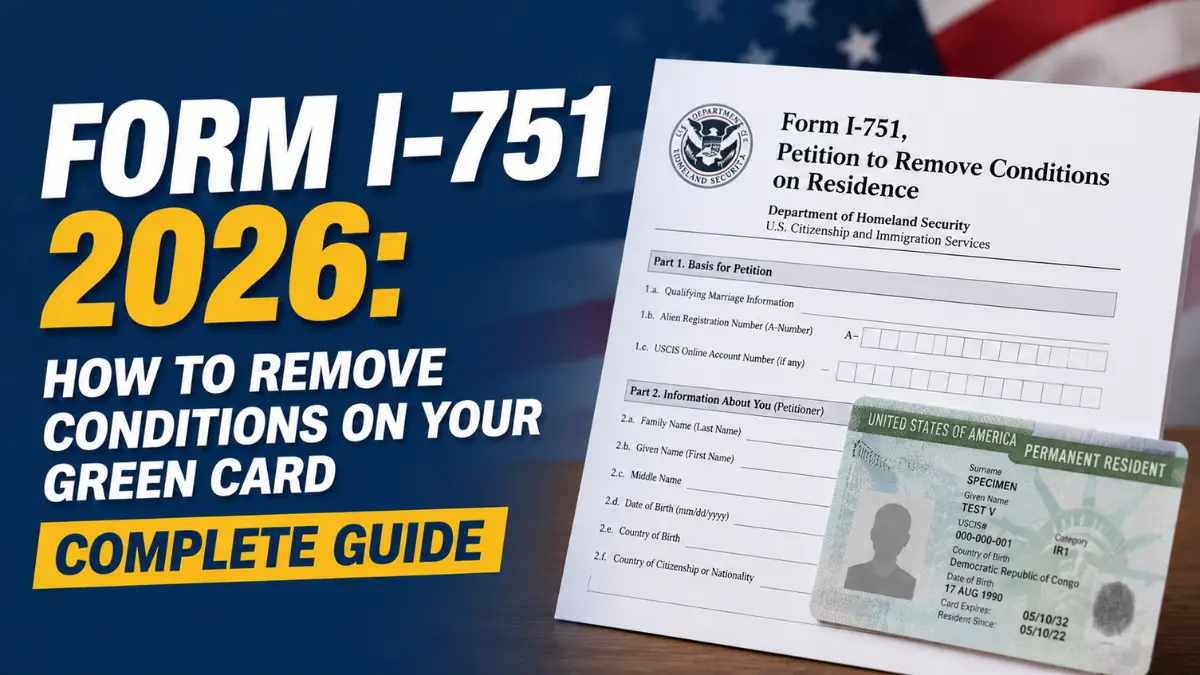
If you received your U.S. green card through marriage and your card is valid for only two years, there is one critical step standing between you and permanent residency: you must file Form I-751 remove conditions on residence before your conditional card expires. Missing this deadline — or filing without sufficient evidence — can cost you your permanent resident status and put you at risk of removal from the United States.
This guide covers everything you need to know about the i-751 petition to remove conditions in 2026: who must file, when to file, what evidence USCIS expects, how much it costs, how long processing takes, and what to do if you are divorced, widowed, or no longer able to file jointly with your spouse.
Whether you are preparing your first conditional green card removal of conditions 2026 filing or trying to understand your options after a difficult change in your marriage, this plain-English guide has you covered.
What Is Form I-751?
📥 Download Form I-751 from the Official USCIS Website →
Form I-751, Petition to Remove Conditions on Residence, is the official USCIS form that conditional permanent residents use to convert a two-year marriage-based green card into a standard 10-year permanent resident card. USCIS issues conditional green cards — also known as CR-1 cards — when a foreign national obtains permanent residency through marriage but has been married for less than two years at the time the green card is approved.
The two-year conditional period exists specifically so USCIS can verify that the marriage was genuine and not entered into solely for immigration purposes. When you file Form I-751, you are asking USCIS to lift those conditions and confirm that your marriage was and remains a real, good-faith relationship. If USCIS approves your petition, you receive a 10-year green card just like any other lawful permanent resident.
Failing to file Form I-751 before your conditional green card expires is not an option. If you do not file, USCIS will automatically terminate your permanent resident status on the second anniversary of the date you received conditional residence, and you will become removable from the United States.
Who Must File Form I-751?
You must file Form I-751 if you are a conditional permanent resident who obtained your green card through marriage to a U.S. citizen or lawful permanent resident, and your green card has a two-year expiration date. This applies to you regardless of whether you are still married to the same spouse, divorced, widowed, or separated.
Your dependent children who received conditional resident status at the same time as you, or within 90 days after you, can be included on your Form I-751 petition. Children who received conditional status outside that 90-day window must file their own separate Form I-751.
One important distinction: Form I-751 is not the same as renewing a green card. Conditional green cards cannot simply be renewed with Form I-90. You must go through the full removal of conditions process using Form I-751 to upgrade from a two-year card to a permanent 10-year card.
When to File: The 90-Day Window
For joint filers (those still married to the same spouse who sponsored them), the 90 day window i-751 filing rule is critical. You must file Form I-751 during the 90-day period immediately before your conditional green card expires — not before, and not after the expiration date if at all possible.
To find your 90-day window, look at the “Card Expires” date on the front of your conditional green card and count back exactly 90 days. That date is the earliest you can file. USCIS will reject your petition if you submit it more than 90 days before your card expires. For example, if your card expires on December 31, 2026, your filing window opens on October 2, 2026.
If you miss the 90-day window and your card expires, you can still file late, but you must include a written explanation with supporting documentation showing that the delay was due to extraordinary circumstances beyond your control. USCIS evaluates late filings on a case-by-case basis. Late filing significantly increases your risk of complications, so file within the window whenever possible.
If you are requesting a waiver of the joint filing requirement (due to divorce, the death of your spouse, abuse, or extreme hardship), the 90-day window does not apply. You may file at any time after receiving your conditional resident status and before removal proceedings are completed.
Form I-751 Filing Fee in 2026
The i-751 filing fee 2026 is currently $750 when filing a paper form by mail, or $700 when filing online through myUSCIS. There is an additional biometric services fee of $85 per petitioner. Children included on the same petition each require an additional $85 biometric fee if they are 14 years of age or older.
| Filing Method | Filing Fee (2026) | Biometric Fee |
|---|---|---|
| Paper (by mail) | $750 | $85 per applicant |
| Online (myUSCIS) | $700 | $85 per applicant |
| Waiver of joint filing requirement | $0 | $85 per applicant |
Note: Conditional residents filing a waiver of the joint filing requirement do not pay the standard filing fee, but they are still required to pay the biometric services fee. If you cannot afford the fees, you may request a fee waiver by submitting Form I-912 along with your petition. Always verify the current fees on the USCIS Fee Schedule at uscis.gov before submitting, as fees are subject to change.
The 48-Month Status Extension
One of the most important benefits of filing Form I-751 on time is the automatic status extension you receive when USCIS accepts your petition. The i-751 48 month extension receipt notice is issued automatically when USCIS sends you a Form I-797 receipt notice confirming your petition was accepted.
This receipt notice extends your conditional permanent resident status for 48 months (four years) beyond your card’s expiration date. That means you can continue to live, work, and travel in the United States legally while your petition is pending, even if your physical green card has already expired. Keep your expired green card and your I-797 receipt notice together, as most employers and agencies will accept this combination as proof of your continued legal status.
Evidence Required: How to Prove a Bona Fide Marriage
The heart of Form I-751 is your evidence for i-751 bona fide marriage. USCIS uses the evidence you submit to determine whether your marriage was entered into in good faith — meaning both spouses married sincerely intending to build a life together, not solely to obtain immigration benefits. The burden of proof falls entirely on you as the petitioner. USCIS does not assume your marriage is genuine; you must actively demonstrate it.
A strong I-751 petition typically includes 20 to 40 pages of supporting documents across multiple categories, spanning the full two years of your conditional residency. Quality and variety of evidence matter more than sheer volume. Here is what USCIS looks for, ranked from strongest to supplementary:
Tier 1: Strongest Financial & Legal Evidence
- Jointly filed federal tax returns for every year of your marriage, with W-2s or 1099s. Request IRS transcripts if you no longer have copies.
- Birth certificates of children born during the marriage listing both parents’ names.
- Joint mortgage deed or property title showing both names as co-owners.
- Joint bank account statements spanning your entire conditional residency period — checking, savings, and investment accounts.
- Joint lease agreement or rental contract listing both spouses’ names.
Tier 2: Strong Supporting Evidence
- Utility bills (electricity, gas, water, internet) addressed to both spouses at the same address.
- Health, auto, life, or home insurance policies listing both spouses or naming each other as beneficiaries.
- Credit card or loan statements in both names.
- Correspondence addressed to both of you at the same address (bank statements, government notices).
- Wills, trusts, or estate planning documents naming each other as heirs or beneficiaries.
Tier 3: Relationship & Personal Evidence
- Wedding photos, honeymoon photos, and family photos spanning the full two years.
- Photos of trips, holidays, and everyday life together.
- Two to four sworn affidavits from people who know you both as a couple — friends, family members, neighbors, coworkers, or religious leaders who can describe specific observations of your relationship.
- Evidence of shared social and community activities (memberships in clubs, religious organizations, or teams).
- Phone records or messaging history showing regular communication.
Your evidence should span the entire two-year conditional period — from your earliest days as conditional residents through the present. Documents concentrated only near the filing date raise questions about what the marriage looked like earlier. If there are gaps in your documentation (for example, separate finances due to employment circumstances, or periods of living apart due to work), address them directly in a cover letter or affidavit rather than leaving a USCIS officer to draw their own conclusions.
How to Fill Out Form I-751: Step-by-Step
Knowing how to file form i-751 correctly is just as important as having strong evidence. Here is a step-by-step walkthrough of the form’s key sections:
Step 1: Download the Current Form Edition
Download the latest edition of Form I-751 from uscis.gov, or file online through myUSCIS. Always verify you are using the most current edition before completing the form — USCIS will reject petitions submitted on outdated versions.
Step 2: Complete Part 1 — Information About You
Enter your full legal name as it appears on your conditional green card, your date of birth, country of birth, Social Security Number, Alien Registration Number (A-Number), your current address, and your green card expiration date. Answer every question. Write “N/A” for anything that does not apply — never leave fields blank.
Step 3: Complete Part 2 — Basis for Petition
Select whether you are filing jointly with your spouse (the standard path for married couples) or whether you are requesting a waiver of the joint filing requirement. If you are requesting a waiver, indicate the specific waiver basis: divorce/annulment, death of spouse, battery or extreme cruelty, or extreme hardship. Selecting the wrong basis here can significantly complicate your case.
Step 4: Complete Part 3 — Biographic Information
Provide your ethnicity, race, height, weight, eye color, and hair color. This biographic data is used to match your petition to your biometrics appointment records.
Step 5: Complete Part 4 — Information About Your Spouse
Provide the full name, date of birth, country of birth, and Social Security Number of the U.S. citizen or lawful permanent resident spouse through whom you obtained conditional residence. If filing jointly, your spouse must also sign the form in Part 6.
Step 6: List Dependent Children (Part 5)
If you are including dependent children who received conditional resident status at the same time as you (or within 90 days), list each child’s full name, date of birth, A-Number, and relationship to you. Each child listed requires an additional biometric fee of $85.
Step 7: Sign the Petition (Part 6)
Both you and your spouse (if filing jointly) must sign and date the form in black ink. An unsigned petition will be rejected. If you are filing with a waiver and not including your spouse’s signature, be sure to indicate your waiver basis clearly in Part 2.
Step 8: Assemble Your Package and File
Compile your completed form, all supporting evidence, your filing fee payment (check or money order payable to U.S. Department of Homeland Security, or pay online), and any waiver documentation. Mail to the correct USCIS lockbox address listed on the Form I-751 direct filing addresses page, or submit online through myUSCIS. Include a cover letter at the top of your package summarizing what you have enclosed.
Step 9: Attend Your Biometrics Appointment
After USCIS accepts your petition, you will receive a biometrics appointment notice for your local Application Support Center (ASC). Attend this appointment on time. USCIS collects your fingerprints, photograph, and signature to conduct background checks. Missing this appointment without rescheduling will delay your case.
Step 10: Await USCIS Decision
USCIS will review your petition and evidence. Many cases are approved without an interview. However, USCIS may schedule you for an interview at your local field office if your evidence is thin, inconsistent, or if your case has any flags. If approved without an interview, USCIS will mail your new 10-year permanent resident card. If USCIS issues a Request for Evidence (RFE), respond promptly and thoroughly by the stated deadline — typically within 87 days.
Form I-751 Processing Time in 2026
The i-751 processing time 2026 is one of the most common concerns for conditional residents. Processing times vary depending on the USCIS service center and whether your case is a joint filing or a waiver. As of June 2026, here are the general timelines:
| Filing Type | Estimated Processing Time (June 2026) |
|---|---|
| Joint petition (standard) | 10–23 months |
| Waiver (divorce, death, abuse, hardship) | 18–36+ months |
Because processing can take well over a year, the 48-month automatic extension on your receipt notice is essential — it keeps you in valid status and authorized to work throughout the entire wait. You do not need to take any action to obtain this extension; it is automatic when USCIS accepts your petition.
You can track your case at egov.uscis.gov using the receipt number on your I-797 notice. If your case has been pending longer than the published processing time for your service center, you may submit a USCIS e-request or call the USCIS Contact Center to inquire.
The I-751 Waiver: Filing Without Your Spouse
Not every conditional resident can file jointly. The i-751 waiver joint filing requirement allows you to file Form I-751 on your own if you fall into one of these four categories:
- Divorce or annulment — Your marriage ended in divorce or was annulled. You must prove that the marriage was entered into in good faith even though it later ended.
- Death of your spouse — Your U.S. citizen or permanent resident spouse died. Include the death certificate and evidence of your good-faith marriage during your spouse’s lifetime.
- Battery or extreme cruelty — You or your child were battered or subjected to extreme cruelty by your sponsoring spouse or stepparent. VAWA-related protections apply in this scenario.
- Extreme hardship — Removal from the United States would result in extreme hardship to you. This is the most difficult waiver basis to establish and requires compelling evidence of hardship beyond the ordinary difficulties of deportation.
For waiver cases, you do not pay the standard filing fee but do pay the biometric services fee. The 90-day filing window does not apply — you may file at any time. Evidence requirements for waivers are essentially the same as for joint petitions, with the addition of documentation supporting your waiver basis (divorce decree, death certificate, police reports, medical records, etc.).
Note that if you are in the middle of divorce proceedings when the 90-day window opens, you can file the petition as a joint filer and amend it to a waiver once the divorce is finalized. Alternatively, you can file a waiver immediately if divorce proceedings have begun. Consult an immigration attorney if your situation is complex.
What Happens at an I-751 Interview?
Many Form I-751 petitions are approved without an interview, especially when the evidence package is strong, complete, and consistent. However, USCIS schedules interviews more frequently in cases where evidence is sparse, the couple has separate addresses without explanation, or there are other flags in the file.
If USCIS schedules an interview, both spouses must appear together at the local USCIS field office (for joint filers). The officer will ask questions about your daily life, how you met, your home, your routines, finances, and other aspects of your relationship. Bring all original supporting documents, your passport, and your conditional green card. Answer questions honestly and consistently — inconsistent answers are a major red flag for USCIS.
For waiver filers, only the conditional resident attends the interview. The officer will focus on the nature of the marriage and the circumstances of the waiver basis.
Common Mistakes That Cause Delays or Denials
- Filing too early. USCIS rejects Form I-751 if submitted more than 90 days before your card expires. Calculate your window carefully before mailing.
- Filing too late. Missing the filing window and letting your card expire puts your status at serious risk. File as early as the 90-day window allows.
- Insufficient or recent-only evidence. A marriage certificate alone proves nothing. USCIS needs documentation spanning your entire conditional residency — not just the weeks before filing.
- Separate addresses without explanation. If you and your spouse live separately for legitimate reasons (work, military deployment, family care), explain it in your cover letter and provide corroborating evidence.
- Missing tax returns. USCIS officers consistently flag cases where jointly filed tax returns are missing. Request IRS transcripts if you have lost copies.
- Leaving questions blank. Write “N/A” for inapplicable questions. Blank fields can trigger rejection.
- Using an outdated form edition. Always download the latest Form I-751 from uscis.gov before completing the form.
- Mailing to the wrong address. USCIS has different lockbox addresses for different I-751 categories. Confirm the correct address on the USCIS direct filing addresses page before mailing.
Other Application Forms You May Need
Filing Form I-751 is often the final step in a multi-year marriage-based green card journey. Depending on where you are in the process, you may also need these related forms:
- Form I-485 — Application to Register Permanent Residence: The green card application that resulted in your conditional card if you adjusted status inside the United States.
- Form I-130 — Petition for Alien Relative: The initial family-based immigrant petition filed by your U.S. citizen or permanent resident spouse.
- Form I-864 — Affidavit of Support: Required during the original green card process; your sponsor’s financial obligation continues until you become a citizen or accumulate 40 qualifying work quarters.
- Form I-90 — Application to Replace Permanent Resident Card: Used after your I-751 is approved to replace a lost or damaged 10-year green card.
- Form N-400 — Application for Naturalization: Spouses of U.S. citizens may apply for citizenship after just 3 years of permanent residence — the removal of conditions is an essential milestone on that path.
Frequently Asked Questions About Form I-751
What happens if I miss the 90-day filing window?
If you miss the 90-day window and your conditional green card expires, you should file Form I-751 as soon as possible with a written explanation of why your filing was late. Include supporting evidence that the delay was beyond your control. Late filings are evaluated case by case. USCIS may require you to appear at a local field office to explain the delay before accepting the petition.
Can I travel outside the U.S. while my I-751 is pending?
Yes, in most cases. Your I-797 receipt notice combined with your expired conditional green card serves as evidence of your continued lawful status and typically allows international travel. However, some airlines and border officers may not be familiar with this combination. Carry both documents together and, if possible, obtain an I-551 ADIT stamp from your local USCIS field office before traveling, which provides a more universally recognized proof of status.
Can I apply for naturalization while my I-751 is pending?
In some cases, yes. If you are the spouse of a U.S. citizen and have been a permanent resident for at least 3 years, you may file Form N-400 even while your I-751 is pending, as long as you remain married to the same U.S. citizen. USCIS will typically adjudicate the I-751 first, or handle both at the same interview. Consult an immigration attorney before pursuing this path.
What if my divorce is not final yet when the 90-day window opens?
You have two options. You can file jointly with your spouse even if divorce proceedings have begun, then notify USCIS and convert to a waiver once the divorce is finalized. Alternatively, if your spouse refuses to cooperate, you can file a waiver petition immediately. Either way, you must file within the 90-day window — do not wait for the divorce to be finalized if it means missing the deadline.
How much evidence is enough for Form I-751?
USCIS does not specify a minimum number of documents. A well-prepared petition typically includes 20 to 40 pages of supporting documents across at least three or four different categories: financial records, housing records, photos, and affidavits. The goal is to tell a coherent story of a genuine shared life from your marriage date through the present. Quality and variety matter more than volume.
Do I need a lawyer to file Form I-751?
You are not required to hire an attorney to file Form I-751. Many couples successfully file on their own with strong documentation. However, legal assistance is strongly recommended if you are filing a waiver (especially for abuse or extreme hardship), if you have had any previous immigration violations, if USCIS has issued a Request for Evidence, or if your case is otherwise complex. An immigration attorney can help you build the strongest possible petition and prepare you for an interview if one is scheduled.
What is the difference between Form I-751 and Form I-90?
Form I-751 is the petition to remove conditions from a two-year conditional green card, converting it to a permanent 10-year card. Form I-90 is used to renew or replace an already permanent 10-year green card that has expired, been lost, or contains incorrect information. Conditional green card holders must file Form I-751 — they cannot use Form I-90 to extend or replace a two-year card.
Can I include my children on my Form I-751?
Yes, if your children received conditional resident status on the same day as you or within 90 days thereafter. List them in Part 5 of Form I-751. Each child requires an additional $85 biometric fee if they are 14 or older. Children who received conditional status outside the 90-day window must file their own separate Form I-751 petition.
Official Resources
- 📋 Download Form I-751 (PDF) — Official USCIS Form
- 📋 Download Form I-751 Instructions (PDF)
- 🔗 USCIS Form I-751 — Official Page
- 🔗 USCIS Processing Times Tool
- 🔗 USCIS Fee Schedule
- 🔗 USCIS Case Status Online
- 🔗 USCIS: Conditional Permanent Residence
Disclaimer: This guide is for informational purposes only and does not constitute legal advice. Immigration laws and USCIS policies change frequently. Always verify current requirements on the official USCIS website and consult a licensed immigration attorney for advice specific to your situation.