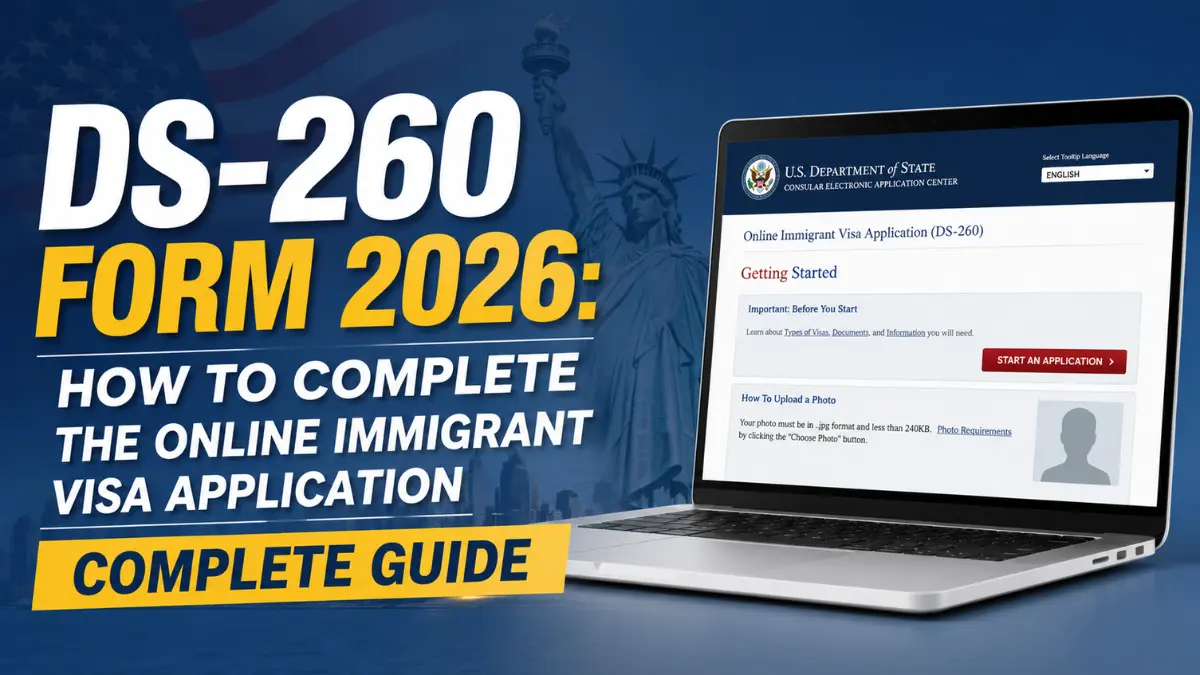
If you are applying for a U.S. green card from outside the United States, there is one form that sits at the center of the entire consular processing journey: the DS-260 online immigrant visa application. Officially titled the Immigrant Visa and Alien Registration Application, Form DS-260 is the electronic application that the U.S. Department of State uses to evaluate your eligibility for an immigrant visa before your interview at a U.S. embassy or consulate abroad.
In 2026, the DS-260 has become more important than ever. A May 2026 USCIS policy memo restricted adjustment of status (Form I-485) to “extraordinary circumstances,” making consular processing through DS-260 the default path to a green card for most applicants who are outside the United States — and for many inside the U.S. as well.
This complete guide explains everything you need to know about how to fill out ds-260 form 2026: who needs it, how the National Visa Center process works, how to access CEAC, current fees, required documents, a step-by-step walkthrough, processing times, and the mistakes that most commonly delay green card approvals.
Also on applicationformportal.us: Form I-485 — How to Apply for a U.S. Green Card from Inside the U.S., Form I-130 — Petition for Alien Relative (the family-based petition that comes before DS-260), and Form I-864 — Affidavit of Support (required alongside DS-260 for family-based cases).
What Is Form DS-260?
📥 Access the DS-260 Online at ceac.state.gov →
Form DS-260, officially the Online Application for Immigrant Visa and Alien Registration, is the U.S. Department of State’s electronic form for applying for a U.S. immigrant visa (green card) through a U.S. embassy or consulate abroad. It is submitted online through the Consular Electronic Application Center (CEAC) and reviewed by the National Visa Center (NVC) before being forwarded to the consulate that handles your interview.
Unlike USCIS forms, DS-260 is entirely a State Department form — USCIS approves your underlying petition (such as Form I-130 or Form I-140), then transfers the case to NVC. From that point on, the State Department runs the process. Consular officers use your DS-260 responses — combined with your civil documents and in-person interview — to determine whether to issue your immigrant visa. If approved, you receive an immigrant visa stamp in your passport, travel to the United States, and become a lawful permanent resident upon entry. USCIS then mails your physical green card within the following weeks.
Important: submitting Form DS-260 does not formally complete a visa application. The visa application is not formally made until you appear before a U.S. consular officer at your interview.
2026 Policy Update: Why DS-260 Matters More Than Ever
In May 2026, USCIS issued Policy Memorandum PM-602-0199 significantly restricting adjustment of status (Form I-485) to “extraordinary circumstances” only. This means that many applicants who previously had the option of adjusting status inside the United States must now pursue consular processing through Form DS-260 as their primary path to a green card. If you are currently in the United States on a nonimmigrant visa and your situation does not qualify as extraordinary circumstances, you may need to complete your green card process through the DS-260 at a U.S. consulate abroad. Always consult an immigration attorney to determine which path applies to your specific case under the current policy.
DS-260 vs I-485: What Is the Difference?
Understanding the ds-260 vs i-485 difference is essential before you begin. Both forms lead to a U.S. green card, but they are for entirely different situations:
| Feature | DS-260 | Form I-485 |
|---|---|---|
| Who uses it | Applicants outside the United States | Applicants already inside the United States |
| Process | Consular processing (State Department) | Adjustment of status (USCIS) |
| Where filed | Online via CEAC — reviewed by NVC | Filed with USCIS directly |
| Interview location | U.S. embassy or consulate abroad | Local USCIS field office (if required) |
| Result | Immigrant visa stamp — green card mailed after entry | Green card mailed directly to U.S. address |
| Filing fee (2026) | $325 per applicant (plus $120 Affidavit of Support fee) | $1,440 (primary applicant) |
| 2026 status | Default path for most applicants | Restricted to extraordinary circumstances |
Who Needs to File Form DS-260?
You need to file Form DS-260 if you are applying for a U.S. immigrant visa (green card) through a U.S. embassy or consulate abroad. This covers all of the following immigrant visa categories:
- Family-based immigrant visas — spouses, children, parents, and siblings of U.S. citizens; spouses and children of lawful permanent residents (F-2A, F-2B categories).
- Employment-based immigrant visas — EB-1, EB-2, EB-3, EB-4, and EB-5 categories after the underlying I-140 or I-526 petition has been approved.
- Diversity Visa (DV) lottery winners — selected applicants from the annual DV lottery program must complete DS-260 as part of their immigrant visa process.
- Special immigrant categories — including religious workers, certain international broadcasters, and others.
Every individual in your family who is immigrating must submit their own DS-260, including children of any age. Parents complete the form on behalf of minor children. There is no paper version of DS-260 — it is completed and submitted exclusively online through CEAC.
Where DS-260 Fits: The Full Consular Processing Timeline
Understanding ds-260 NVC consular processing requires knowing where the form sits in the broader immigrant visa journey. Here is the full sequence:
- Petition filed and approved by USCIS — For family-based cases: Form I-130. For employment-based: Form I-140. For EB-5 investors: Form I-526. USCIS approves the petition and transfers the case to NVC.
- NVC Welcome Letter — The National Visa Center sends a welcome letter (by email or mail) containing your case number and invoice ID. This is your official signal to begin the DS-260 process.
- File DS-261 — Before submitting DS-260, you must complete the simpler Form DS-261 (Choice of Address and Agent) in CEAC, designating how the State Department will communicate with you. Processing takes up to three weeks.
- Pay NVC fees — Pay the immigrant visa application fee ($325 per applicant) and, for family-based cases, the Affidavit of Support fee ($120). Fees are paid online through CEAC. DS-260 cannot be accessed until fees are marked as “PAID” in the system.
- Complete and submit DS-260 — Complete your DS-260 online in CEAC. Each family member completes their own.
- Upload civil documents — Upload supporting civil documents through CEAC for NVC review.
- NVC review and case completion — NVC reviews your DS-260 and documents. If everything is in order, NVC “completes” your case and forwards it to the consulate.
- Visa interview scheduled — The consulate schedules your immigrant visa interview.
- Medical examination — Complete an immigration medical examination (Form I-693 equivalent, performed by a designated panel physician) before your interview.
- Consular interview and visa issuance — Attend your interview. If approved, receive your immigrant visa stamp. Travel to the U.S. and become a lawful permanent resident upon entry.
DS-260 Filing Fee in 2026
The ds-260 filing fee 2026 is $325 per applicant for the immigrant visa application processing fee. This fee is paid through CEAC before you can begin completing DS-260. In addition to the application fee, family-based cases require a separate $120 Affidavit of Support processing fee. Each family member applying for an immigrant visa pays the $325 fee separately — including children.
| Fee Type | Amount (2026) | Who Pays |
|---|---|---|
| IV Application Processing Fee (DS-260) | $325 per applicant | Each applicant including children |
| Affidavit of Support Fee | $120 per case | Family-based cases only |
| Medical Examination | Varies by country/physician | Each applicant |
| Police Certificate fees | Varies by country | Each adult applicant |
All fees paid to NVC are non-refundable regardless of whether your immigrant visa is ultimately approved or denied. Always verify current fees on the State Department’s official fee schedule at travel.state.gov before paying, as fees are subject to change.
How to Access DS-260 on CEAC
Knowing how to access the ds-260 CEAC case number invoice ID system correctly is the first step. You will need the case number and invoice ID from your NVC welcome letter before you can log in. Here is how to access and begin your DS-260:
- Go to ceac.state.gov and select the Immigrant Visa section.
- Click “Access My Application.”
- Enter your NVC Case Number and Invoice ID from your NVC welcome letter. These are two different numbers — do not confuse them.
- Once logged in, you will see the IV Application Summary page showing each family member’s application status (Not Started, Incomplete, or Submitted).
- After your fees are marked “PAID,” click “START NOW” under IV Application to begin DS-260 for each applicant.
- Save your progress frequently using the on-screen Save button. The session times out after 20 minutes of inactivity.
DS-260 Required Documents Checklist
The ds-260 required documents checklist covers the supporting documents you must gather before and after completing the form. Having these ready before you start the DS-260 will make the process significantly faster and reduce errors.
Before You Start DS-260
- Your NVC Case Number and Invoice ID (from NVC welcome letter)
- Valid passport (must be valid for at least six months beyond your intended U.S. entry date)
- All addresses where you have lived since age 16
- Employment history for the past five years
- Education history (schools attended, dates, degrees)
- Family member information (parents’ names, spouse’s details, children’s details)
- Travel history — all countries visited in the past five years
- Previous U.S. visa information and any prior visa refusals
- Social media handles used in the past five years (including deleted accounts)
Civil Documents to Upload After DS-260 Submission
- Birth certificate (for each applicant)
- Marriage certificate (if applicable)
- Divorce or death certificates (if applicable, for prior marriages)
- Police clearance certificates for every country where you have lived for six months or more since age 16
- Military records (if applicable)
- Court records (if you have any criminal history)
- Form I-864 Affidavit of Support from your U.S. sponsor (family-based cases)
- Proof of relationship to the petitioner (photos, correspondence, joint documents for marriage-based cases)
- Immigration medical examination results (from a designated panel physician)
All documents not in English must be accompanied by a certified English translation. Check the State Department’s Reciprocity and Civil Documents page for your specific country to confirm any country-specific document requirements and whether originals or notarized copies are required.
How to Fill Out DS-260: Step-by-Step Guide
The DS-260 is a comprehensive form covering your personal background, travel history, family situation, employment, education, and security history. All answers must be in English. Here is a section-by-section walkthrough of the key areas:
Step 1: Personal Information
Enter your full name exactly as it appears on your passport — character for character. Include all other names you have ever used (maiden name, previous names, nicknames used on official documents). Enter your date and place of birth, all nationalities you currently hold, and your National Identification Number if your country issues one. If a field does not apply to you, enter “Does Not Apply” or “N/A” — never leave a field blank.
Step 2: Address History
List every address where you have lived since age 16, in reverse chronological order. Include city, state or province, country, and the dates you lived at each address. This information is used for background checks — be thorough and accurate. If you lived in multiple countries, list each address separately.
Step 3: People Information (Family)
Provide full details for your parents, all siblings, your current and any previous spouses, and all children — regardless of whether they are immigrating with you. For each person, include their name, date of birth, country of birth, and whether they are a U.S. citizen or permanent resident. Be complete: omitting family members is a red flag for consular officers.
Step 4: Present Work and Education
Provide your current employer’s complete name and verified address, your job title, and your employment start date. Then list your educational history — schools attended, their locations, and dates of attendance. Finally, provide your employment history for the past five years including all employers, their addresses, your job titles, and dates of employment.
Step 5: Previous U.S. Travel and Immigration History
List all previous visits to the United States with arrival and departure dates. Disclose any prior U.S. visa applications (including those that were approved, denied, or withdrawn), any prior periods of unlawful presence, any prior removal or deportation orders, and any prior immigration violations. USCIS and CBP maintain records of all U.S. entries — any inconsistency between your DS-260 and government records will be identified at your interview.
Step 6: Social Media
List all social media usernames and handles you have used in the past five years across the platforms listed in the form. Include accounts that have been deleted or deactivated — omitting them can be treated as misrepresentation. Consular officers cross-reference social media activity against your DS-260 answers and supporting documents.
Step 7: Security and Background Questions
This is the most legally significant section of the DS-260. It contains groups of yes/no questions covering communicable diseases, drug trafficking, criminal history, terrorism, persecution of others, and prior immigration violations. Read every question carefully — some are double negatives. Answer truthfully. If you answer “Yes” to any question, you will be prompted to provide a detailed explanation. Prior convictions, even for minor offenses, must generally be disclosed. An immigration attorney can advise you on whether a past conviction makes you inadmissible and whether a waiver may be available.
Step 8: Review and Submit
Before clicking “Sign and Submit,” review every answer one final time. Once you click Submit, you cannot access or edit your DS-260 again without NVC assistance (for standard immigrant visas) or KCC assistance (for Diversity Visa cases). Print your confirmation page immediately after submission — you are required to bring it to your consular interview.
DS-260 Processing Time in 2026
The ds-260 processing time 2026 has two distinct phases: NVC review after you submit, and consulate scheduling after NVC completes your case.
| Stage | Estimated Time (2026) |
|---|---|
| NVC review after DS-260 submission | 2–4 months (standard); longer for complex cases or missing documents |
| Consulate interview scheduling after NVC completion | Varies by consulate — 1 week to 12+ months |
| Visa issuance after approved interview | Typically a few business days (passport returned with immigrant visa stamp) |
| Green card mailed after U.S. entry | 4–6 weeks after entry |
NVC review times depend on how complete and accurate your DS-260 and supporting documents are. Missing documents, inconsistencies, or requests for additional evidence (RFEs) can add weeks or months to the NVC review phase. High-demand consulates such as those in Mexico City, Mumbai, Manila, and Seoul have significantly longer wait times for interview scheduling than lower-volume posts.
DS-260 for Diversity Visa Lottery Winners
If you were selected in the Diversity Visa (DV) lottery, the DS-260 is your immigrant visa application and completing it on time is critical. Ds-260 diversity visa lottery green card applicants must be especially aware of the annual DV program deadline — all DV cases must be completed, including the immigrant visa interview, by September 30 of the fiscal year in which you were selected. Cases not completed by this deadline are cancelled with no exception, regardless of how far along the process is. Start your DS-260 as early as possible after receiving your selection notification and KCC instructions.
What Happens at the DS-260 Immigrant Visa Interview
The ds-260 immigrant visa interview consulate is the final step before you receive your green card. Here is what to expect:
- Bring your printed DS-260 confirmation page, your passport, your appointment letter, and all original civil documents (birth certificate, marriage certificate, police clearances, medical exam results).
- The consular officer will ask questions about your background, your relationship to your petitioner (for family-based cases), your employment and travel history, and any answers on your DS-260 that require clarification.
- Most decisions are made the same day. If approved, you will be told to expect your visa-stamped passport back within a few business days via courier.
- If the officer issues a 221(g) refusal (administrative processing), your case is placed in additional review. This is not a final denial but requires additional time — sometimes days, sometimes months.
- If your visa is approved, travel to the United States within the validity period of your immigrant visa (typically six months from the date of issue). You become a lawful permanent resident upon admission at the U.S. port of entry.
Common DS-260 Mistakes That Cause Delays
- Incomplete address history. Every address since age 16 must be listed. Leaving gaps in your address history is one of the most common reasons NVC sends cases back for correction.
- Missing family members. All family members must be listed in the People section regardless of whether they are immigrating — including children from prior relationships.
- Not disclosing prior visa refusals. Any prior U.S. or foreign visa refusal must be disclosed. Omitting a refusal is misrepresentation under INA section 212(a)(6)(C)(i) and can result in a permanent bar from the United States.
- Name discrepancies. Your name on DS-260 must match your passport exactly. Even slight differences trigger delays at NVC review.
- Leaving fields blank. Every question must be answered. Use “N/A” or “Does Not Apply” for inapplicable fields. Blank fields cause NVC to return your application.
- Inconsistencies with supporting documents. Your DS-260 answers will be compared against your civil documents, police certificates, and employment records. Any discrepancy requires explanation and causes delays.
- Missing social media accounts. All social media accounts used in the past five years, including deleted ones, must be disclosed.
- Submitting documents in foreign languages without translations. All documents not in English must include a certified English translation.
- Not printing the confirmation page. You are required to bring the DS-260 confirmation page to your consular interview. Print it immediately after submission.
Other Application Forms You May Need
- Form I-130 — Petition for Alien Relative: The family-based immigrant petition filed by your U.S. citizen or permanent resident sponsor that must be approved by USCIS before your case reaches NVC and DS-260.
- Form I-864 — Affidavit of Support: Required for virtually all family-based immigrant visa cases. Your U.S. sponsor must demonstrate they can financially support you at 125% of the federal poverty level.
- Form I-485 — Application to Register Permanent Residence: The adjustment of status alternative to DS-260 for applicants already inside the United States, now restricted to extraordinary circumstances under the May 2026 USCIS policy memo.
- Form I-765 — Employment Authorization Document: After you enter the U.S. on your immigrant visa and before your green card arrives, some applicants may need interim work authorization documentation.
- Form I-131 — Advance Parole: If you need to travel internationally while a related U.S. immigration case is pending, you may need this form.
Frequently Asked Questions About Form DS-260
Can I edit my DS-260 after submitting?
No. Once submitted, DS-260 is locked and cannot be edited by the applicant. If you need to make a correction, contact NVC (for family-based and employment-based cases) or the Kentucky Consular Center (for DV lottery cases) to request that the application be unlocked. At your interview, inform the consular officer of any information that has changed since submission.
What is the difference between DS-260 and DS-261?
DS-261 (Choice of Address and Agent) is a simple form completed in CEAC before DS-260. It tells the State Department how to communicate with you and designates your authorized representative (if any). It must be processed before you can pay NVC fees and begin DS-260. Processing DS-261 typically takes up to three weeks.
Do children need their own DS-260?
Yes. Every family member immigrating, including infants and young children, must complete their own DS-260. Parents complete the form on behalf of minor children. Each applicant also pays the $325 IV application fee separately.
When can I submit DS-260?
You can submit DS-260 after you have received your NVC welcome letter, filed DS-261, and paid the required NVC fees. For family-based cases involving visa number backlogs (preference categories), you may need to wait until a visa number is available in the monthly State Department Visa Bulletin before NVC will schedule your interview, but you can generally submit DS-260 as soon as fees are paid.
How long is the DS-260 valid?
Once submitted, DS-260 remains valid throughout your consular processing. However, if significant time passes between submission and your interview (which can happen due to visa number backlogs or consulate scheduling delays), you may be asked to update information that has changed — such as your address, employment, or marital status. Contact NVC to request an update if your circumstances change materially after submission.
What happens after my DS-260 is reviewed by NVC?
After NVC reviews and accepts your DS-260 and supporting documents, it marks your case as “documentarily complete” and forwards it to the U.S. embassy or consulate responsible for your interview. The consulate then contacts you (or your agent listed on DS-261) to schedule your visa interview. Once your interview is scheduled, you complete your immigration medical examination with a designated panel physician before the interview date.
Official Resources
- 🔗 Complete DS-260 Online — CEAC Immigrant Visa Portal
- 🔗 State Department: Complete DS-260 Online Application
- 🔗 DS-260 Frequently Asked Questions — State Department
- 🔗 Immigrant Visa Fee Schedule — State Department
- 🔗 U.S. Visa Appointment Wait Times by Country
Disclaimer: This guide is for informational purposes only and does not constitute legal advice. Immigration laws, fees, and processing times change frequently — the May 2026 USCIS policy changes affecting adjustment of status are particularly significant and subject to ongoing legal challenges. Always verify current requirements at travel.state.gov and uscis.gov, and consult a licensed immigration attorney for advice specific to your situation.