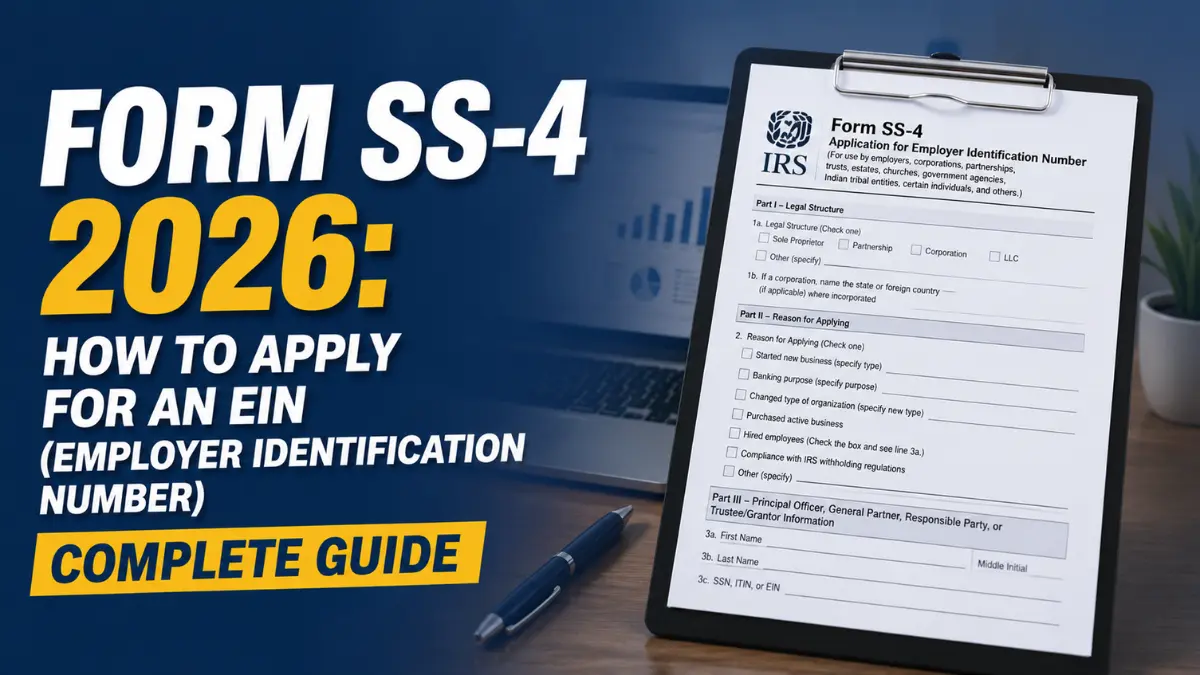
Every new business, LLC, corporation, nonprofit, estate, and trust in the United States needs a federal tax identification number — and the way you get one is by filing Form SS-4 employer identification number application with the IRS. Whether you are launching a business, opening a bank account, hiring your first employee, or settling an estate, an EIN is one of the first official steps you will take, and the good news is that the IRS provides it completely free.
This complete guide covers everything you need to know about the IRS EIN application 2026 process: what an EIN is, who needs one, how to fill out Form SS-4 line by line, all three ways to apply, and exactly how long each method takes. By the end, you will know exactly how to get your EIN as fast as possible — sometimes in under five minutes.
Also on applicationformportal.us: Form 1040 2026 — once your business is up and running, your EIN will appear on your federal tax return filings. And Form W-9 — clients and vendors will ask for your EIN on a W-9 when paying you for services.
What Is Form SS-4?
📥 Download Form SS-4 from the Official IRS Website →
Form SS-4, officially titled Application for Employer Identification Number, is the IRS form used by businesses, organizations, estates, and trusts to request a unique nine-digit Employer Identification Number. Think of an EIN as your business’s equivalent of a Social Security Number — it is the federal tax ID the IRS uses to identify your entity for all tax filing, reporting, and compliance purposes.
The current edition of Form SS-4 was revised in December 2025 and includes updated fax numbers, mailing addresses, and reinstated guidance on the Form 944 annual filing election for small employers. The form itself is a single page with 18 fields — straightforward when you know what each line is asking for.
What Is an EIN and Why Does Your Business Need One?
What is an EIN number for a business? An Employer Identification Number is a unique nine-digit number formatted as XX-XXXXXXX (for example, 12-3456789) that the IRS assigns to business entities for tax filing and reporting purposes. Despite the name, you do not need to have employees to need an EIN — many sole proprietors, single-member LLCs, and nonprofits with no employees are still required to have one.
Here is why your business needs an EIN:
- Open a business bank account — virtually every bank in the U.S. requires an EIN to open a business checking or savings account.
- Hire employees — you cannot process payroll, withhold taxes, or file employment tax returns without an EIN.
- File federal tax returns — partnerships, corporations, and most LLCs must use an EIN on all federal tax filings.
- Apply for business licenses and permits — many local and state agencies require your EIN on license applications.
- Apply for business credit and loans — lenders use your EIN instead of your personal SSN to evaluate business credit applications.
- Set up a retirement plan — self-employed pension (SEP) IRAs, SIMPLE IRAs, and Keogh plans all require an EIN.
- Protect your personal SSN — using an EIN on vendor and client forms keeps your Social Security Number private.
Who Needs to File Form SS-4?
You must apply for an EIN using Form SS-4 if any of the following apply to your situation:
- You are starting a new business as a corporation, partnership, or multi-member LLC.
- You are a sole proprietor or single-member LLC and plan to hire employees.
- You are a sole proprietor or single-member LLC and need to file excise, alcohol, tobacco, or firearms tax returns.
- You have established a self-employed retirement plan (SEP IRA, Keogh, SIMPLE IRA).
- You are representing an estate of a deceased person and need an EIN for the estate.
- You are a trustee setting up a trust that requires a separate tax ID.
- You are a nonprofit organization applying for tax-exempt status or filing annual returns.
- You have changed your business structure (for example, converted from a sole proprietorship to an LLC or corporation).
- You have purchased an existing business (you generally need a new EIN, not the previous owner’s).
One common question: do I need an EIN for my LLC? The answer is almost always yes. Even a single-member LLC with no employees should obtain an EIN to open a business bank account, keep business and personal finances separate, and protect the owner’s SSN from being shared with clients and vendors. Multi-member LLCs are always required to have one.
You do not need a new EIN if you have only changed your business name, changed your business address, or simply changed the way your LLC is taxed via Form 8832 (without changing its fundamental structure). Your existing EIN remains valid in those situations.
How to Fill Out Form SS-4: Line-by-Line Instructions
Knowing the ss-4 form instructions line by line is the key to getting your EIN without delays. Here is a complete walkthrough of every field on the December 2025 edition of Form SS-4:
Lines 1–2: Business Name
Line 1 asks for the legal name of the entity. For an LLC or corporation, enter the exact name as it appears on your Articles of Organization or Articles of Incorporation — including any suffixes like “LLC,” “Inc.,” or “Corp.” For a sole proprietor, enter your full personal legal name, not your business name. For a trust, enter the name as it appears on the trust instrument. For an estate, enter the decedent’s name followed by “Estate.”
Line 2 is for your trade name or DBA (doing business as) name, if different from your legal name. Leave blank if your trade name is the same as your legal name.
Line 3: Executor or Trustee Name
Complete Line 3 only if you are applying for an estate (enter the executor’s name) or a trust (enter the trustee’s name). Leave blank for all other entity types.
Lines 4a–5b: Mailing and Street Address
Lines 4a and 4b capture your mailing address — this is where the IRS will send all correspondence including your EIN confirmation letter. Lines 5a and 5b are for your physical street address if it differs from your mailing address. International applicants can use a foreign address on these lines.
Line 6: County and State
Enter the county and state where your principal business is located. This helps the IRS assign your account to the correct service center.
Lines 7a–7b: Responsible Party
The responsible party is the individual who controls, manages, and directs the entity and its funds. For most small businesses, this is the owner. Line 7a asks for the responsible party’s name; Line 7b asks for their Social Security Number (SSN), Individual Taxpayer Identification Number (ITIN), or existing EIN. This is the only place on Form SS-4 where a personal SSN is required. Non-U.S. residents without an SSN or ITIN cannot use the online system and must apply by fax or phone instead.
Lines 8a–8b: LLC Information
Line 8a asks whether the entity is a Limited Liability Company (LLC). If yes, Line 8b asks for the number of LLC members. A single-member LLC enters “1.” A multi-member LLC enters the total member count. This information determines your default tax classification: single-member LLCs are treated as disregarded entities by default; multi-member LLCs are treated as partnerships.
Line 9a: Type of Entity
Check the one box that best describes your entity type: Sole Proprietor, Partnership, Corporation, Personal Service Corporation, Church, Other Nonprofit, Trust, Estate, Plan Administrator, or Limited Liability Company. Only check one box. Note that checking a box here is not a tax classification election for your LLC — that requires a separate Form 8832 or Form 2553.
A common point of confusion: if you are a single-member LLC and have not elected S-corp or C-corp taxation, check “Limited Liability Company” and enter “1” for the number of members. Do not check “Sole Proprietor” for an LLC, even if you are the only owner.
Line 9b: Reason for Applying
Select the reason you are applying for an EIN. The most common options are: Started a new business, Hired employees, Banking purpose, Created a trust, Created a pension plan, Purchased a going business, Changed type of organization, or Other. Choose the option that most accurately describes your situation.
Line 10: Date Business Started or Acquired
Enter the date your business was legally formed, started operations, or was acquired. Use MM/DD/YYYY format. For new businesses, this is typically the date on your formation documents (Articles of Organization or Articles of Incorporation).
Line 11: Closing Month of Accounting Year
For most businesses that use a calendar year for accounting, enter December. If your business operates on a fiscal year, enter the last month of your fiscal year.
Lines 12–13: Expected Employees
Line 12 asks for the highest number of employees you expect in the next 12 months, broken down by Agricultural, Household, and Other (general) employees. If you expect no employees at all, enter zero and skip Line 13. Line 13 asks for the first date wages were or will be paid.
Line 14: Annual vs. Quarterly Employment Tax Filing
Line 14 asks whether you want to file Form 944 (annual employment tax return) instead of Form 941 (quarterly). You are eligible to file Form 944 annually if you expect your total employment tax liability to be $1,000 or less per year — generally meaning you pay $5,000 or less in total wages subject to Social Security, Medicare, and federal income tax withholding. This election was reinstated in the December 2025 revision of Form SS-4.
Lines 15–16: Principal Business Activity
Check the box that best describes your principal business activity (such as Construction, Real Estate, Manufacturing, Retail, Health Care, Finance, or Other). Then in Line 16, briefly describe your specific products or services (for example, “web design services” or “residential plumbing contractor”).
Third-Party Designee and Signature
If you want to authorize another person (an accountant, attorney, or agent) to receive your EIN and answer IRS questions about this form, complete the Third-Party Designee section with their name, phone number, and fax number. The responsible party listed on Lines 7a–7b must sign and date the form. For online applications, the electronic submission process replaces the physical signature requirement.
How to Apply for an EIN: 3 Methods in 2026
There are three ways to apply for an EIN using the information from Form SS-4. Here is how each method works and how long it takes:
Method 1: Apply Online (Fastest — Instant)
The best way to how to apply for EIN online IRS is through the free EIN Assistant on irs.gov. The online system walks you through the same questions as Form SS-4 and issues your EIN immediately upon completion — typically in under five minutes. This is the recommended method for virtually every domestic applicant.
Important rules for online EIN applications: your principal business or legal residence must be in the United States or its territories; the responsible party must have a valid SSN or ITIN; the application must be completed in a single session (the system times out after 15 minutes of inactivity); and you can only apply for one EIN per day per entity. You must print or save your EIN confirmation letter immediately — it will not be available to download again later.
The online system is available Monday through Friday, 7:00 a.m. to 10:00 p.m. Eastern Time.
Method 2: Apply by Fax (4–7 Business Days)
If you cannot use the online system, you can complete Form SS-4 and fax it to the IRS. According to the IRS’s own processing status page updated June 2026, faxed Form SS-4 applications are processed within 7 business days of receipt. Include a return fax number on your form so the IRS can fax your EIN back to you rather than mailing it.
The ss-4 fax number IRS 2026 for U.S. businesses (in the 50 states or the District of Columbia) is 855-641-6935. For international applicants faxing from outside the U.S., the fax number is 304-707-9471. Always verify fax numbers on the current IRS instructions page before sending, as they are subject to change.
Method 3: Apply by Mail (4+ Weeks)
Mailing Form SS-4 is the slowest method and should only be used when the other two options are not available. According to the IRS processing status page, paper SS-4 applications are processed within 30 days of receipt. As of 2026, IRS paper processing backlogs may extend this timeline further.
Mail your completed, signed Form SS-4 to: Internal Revenue Service, Attn: EIN Operation, Cincinnati, OH 45999. For international applicants mailing from outside the U.S., mail to: Internal Revenue Service, Attn: EIN International Operation, Cincinnati, OH 45999.
Method 4: Apply by Phone (International Applicants Only)
International applicants whose principal business is outside the United States and who do not have a U.S. SSN or ITIN can apply for an EIN by telephone. Call the IRS at 267-941-1099, Monday through Friday, 6:00 a.m. to 11:00 p.m. Eastern Time. Have a completed Form SS-4 in hand before calling — the IRS representative will ask you each line’s information and issue your EIN during the call.
| Application Method | Processing Time (2026) | Who Can Use |
|---|---|---|
| Online (irs.gov) | Immediate (minutes) | U.S. applicants with SSN/ITIN |
| Fax (Form SS-4) | 7 business days | U.S. and international applicants |
| Mail (Form SS-4) | 30+ days | U.S. and international applicants |
| Phone | Immediate (during call) | International applicants only |
EIN Application Processing Time in 2026
The EIN application processing time 2026 depends entirely on the method you use. Online applications remain the fastest at immediate issuance, while the IRS has confirmed that faxed SS-4 forms are processed within 7 business days and paper forms within 30 days. Due to ongoing IRS staffing reductions in 2026, paper processing times may run longer than the standard 30-day window.
If you need an EIN before your tax return or deposit is due and have not yet received it, the IRS instructs you to write “Applied For” and the application date in the EIN field on your return. Do not write your SSN in the EIN field under any circumstances.
How to Get Your EIN for Free
You should always know how to get EIN number free IRS — because the IRS provides EINs at absolutely no charge through its official website at irs.gov. Dozens of third-party websites charge $50 to $300 to apply for an EIN on your behalf. These services do nothing more than complete the same Form SS-4 you could fill out yourself in minutes. The IRS explicitly warns: “Beware of websites that charge for an EIN. You never have to pay a fee for an EIN.” Avoid these services. Always apply directly at irs.gov or submit Form SS-4 directly to the IRS by fax or mail.
The EIN Confirmation Letter: IRS CP 575
When the IRS issues your EIN, it sends an official confirmation letter called the EIN confirmation letter IRS CP 575. For online applicants, this confirmation is displayed on screen immediately after your EIN is issued — print or save it at that moment because the IRS does not allow you to retrieve it online later. For fax applicants, USCIS faxes your EIN back, and the CP 575 letter follows by mail. For mail applicants, the CP 575 arrives by mail with your EIN.
If you lose your CP 575 letter, the IRS will not reissue it. However, you can request a replacement document called a 147C letter by calling the IRS Business & Specialty Tax Line at 800-829-4933. The 147C letter serves the same purpose as the CP 575 and is accepted by banks, lenders, and government agencies as proof of your EIN. You can also look up your EIN by checking prior tax returns, your bank account setup documents, or any W-2 or 1099 forms previously filed under your EIN.
Common Mistakes When Filing Form SS-4
- Name mismatch on Line 1. The legal name must match exactly what is on your Articles of Organization, Articles of Incorporation, or trust instrument. Even minor discrepancies can trigger IRS follow-up and delay your EIN.
- Wrong entity type on Line 9a. Selecting the wrong entity type (for example, checking “Sole Proprietor” for an LLC) can cause tax classification problems down the line. Single-member LLCs should select “Limited Liability Company” and enter “1” on Line 8b.
- Applying for a new EIN when you don’t need one. A business name change, address change, or LLC tax election change does not require a new EIN. Applying unnecessarily creates a duplicate account problem with the IRS.
- Using the wrong fax number. The IRS fax number for Form SS-4 changed in the December 2025 revision. Always verify the current fax number in the latest IRS instructions before sending.
- Leaving Line 7b blank for non-residents. Non-U.S. residents without an SSN or ITIN cannot apply online and must use the fax or phone method. They may leave Line 7b blank if they truly have no U.S. taxpayer identification number.
- Not completing the session in one sitting (online). The IRS online EIN system times out after 15 minutes of inactivity and does not save progress. Have all your information ready before you start the online application.
- Paying a third party for a free service. The IRS provides EINs completely free. Never pay a third-party website to obtain your EIN.
Keeping Your EIN Information Current
Once you receive your EIN, it is permanent — the IRS does not cancel EINs, though it can deactivate them if your business closes. If your responsible party, business address, or business location changes after you receive your EIN, you are required to notify the IRS within 60 days using Form 8822-B (Change of Address or Responsible Party — Business). Failing to update your responsible party information within 60 days is a violation of IRS rules introduced in recent years to prevent tax fraud and identity theft involving business tax accounts.
Other Application Forms You May Need
Obtaining your EIN is usually the first in a series of IRS and government filings you will make as a business owner. Here are related forms you may need next:
- Form W-9 — Request for Taxpayer Identification Number and Certification: Clients and businesses that pay you for services will ask you to complete a W-9 with your EIN so they can file a 1099 with the IRS.
- Form W-4 — Employee’s Withholding Certificate: Once you hire employees, each one must complete a W-4 so you can withhold the correct amount of federal income tax from their pay.
- Form 1040 — U.S. Individual Income Tax Return: Sole proprietors and single-member LLC owners report business income on Schedule C attached to their personal Form 1040.
- FAFSA 2026–27: If you or your dependents are applying for federal student aid, your business EIN and tax information will be required on the FAFSA application.
Frequently Asked Questions About Form SS-4 and EINs
Is an EIN the same as a Tax ID number?
Yes. An EIN is also commonly called a Federal Tax Identification Number, Federal Employer Identification Number (FEIN), or simply a Tax ID number. They all refer to the same nine-digit number the IRS assigns to your business entity through Form SS-4.
Can a sole proprietor use their SSN instead of an EIN?
A sole proprietor with no employees and no other EIN requirement can use their personal SSN as their tax ID for business purposes. However, getting an EIN is still strongly recommended even for sole proprietors because it protects your SSN from being shared with clients and vendors, and it is required to open a dedicated business bank account at most financial institutions.
Can I apply for more than one EIN per day?
No. The IRS limits EIN applications to one per responsible party per day, regardless of the application method used (online, fax, or mail). If you need EINs for multiple entities with the same responsible party, you must apply on separate days.
Do I need a new EIN if I change my business name?
No. A business name change does not require a new EIN. Simply notify the IRS of the name change using Form 8822-B (for a business address or responsible party change) or by checking the name change box on your next annual tax return. Your existing EIN remains valid.
What if I lose my EIN confirmation letter?
Call the IRS Business & Specialty Tax Line at 800-829-4933 to request a replacement 147C letter, which serves the same purpose as the original CP 575 confirmation letter. You can also find your EIN on prior tax returns, business bank account documents, or any 1099 or W-2 forms filed under your EIN.
Can a non-U.S. citizen or foreign business apply for an EIN?
Yes. Foreign businesses and non-U.S. citizens can apply for an EIN using Form SS-4. Because the online system requires a U.S. SSN or ITIN, international applicants must apply by fax (to 304-707-9471) or by phone (267-941-1099). Non-residents may leave Line 7b blank if they do not have a U.S. taxpayer identification number.
How do I update my EIN information after receiving it?
Use Form 8822-B to notify the IRS of any changes to your business address, location, or responsible party. Changes to the responsible party must be reported within 60 days. Business name changes can be reported on your next annual tax return or by sending a signed letter to the IRS with your EIN and the corrected name.
Official Resources
- 📥 Download Form SS-4 (PDF) — Official IRS Form
- 📥 Download Form SS-4 Instructions (PDF)
- 🔗 Apply for an EIN Online — IRS EIN Assistant
- 🔗 IRS Form SS-4 Official Page
- 🔗 IRS Processing Status for Tax Forms (Updated Monthly)
Disclaimer: This guide is for informational purposes only and does not constitute legal or tax advice. IRS rules, fees, and processing times change frequently. Always verify current requirements on the official IRS website at irs.gov and consult a licensed tax professional for advice specific to your situation.