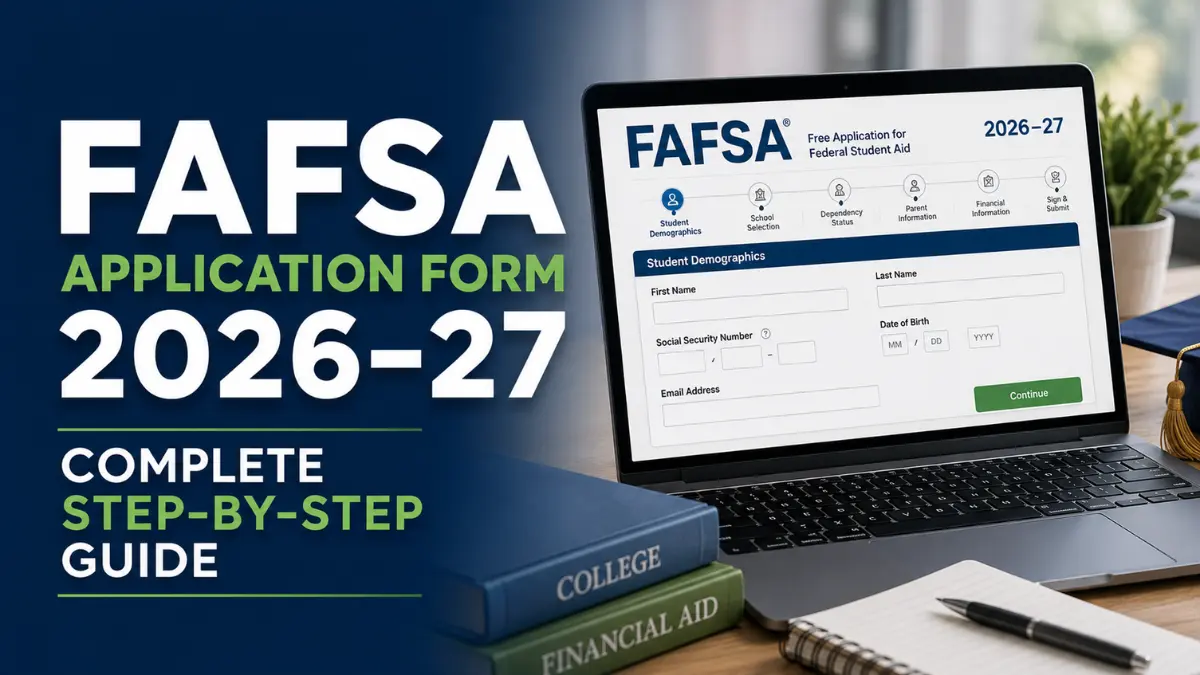
Every year, millions of students and families across the United States sit down to fill out one of the most important financial documents they will ever complete. The FAFSA application form 2026 — the Free Application for Federal Student Aid — is the gateway to federal grants, work-study funds, and student loans that make college, trade school, and career training affordable for millions of Americans. And right now is the best time to complete it: the 2026–27 FAFSA opened ahead of schedule in late 2025, and every week you wait is a week closer to state and school deadlines that could cost you thousands of dollars in aid you would otherwise have received.
This guide explains what is FAFSA, who qualifies, and exactly how to apply for FAFSA step by step. You will find the complete FAFSA documents needed checklist, the truth about the FAFSA income limit 2026 (spoiler: there is no hard cutoff), how the Student Aid Index determines what you receive, what the maximum FAFSA Pell Grant is worth this year, the FAFSA deadline 2026 for both federal and state programs, and a clear explanation of what your FSA ID is and why both you and your parent need one. We also cover FAFSA eligibility requirements in plain English so you know before you start whether you qualify — and how to maximize the aid you receive.
What Is FAFSA?
FAFSA stands for Free Application for Federal Student Aid. It is a form administered by the U.S. Department of Education that determines how much federal financial assistance a student is eligible to receive for higher education. Schools also use FAFSA data to award their own institutional grants and scholarships. Many states use it to determine eligibility for state-funded aid programs as well.
The FAFSA collects information about the student — and, for dependent students, about their parents — including income, assets, household size, and enrollment status. That information is run through a federal formula to produce a Student Aid Index (SAI), a number that colleges use to calculate how much need-based aid to offer. A lower SAI means more need-based aid. An SAI of zero or below means the student qualifies for the maximum Pell Grant award.
📥 Start Your 2026–27 FAFSA Application at StudentAid.gov →
2026–27 Update — What Changed and What You Need to Know
The 2026–27 FAFSA opened ahead of its usual October 1 schedule, making it available in late September 2025. Several important changes took effect this cycle that affect eligibility, asset reporting, and Pell Grant thresholds.
Small Business and Farm Assets Excluded
Under the One Big Beautiful Bill Act (OBBBA), the 2026–27 FAFSA no longer counts the following as reportable assets: family-owned businesses with 100 or fewer full-time employees, farms on which the family resides, and family-owned commercial fishing businesses. This change significantly reduces the SAI for many rural and small-business families who were previously penalized by high asset valuations.
New Pell Grant SAI Cap
Beginning with the 2026–27 award year, students with a Student Aid Index equal to or greater than $14,790 (twice the maximum Pell Grant amount of $7,395) are ineligible for a Pell Grant. This is a new rule introduced by the OBBBA that did not exist in prior years.
Streamlined Contributor Process
Students can now invite a parent or spouse to complete their contributor section using just an email address — no Social Security Number or date of birth required to send the invite. New StudentAid.gov accounts linked to an SSN are also verified instantly, eliminating the previous 3-day waiting period before the FSA ID could be fully used.
Tax Year Used: 2024 Data
The 2026–27 FAFSA uses 2024 federal tax information, imported automatically via the IRS Direct Data Exchange (DDX). You will be asked to consent to this import when completing the form. If you filed your 2024 taxes, the process is largely automated. If you did not file, you will need to enter income information manually.
FAFSA Eligibility Requirements — Who Can Apply
To qualify for federal student aid through the FAFSA, you must meet all of the following basic requirements:
- Be a U.S. citizen, U.S. national, or an eligible non-citizen (such as a lawful permanent resident)
- Have a valid Social Security Number (with limited exceptions for certain residents of certain U.S. territories)
- Be enrolled or accepted for enrollment in an eligible degree or certificate program at a qualifying school
- Be working toward a first undergraduate degree, or be a graduate student
- Maintain satisfactory academic progress as defined by your school
- Not be in default on any federal student loan and not owe a refund on a federal grant
Is There a FAFSA Income Limit?
No. There is no income threshold that disqualifies you from submitting the FAFSA. Anyone who meets the eligibility requirements above can and should apply, regardless of family income. Higher income reduces the amount of need-based aid you may receive, but students from higher-income families may still qualify for unsubsidized federal loans, work-study, and merit-based institutional scholarships that require FAFSA completion. Never assume your family earns too much — file and let the formula decide.
FAFSA Documents Needed — Complete Checklist
Gather everything below before you start. Having it all ready means you can complete the form in one sitting, which typically takes 30 to 60 minutes.
For the Student
- Social Security Number (or Alien Registration Number if not a U.S. citizen)
- FSA ID username and password (create at StudentAid.gov if you do not already have one)
- 2024 federal tax return (Form 1040) and W-2s — imported automatically via DDX if you consent
- Current balances of bank accounts, savings, and checking
- Records of untaxed income (child support received, veterans benefits, etc.)
- List of schools you want to receive your FAFSA results (up to 20)
For the Parent (if student is dependent)
- Parent’s Social Security Number and FSA ID
- Parent’s 2024 federal tax return and W-2s
- Current balances of parent bank, savings, and investment accounts
- Net worth of investments (real estate other than primary home, stocks, bonds, etc.)
- Records of any untaxed income received in 2024
FAFSA Fee Breakdown — Is It Really Free?
Yes. Completing and submitting the FAFSA is completely free. There is no application fee, no processing fee, and no cost to send your FAFSA results to schools. If any website, office, or individual asks you to pay money to help complete your FAFSA, that is a scam. The only official place to complete the FAFSA is studentaid.gov.
How to Apply for FAFSA — Step-by-Step Instructions
Step 1 — Create Your FSA ID
Your FSA ID is a username and password tied to your Social Security Number that lets you sign the FAFSA electronically and access your federal student aid records. Go to studentaid.gov and create your account. If you are a dependent student, your parent must also create a separate FSA ID using their own Social Security Number. New accounts linked to an SSN are now verified instantly for the 2026–27 cycle.
Step 2 — Gather Your Documents
Refer to the checklist above. Even if you plan to use the IRS Direct Data Exchange to auto-import your tax data, you will still need your SSN, current bank balances, and untaxed income records. Parents of dependent students need the same information for their own section.
Step 3 — Go to fafsa.gov and Start Your Form
Navigate to studentaid.gov and log in with your FSA ID. Select “Start a New Form” and choose the 2026–27 award year. The online form is fully mobile-responsive, so you can complete it from a smartphone, tablet, or computer.
Step 4 — Complete the Student Section
Answer all questions about yourself: personal information, dependency status, enrollment details, and any military or veteran status. The form will ask whether you are a dependent or independent student based on a series of questions about your age, marital status, military status, and other factors.
Step 5 — Invite Your Parent Contributor (if dependent)
If you are a dependent student, you will invite your parent to complete their section. Under the 2026–27 update, you can send the invite using just their email address. Your parent will receive a link, log in with their own FSA ID, and complete their income and asset section independently. Both of you must consent to the IRS Direct Data Exchange to auto-import 2024 tax data.
Step 6 — Enter Financial Information
If you consented to the DDX, your 2024 tax data will be imported automatically from the IRS — reducing errors and saving significant time. Any information not available via DDX (such as current asset balances and untaxed income) must be entered manually. Double-check every figure before proceeding.
Step 7 — Add Your Schools
Enter the Federal School Codes for every college or career school you want to receive your FAFSA data. You can add up to 20 schools. Include every school you are seriously considering, not just your top choice. Adding a school to your FAFSA does not commit you to attending — it simply sends your financial aid information so the school can build your aid package.
Step 8 — Review and Sign
Review every answer carefully before submitting. Both the student and the parent (if applicable) must sign the form electronically using their respective FSA IDs. The form cannot be submitted until all required signatures are collected. Once signed and submitted, you will receive a confirmation page — save or screenshot it as proof.
Step 9 — Review Your FAFSA Submission Summary
Within 1 to 3 days of submission, your FAFSA will be processed and you will be able to view your FAFSA Submission Summary at studentaid.gov. This replaces the old Student Aid Report (SAR). Review it carefully for errors. If any information needs to be corrected, log back in and make changes before your school’s priority deadline.
FAFSA Deadline 2026 — Federal, State, and School Deadlines
There are three sets of deadlines every FAFSA applicant must track. Missing any one of them can cost you significant aid.
| Deadline Type | Date | Notes |
|---|---|---|
| Federal Deadline (2025–26 FAFSA) | June 30, 2026 | Last day to submit for the current award year |
| Federal Deadline (2026–27 FAFSA) | June 30, 2027 | Last day to submit for the upcoming award year |
| State Deadlines | Varies by state (many Feb–Apr) | Often first-come, first-served — apply early |
| School Priority Deadlines | Varies by institution | Missing this can mean less institutional aid |
State deadlines are often the most critical. Many states award grant money on a first-come, first-served basis and funds run out before the federal deadline. Filing in October or November gives you the best chance of receiving the maximum state aid available. Check your state’s specific deadline at studentaid.gov/apply-for-aid/fafsa/fafsa-deadlines.
Pell Grant — How Much Can You Receive in 2026–27?
The Federal Pell Grant is the largest need-based grant the U.S. government offers. Unlike loans, it does not have to be repaid. For the 2026–27 award year, the maximum Pell Grant is $7,395. Your actual award depends on your Student Aid Index, your enrollment status (full-time vs. part-time), and the cost of attendance at your school.
| Student Aid Index (SAI) | Pell Grant Eligibility |
|---|---|
| $0 or below (negative SAI) | Maximum Pell Grant ($7,395) |
| $1 – $6,206 | Partial Pell Grant (amount decreases as SAI rises) |
| $6,207 – $14,789 | Minimum Pell Grant (some eligibility) |
| $14,790 or above | Not eligible for Pell Grant (new 2026–27 rule) |
A family earning $54,200 or less (dependent student) may qualify for an automatic maximum Pell Grant, depending on household size and other factors. Students with a zero or negative SAI receive the full $7,395 automatically. Even if you do not qualify for the Pell Grant, submitting the FAFSA can unlock federal loans, work-study, and institutional aid from your school.
What Happens After You Submit the FAFSA?
Processing (1–3 Days)
Online FAFSA submissions are typically processed within one to three days. Paper submissions take significantly longer — up to three weeks. Once processed, you can view your FAFSA Submission Summary at studentaid.gov. Your FAFSA data is simultaneously transmitted to each school you listed.
Financial Aid Package from Your School
After receiving your FAFSA data, your school’s financial aid office will put together a financial aid award package. This outlines the total aid available to you — broken down by grants, scholarships, work-study, and loans. Timelines vary by school, but most send award letters by early spring for fall enrollment.
Track and Update Your FAFSA
Log in to studentaid.gov at any time to check your FAFSA status, add schools, correct errors, or make updates due to special circumstances like a loss of income. If your family’s financial situation has changed significantly from your 2024 tax data, contact your school’s financial aid office about a professional judgment review.
Official Links — FAFSA Application and Resources
- 💻 Start Your 2026–27 FAFSA at StudentAid.gov →
- 🔐 Create Your FSA ID →
- 📅 FAFSA State and School Deadlines →
- 💰 Federal Pell Grant Information →
- 📞 Federal Student Aid Help Center (1-800-433-3243) →
Other Application Forms You May Need
Depending on your situation, you may also need to complete other official U.S. government application forms. Here are some of the most-searched forms on our site to help you stay prepared:
- 📋 SS-5 Form — How to Apply for a Social Security Card
To create your FSA ID and complete the FAFSA, you need a valid Social Security Number. If you do not have one or need a replacement Social Security card, the SS-5 is the official form filed with the Social Security Administration. - 📋 Food Stamps Application — How to Apply for SNAP Benefits
Many families who qualify for the maximum Pell Grant may also be eligible for SNAP food assistance. If your household income falls below federal poverty guidelines, applying for SNAP can provide additional financial relief while you pursue your education.
Frequently Asked Questions About the FAFSA Application Form
Do I have to reapply for FAFSA every year?
Yes. You must submit a new FAFSA for every academic year you want to receive financial aid. Your income, assets, and family situation may change year to year, and schools need updated information to award aid for each new enrollment period. Many returning students can use the FAFSA renewal feature, which pre-populates some information from the prior year’s form to speed up the process.
What income year does the 2026–27 FAFSA use?
The 2026–27 FAFSA uses 2024 federal income tax data. This information is imported automatically through the IRS Direct Data Exchange when you provide consent during the application. If your financial situation has changed significantly since 2024 — such as a job loss, divorce, or death of a parent — contact your school’s financial aid office about requesting a professional judgment adjustment.
Can I submit the FAFSA if I haven’t been accepted to college yet?
Yes. You do not need to be accepted to a school to submit the FAFSA. You can list up to 20 schools on your application, including schools you have not yet applied to. The earlier you submit, the better your chances of qualifying for first-come, first-served state and institutional aid. If you are later accepted to a school not on your list, you can log back in and add it.
What is the difference between a dependent and an independent student?
A dependent student must include parental income and assets on the FAFSA. An independent student does not. You are automatically considered independent if you are 24 or older, married, a veteran, an active-duty military member, a graduate or professional student, an emancipated minor, or have legal dependents of your own. If you do not meet any of these criteria, you are considered dependent regardless of whether your parents actually support you financially.
What if my parents are divorced?
For the 2026–27 FAFSA, divorced or separated parents must report the income and assets of the parent who provided the most financial support to the student over the past 12 months — not necessarily the parent the student lives with. If financial support was equal, the parent with the higher income provides the FAFSA information. Stepparents of the reporting parent must also report their financial information if they are currently married to that parent.
How long does FAFSA processing take?
Online submissions are typically processed in one to three days. Paper submissions can take up to three weeks. After processing, you can view your FAFSA Submission Summary at studentaid.gov. Your data is simultaneously sent to each school you listed. Schools then use that data to build your financial aid award package, which may take several additional weeks depending on the institution.
Can undocumented students apply for FAFSA?
Undocumented students are generally not eligible for federal student aid through the FAFSA. However, some states allow undocumented or DACA students to apply for state financial aid using a state-specific form rather than the federal FAFSA. Check your state’s higher education agency website for details on what aid is available to you.
What is the maximum Pell Grant for 2026–27?
The maximum Federal Pell Grant for the 2026–27 award year is $7,395. Students with a Student Aid Index of zero or below automatically qualify for the full amount. Under the new OBBBA rule, students with an SAI of $14,790 or higher are no longer eligible for any Pell Grant funding.
Disclaimer
This guide is for informational purposes only. FAFSA rules, income thresholds, Pell Grant amounts, and deadlines are subject to change by the U.S. Department of Education. Always verify current information at studentaid.gov before applying. Contact your school’s financial aid office for guidance specific to your situation.