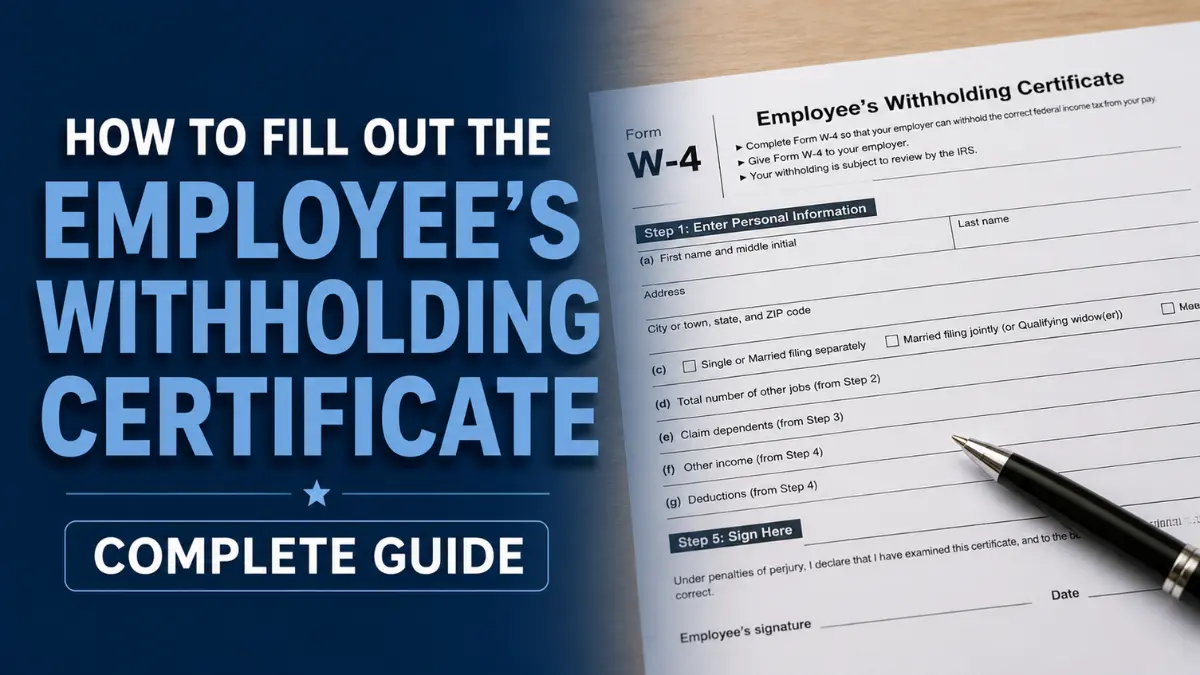
If you started a new job, got married, had a child, or simply want to make sure your paycheck withholding is right for 2026, you need to know about the W-4 form 2026. The Internal Revenue Service (IRS) released an updated version of Form W-4 that is more detailed than ever — expanding from four pages to five — and it includes brand-new deduction lines tied to the landmark One Big Beautiful Bill Act (OBBBA). Whether you are filling one out for the very first time or updating an existing one, this complete guide walks you through every section, every step, and every 2026-specific change you need to know.
The employee’s withholding certificate tells your employer exactly how much federal income tax to subtract from each paycheck. Get it wrong and you could owe a large tax bill in April — or hand the government an interest-free loan by overpaying all year. The good news: once you understand the five-step structure, the IRS W-4 2026 is straightforward to complete. Let’s get into it.
Looking for another IRS form? See our guide on the W-9 form 2026 for independent contractors and freelancers, or our FAFSA 2026–27 guide if you have a college student in the family.
What Is the W-4 Form?
The W-4 form download 2026 is officially titled Employee’s Withholding Certificate and carries IRS OMB No. 1545-0074. Every employee in the United States must submit one to their employer when they start a new job. Your employer uses the information on the form to calculate how much federal income tax to withhold from your wages each pay period.
📥 Download Form W-4 2026 from the Official IRS Website →
Importantly, the W-4 does not go to the IRS — your employer keeps it on file for at least four years. The W-4 also has no effect on Social Security tax or Medicare tax (FICA), which are fixed by federal law. It only controls federal income tax withholding.
W-4 vs. W-2: What Is the Difference?
Employees frequently confuse these two forms. The W-4 is what you fill out to set your withholding; the W-2 is the annual statement your employer sends you in January showing what was actually withheld. The W-4 goes to your employer. The W-2 goes to you and the IRS.
What Changed on the 2026 W-4?
The 2026 update is the most significant revision to the W-4 in several years. Here is a summary of every change compared to the 2025 version:
| Feature | 2025 Form W-4 | 2026 Form W-4 |
|---|---|---|
| Total pages (incl. instructions) | 4 pages | 5 pages |
| Child Tax Credit amount | $2,000 per qualifying child | $2,200 per qualifying child |
| Deductions Worksheet lines | ~5 lines | 15 lines (full page) |
| Qualified tips deduction line | Not available | New — Line 1(a) |
| Qualified overtime deduction line | Not available | New — Line 1(b) |
| Vehicle loan interest deduction | Not available | New — Line 1(c) |
| Senior deduction (age 65+) | Not available | New — Lines 3(a)/3(b), $6,000 each |
| Exempt from withholding | Write “Exempt” in blank space | Check a box |
| Step 4 label | “Optional” | No longer labeled Optional |
The biggest driver of these changes is the One Big Beautiful Bill Act (OBBBA), which introduced “no tax on tips” and “no tax on overtime” deductions for eligible workers starting in tax year 2025 — and the 2026 W-4 now lets you factor those deductions directly into your paycheck withholding so you do not overpay taxes throughout the year.
Who Needs to Fill Out a W-4 in 2026?
You must submit a new W-4 form 2026 to your employer if any of the following apply:
- You are starting a new job for the first time or changing employers.
- You got married or divorced.
- You had a baby or adopted a child.
- Your household income changed significantly (second job, spouse started working, side income stopped).
- You want to claim new OBBBA deductions for tips, overtime, or vehicle loan interest.
- You received a large tax refund or unexpectedly owed taxes at the end of the year — both signs that your withholding needs adjustment.
- You turn 65 in 2026 and want to claim the new senior deduction on the Deductions Worksheet.
You are not legally required to update your W-4 every year if nothing in your life changed. However, reviewing it annually is good financial practice — especially in 2026 when so many new deduction lines are available.
How to Fill Out the W-4 Form 2026: Step-by-Step
The 2026 W-4 has five steps. Only Steps 1 and 5 are required for every employee. Steps 2 through 4 apply only in specific situations. Here is exactly what to do at each step.
Step 1: Enter Your Personal Information
This step is mandatory for everyone. Fill in your:
- Full legal name as it appears on your Social Security card
- Home address (number, street, city, state, ZIP)
- Social Security number
- Filing status — check one box: Single or Married filing separately, Married filing jointly or Qualifying surviving spouse, or Head of household
Head of household status applies only if you are unmarried and pay more than half the cost of keeping up a home for yourself and a qualifying person. Do not check it if you are married, even if your spouse does not work.
If you skip your filing status, the IRS instructs your employer to withhold at the Single — No Deductions rate, which is the highest possible federal withholding. Always complete Step 1.
Step 2: Account for Multiple Jobs or a Working Spouse
This step applies to you if:
- You hold more than one job at the same time, or
- You are married filing jointly and your spouse also works.
You have three options — choose one:
- Use the IRS Tax Withholding Estimator at irs.gov/W4App. This gives the most accurate result, especially if one spouse has self-employment income.
- Use the Multiple Jobs Worksheet on page 3 of the 2026 W-4 and enter the result in Step 4(c).
- Check the box in Step 2(c) — but only if there are exactly two jobs total (both yours and your spouse’s combined) and the lower-paying job earns more than half of the higher-paying job. This is the simplest option but the least precise.
If you have privacy concerns and do not want your employer to know you have a second job, use Option 1 or Option 2 — not Option 3, which signals a second income to your employer.
Step 3: Claim Dependents and Credits
This step reduces your withholding by accounting for the Child Tax Credit and Other Dependent Credit. It only applies if your total income is $400,000 or less (married filing jointly) or $200,000 or less (all other filing statuses).
In 2026, Step 3 is split into two labeled lines:
- Line 3(a) — Qualifying children under age 17: Multiply the number of qualifying children by $2,200 (increased from $2,000 in 2025 under the OBBBA). Enter the total.
- Line 3(b) — Other dependents: Multiply the number of other qualifying dependents by $500. Enter the total.
Add Lines 3(a) and 3(b) and enter the combined amount on Line 3. This amount reduces your annual withholding — effectively spreading the credit across every paycheck throughout the year.
Step 4: Other Adjustments (No Longer Optional)
In 2025, Step 4 was labeled “Optional.” The 2026 form drops that label — and for good reason, because this is where the major new OBBBA deductions live. Step 4 has three sub-sections:
Step 4(a) — Other Income Not from Jobs
If you have income not subject to withholding — interest, dividends, retirement income, rental income — you can enter that annual amount here. Your employer will withhold additional tax to cover it, preventing a tax bill at filing time.
Step 4(b) — Deductions (Use the Deductions Worksheet)
This is the most important — and most changed — part of the 2026 W-4. The W-4 withholding allowances 2026 system no longer uses allowances; instead, you use this Deductions Worksheet to calculate how much your itemized or special deductions exceed the standard deduction. The result reduces your withholding.
The worksheet is now a full page with 15 lines. Key new lines under the OBBBA include:
- Line 1(a) — Qualified tips: If your total income is under $150,000 ($300,000 married filing jointly), enter your estimated qualified tip income, up to $25,000 ($50,000 if married filing jointly). This reflects the new “no tax on tips” deduction — making W-4 tips and overtime deduction 2026 one of the most searched terms this year.
- Line 1(b) — Qualified overtime compensation: If your income is under $150,000 ($300,000 married filing jointly), enter your estimated overtime premium (the “half” portion of time-and-a-half pay), up to $12,500 ($25,000 if married filing jointly).
- Line 1(c) — Qualified passenger vehicle loan interest: If your total income is under $100,000 ($200,000 married filing jointly), you can deduct up to $10,000 in interest on a qualifying new vehicle loan.
- Lines 3(a) & 3(b) — Senior deduction: If you are 65 or older, enter $6,000 on Line 3(a). If your spouse is 65 or older, enter $6,000 on Line 3(b).
The worksheet also retains traditional deduction lines for medical/dental expenses, state and local taxes (SALT), home mortgage interest, charitable contributions, and student loan interest. After completing the worksheet, enter the final number in Step 4(b) on the main form. If you skip Step 4(b) entirely, your employer will base withholding on the standard deduction only.
Step 4(c) — Extra Withholding
If you want your employer to withhold an additional fixed dollar amount from every paycheck — for example, to cover taxes on freelance income or to build a buffer — enter it here. This is also where you enter any result from the Multiple Jobs Worksheet.
Step 5: Sign and Date
Sign and date the form. An unsigned W-4 is not valid. Your employer cannot accept it and must withhold at the Single — No Deductions rate until you provide a properly signed form. Electronic signatures are acceptable as long as they meet IRS e-signature requirements.
How to Claim Exempt from Withholding on the 2026 W-4
Understanding W-4 exempt from withholding 2026 is simpler than ever this year. If you had no federal income tax liability in 2025 and expect none in 2026, you may qualify for exemption. The 2026 form replaces the previous “write Exempt” instruction with a dedicated checkbox in a new section between Steps 4 and 5.
To claim exempt from withholding, you must:
- Complete Step 1(a), Step 1(b), and Step 5 only.
- Check the Exempt from Withholding box.
- Leave all other steps blank.
- Submit a new W-4 annually (you will need to re-certify exemption for 2027 by February of that year).
Important: Claiming exempt from withholding does not affect Social Security or Medicare taxes. Those are still withheld from every paycheck regardless.
How to Fill Out a W-4 for a New Job
Knowing how to fill out W-4 for new job situations is something every American worker needs at some point. Here is the simplest path for common scenarios:
| Your Situation | What to Do |
|---|---|
| Single, one job, no dependents | Complete Steps 1 and 5 only. Leave everything else blank. |
| Married, spouse does not work | Complete Steps 1 and 5. Optionally complete Step 3 to claim the Child Tax Credit. |
| Two-income household | Complete Steps 1, 2, and 5. Use the IRS Withholding Estimator for best accuracy. |
| Single parent (head of household) | Complete Steps 1 (check Head of household), 3, and 5. |
| Tipped or overtime worker | Complete Steps 1, 4(b) using Deductions Worksheet Lines 1(a) and/or 1(b), and 5. |
| Multiple jobs | Complete Steps 1, 2, and 5. Use the Multiple Jobs Worksheet or IRS Estimator. |
The Multiple Jobs Worksheet: When and How to Use It
The W-4 multiple jobs worksheet 2026 is on page 3 of the updated form. You only need this worksheet if you chose Step 2(b) (the non-online option for multiple jobs). Here is how it works:
- Find the intersection of the higher-paying job’s wages and the lower-paying job’s wages in the provided table.
- Enter the result from the table on Line 1 of the worksheet.
- Divide by the number of pay periods remaining in the year (Line 2).
- Enter the result in Step 4(c) on your W-4.
Only one spouse (or one of you, if you have two jobs) needs to complete this worksheet. Fill it out on the W-4 for the highest-paying job only. Submit a separate W-4 to the other employer as well, but leave Step 2 blank on that one.
Where to Download the W-4 Form 2026 PDF
The official IRS W-4 2026 is available for free at irs.gov. You can download, print, and hand the completed form to your employer’s HR or payroll department. Many employers also provide the form digitally through an onboarding portal or payroll system.
The IRS also provides a free Tax Withholding Estimator at irs.gov/W4App. This tool was updated in early 2026 to reflect all OBBBA changes including the tips, overtime, and vehicle loan interest deductions. It is the most reliable way to determine the exact dollar amounts to enter in Steps 3 and 4.
Common W-4 Mistakes to Avoid
- Not updating after a major life event. Marriage, divorce, a new baby, or a big pay raise can all shift your tax liability significantly. Review your W-4 any time your life changes.
- Leaving Step 2 blank when you have two jobs. If you and your spouse both work and you skip Step 2, each employer withholds at the single-job rate — almost certainly not enough to cover your combined tax bill.
- Claiming exempt when you do not qualify. If you claimed exempt but end up owing taxes, the IRS can assess a penalty.
- Skipping the Deductions Worksheet if you earn tips or overtime. Millions of workers in 2026 can reduce their withholding legally using Lines 1(a) and 1(b) — but only if they fill out the worksheet.
- Using an outdated form. Always use the current year’s W-4. A 2024 or earlier form does not include the new OBBBA deduction lines.
Other Application Forms You May Need
Completing tax and government paperwork rarely stops at one form. Here are two related guides on applicationformportal.us that may help you next:
- 📄 W-9 Form 2026 — Required when you work as an independent contractor or freelancer. Your clients use it to report payments to the IRS.
- 📄 SS-5 Form — The application for a Social Security card or replacement card. You need a valid Social Security number to complete your W-4.
Frequently Asked Questions About the W-4 Form 2026
Do I have to fill out a new W-4 every year?
No. You only need to submit a new W-4 when something changes — a new job, a change in marital or dependent status, or a significant income change. The exception is if you claimed exempt from withholding; in that case, you must resubmit a new form annually (by February 15 of the following year) to maintain exempt status.
What happens if I don’t submit a W-4?
If your employer does not receive a completed, signed Form W-4, they are required by IRS rules to withhold federal income tax at the Single — No Deductions rate. This is the maximum possible withholding rate. You may get a refund at tax time, but your take-home pay will be lower than necessary until you submit the form.
Can I claim the tips and overtime deductions on my W-4?
Yes, if you qualify. The 2026 Deductions Worksheet (Step 4(b), Lines 1(a) and 1(b)) allows tipped workers and hourly employees who regularly earn overtime to reduce their withholding by estimating those deductions upfront. Your income must be below $150,000 (single) or $300,000 (married filing jointly) to be eligible, and there are caps — $25,000 for tips and $12,500 for overtime (double for married filing jointly).
Should I use the IRS Tax Withholding Estimator or fill out the form manually?
For most people with straightforward situations — one job, standard deduction, no OBBBA deductions — filling out the form manually is fine. For anyone with multiple jobs, a working spouse, self-employment income, or who wants to claim tips/overtime deductions, the IRS Tax Withholding Estimator at irs.gov/W4App is strongly recommended. It was updated in March 2026 to reflect all OBBBA changes.
How many allowances should I claim on the 2026 W-4?
The 2026 W-4 does not use allowances. The allowance system was eliminated in the 2020 redesign. If you are looking for how to fill out W-4 2026 using allowances, that method no longer applies. Instead, you now directly enter dollar amounts for dependents (Step 3) and deductions (Step 4(b)) to adjust your withholding.
Does my employer have to accept my W-4?
Yes. Employers must accept any properly completed and signed W-4 from an employee. They cannot instruct you on how to fill it out or suggest what entries to make. However, if the IRS notifies your employer that your withholding appears to be significantly under what is required, the employer may be directed to withhold at a different rate.
Is the 2026 W-4 different from prior years if I have a simple tax situation?
For most employees with a single job, no dependents, and no special deductions, the process is identical to recent years: complete Steps 1 and 5, leave everything else blank, and hand the form to your employer. The biggest changes in 2026 are in the Deductions Worksheet, which only affects those claiming tips, overtime, vehicle loan interest, or senior deductions.
Official W-4 Resources
- 🟢 Download the 2026 Form W-4 PDF — irs.gov
- 🟢 IRS Tax Withholding Estimator — irs.gov/W4App
- 🟢 About Form W-4 — IRS Official Page
Disclaimer: This guide is for general informational purposes only and does not constitute tax or legal advice. Tax laws and IRS regulations can change. Always refer to the official IRS website at irs.gov or consult a qualified tax professional for advice specific to your situation.