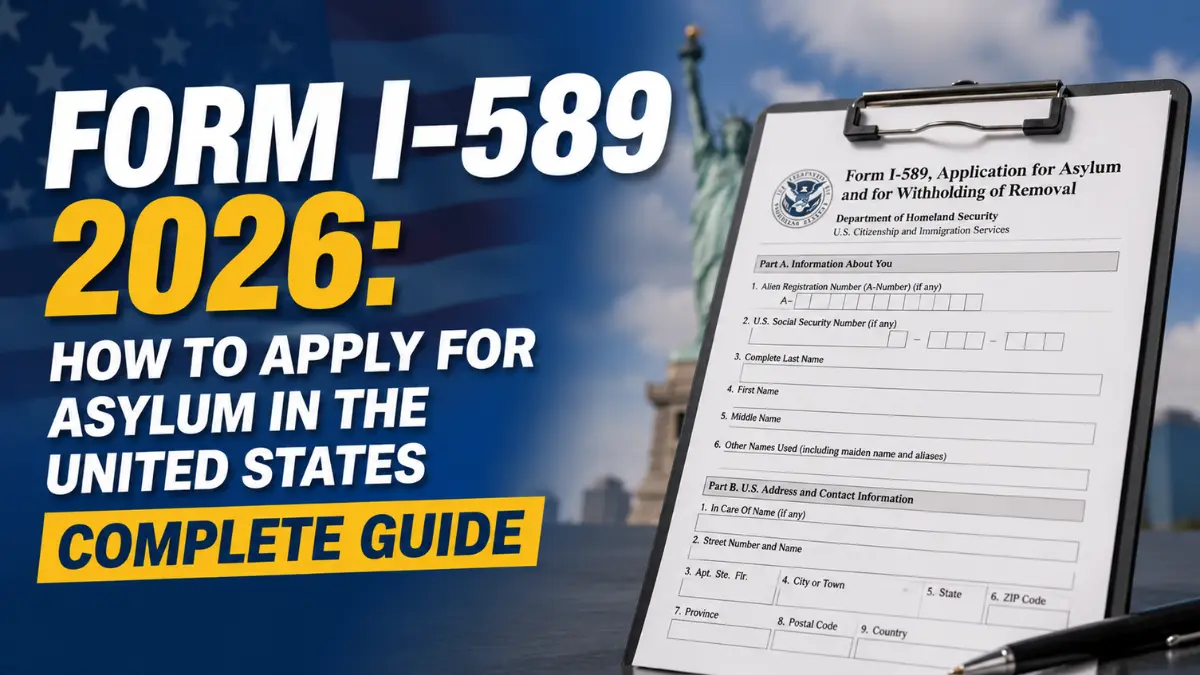
If you are in the United States and fear returning to your home country because of persecution, one of the most important steps you can take is filing Form I-589 asylum application with U.S. Citizenship and Immigration Services (USCIS) or the immigration court. This single form — the Application for Asylum and for Withholding of Removal — is the gateway to protection under U.S. law for people fleeing persecution based on race, religion, nationality, political opinion, or membership in a particular social group.
This complete 2026 guide explains everything you need to know about how to apply for asylum in the US 2026: who is eligible, how the one-year filing deadline works, the difference between affirmative and defensive asylum, how to complete the form, what supporting documents to include, current fees, and the most common mistakes that lead to delays or denials.
Also on applicationformportal.us: Form I-765 — Employment Authorization Document: after your asylum application has been pending for 150 days, you may apply for an EAD work permit using this form. And Form I-131 — Advance Parole: if you need to travel outside the U.S. while your asylum case is pending, read this guide first.
What Is Form I-589?
📥 Download Form I-589 from the Official USCIS Website →
Form I-589, Application for Asylum and for Withholding of Removal, is the official USCIS form used to apply for asylum protection in the United States. It is also the form used to request withholding of removal — a related but distinct form of protection with a higher burden of proof. The January 20, 2025 edition of Form I-589 is currently in use.
Form I-589 is available in 12 languages including Arabic, Spanish, French, Portuguese, Russian, Somali, Turkish, Vietnamese, and others for reading purposes, but USCIS only accepts completed applications in English. If you cannot read or write in English, you must have a translator complete the form on your behalf, and the translator must certify their translation.
Asylum Eligibility Requirements 2026
Understanding asylum eligibility requirements US 2026 is the first step. To qualify for asylum in the United States, you must meet all of the following criteria:
- You are physically present in the United States — regardless of how you entered or whether you are currently in lawful immigration status. You can apply for asylum even if you entered without authorization.
- You are not a U.S. citizen.
- You have a well-founded fear of persecution — meaning a reasonable possibility of being harmed if you return to your home country. This fear can be based on past persecution you already experienced, or on a credible threat of future persecution.
- The persecution is based on one of five protected grounds: race, religion, nationality, membership in a particular social group, or political opinion.
- You file within one year of your most recent arrival in the United States (with narrow exceptions — see below).
Importantly, general violence, poverty, crime, or difficult economic conditions in your home country do not qualify you for asylum under U.S. law. The fear of persecution must be directly linked to one of the five specific protected grounds listed above. If the harm you fear comes from private individuals (such as gangs or family members) rather than the government, you must show that the government in your home country is unwilling or unable to protect you.
Certain individuals are ineligible for asylum regardless of their fear of persecution, including those who have persecuted others, committed serious nonpolitical crimes, been convicted of particularly serious crimes, posed a danger to U.S. security, or firmly resettled in a third country before arriving in the United States.
The One-Year Filing Deadline
The i-589 one year filing deadline asylum rule is one of the most consequential — and most commonly missed — requirements in U.S. asylum law. In most cases, you must file Form I-589 within one year of your most recent arrival in the United States. If you miss this deadline, you will generally be barred from receiving asylum, no matter how strong your underlying claim is.
There are two narrow exceptions to the one-year deadline:
- Changed circumstances — A significant change in conditions in your home country or in your own personal circumstances that materially affects your eligibility for asylum. For example, a change in government, new laws targeting your group, or a change in your family situation.
- Extraordinary circumstances — Serious illness or mental or physical disability, legal disability, ineffective assistance of counsel, or other circumstances beyond your control that prevented timely filing. These exceptions are strictly evaluated and are difficult to prove without legal assistance.
If you believe you qualify for one of these exceptions, you must apply as soon as possible after the exception arises and explain in detail why you were unable to file within one year. Do not wait. Even a few days past the one-year mark can be the difference between eligibility and a permanent bar. If you are approaching the deadline, file your Form I-589 immediately, even if your application is not yet complete — an incomplete application can be returned and re-filed, but a missed deadline generally cannot be cured.
Affirmative vs Defensive Asylum: What Is the Difference?
Understanding affirmative vs defensive asylum application is critical because it determines where you file Form I-589 and how your case will be handled.
Affirmative Asylum
Affirmative asylum is for individuals who are not currently in removal (deportation) proceedings and who proactively apply for protection. You file Form I-589 with USCIS and are interviewed by a USCIS asylum officer. The interview is not a courtroom hearing — it is a one-on-one conversation, usually lasting a few hours, where the officer asks about your background, your fear of persecution, and the specific events that led you to seek asylum. You may bring a lawyer and an interpreter.
If the asylum officer approves your case, you are granted asylum. If the officer does not approve your case and you are not in lawful immigration status, your case is referred to an immigration judge for further review — at which point it becomes a defensive case.
Defensive Asylum
Defensive asylum is for individuals who are already in removal proceedings before an immigration judge at the Executive Office for Immigration Review (EOIR). You raise asylum as a defense against deportation, and your case is heard in a formal court proceeding where you must present evidence, testify, and respond to questions from both the judge and an ICE attorney representing the government.
In defensive cases, you file Form I-589 directly with the immigration court, not with USCIS. The standard for asylum is the same as in affirmative cases, but the proceedings are more formal and the stakes are higher because denial of a defensive claim typically means an order of removal.
Form I-589 Filing Fee in 2026
The i-589 filing fee 2026 is an important and recently changed aspect of the asylum process. As of July 2025, a filing fee was introduced for Form I-589 through the “One Big Beautiful Bill” budget reconciliation legislation. The fee structure is:
| Fee Type | Amount (2026) |
|---|---|
| Initial Form I-589 filing fee | $100 |
| Annual Asylum Filing Fee (AAF) — per year pending | $102 (adjusted for inflation from $100 in 2025) |
| Biometric services fee | $0 (no charge for asylum applicants) |
As of May 29, 2026, USCIS will reject pending Form I-589 applications for applicants who do not timely pay the Annual Asylum Filing Fee (AAF). The fee is not paid at the time of initial filing but is assessed as the case remains pending. Always check the current USCIS fee schedule at uscis.gov before filing, as fee rules for asylum are in active litigation and subject to change.
What Documents Do You Need to File Form I-589?
Supporting documents are what transform a personal account of fear into a credible, legally supported asylum claim. USCIS evaluates your application based on the totality of your evidence. Here is what to include:
Identity Documents
- Copies of your passport (all pages)
- Birth certificate
- Any national ID card or other government-issued identification
- Documents showing your entry into the United States (I-94, visa, border entry stamps)
Evidence of Persecution
- Police reports, arrest records, or court documents related to your persecution
- Medical records documenting injuries from persecution or torture
- Photographs of injuries, damaged property, or other evidence of harm
- Written statements from witnesses who can attest to events you experienced
- Letters or threats you received from persecutors
- News articles, human rights reports, or country condition reports documenting persecution of your group
- Reports from recognized organizations such as Amnesty International, Human Rights Watch, or the U.S. State Department Country Reports on Human Rights Practices
Personal Statement
Knowing how to fill out i-589 personal statement correctly is one of the most important aspects of the entire application. Your personal statement — attached to Part B of the form — is your opportunity to tell your story in detail. It should explain who harmed you or who you fear, what happened or what you fear will happen, when and where events occurred, why you were targeted (connecting the harm to one of the five protected grounds), and why you cannot safely return to your home country.
Write your personal statement in the first person and with as much specific detail as possible: specific dates, locations, names of people involved, and what was said or done. Vague or general statements (“I was afraid” without specifics) are much less persuasive than detailed, concrete accounts. Your statement should be internally consistent and match everything you say in your Form I-589 and at your asylum interview.
Documents in Foreign Languages
All documents not in English must be accompanied by a certified English translation. The translator must certify that they are competent in both languages and that the translation is accurate and complete. You do not need to use a professional translation service — a bilingual person can certify the translation themselves as long as they sign a certification statement.
How to Fill Out Form I-589: Step-by-Step
Form I-589 consists of six parts plus supplemental pages. All answers must be typed or printed in black ink in English. Every question must be answered — write “N/A” for questions that do not apply. Never leave a question blank.
Step 1: Part A.I — Information About You
Enter your full legal name, date of birth, country of birth, country of nationality, immigration status, and your address in the United States. Include your A-Number if you have one. Provide your mailing address if different from your physical address. Answer every question in this section, including your last address in your home country and the address of the place where you fear persecution if different.
Step 2: Part A.II — Spouse and Children
You must list your spouse and all of your children in this section, regardless of their age, marital status, whether they are in the United States, or whether they are included in your application. If you want to include your spouse and unmarried children under 21 who are in the United States as derivative applicants on your claim, indicate this in the appropriate column. Use Form I-589, Supplement A to list additional children if needed.
Step 3: Part A.III — Background Information
Provide information about your background including your education, employment history, parents’ names, and membership in organizations. Be thorough and accurate. USCIS will cross-reference this information with other records and your interview testimony.
Step 4: Part B — Your Asylum Application
This is the most important section of the form. Check all boxes that apply to your basis for asylum (race, religion, nationality, particular social group, political opinion). Then answer questions A and B: whether you or your family have experienced past harm, and whether you fear harm if you return. Provide detailed written responses using Form I-589 Supplement B or additional sheets of paper if the space provided is insufficient. Write “See Supplement B” in the original space when attaching additional pages.
Step 5: Part C — Additional Information
Answer all background questions about prior asylum applications, immigration history, criminal history, and organizational memberships. If you answer “Yes” to any question, provide a full written explanation. Incomplete answers here are a common reason for delays and denials. Be honest — inconsistencies between your Form I-589, your interview testimony, and records USCIS already has about you are serious credibility flags.
Step 6: Part D — Your Signature
You must sign Part D of the form after completing and reviewing it. Sign in black ink. Do not sign Part F (the section completed at the asylum interview) before you file — you will be asked to sign it at your interview. If someone helped you complete the form, they must complete and sign Part E.
Step 7: Assemble and File Your Application
For affirmative asylum (USCIS), assemble your completed Form I-589, all supplement pages, your personal statement, all supporting documents with certified translations, and any other evidence. File with the appropriate USCIS Asylum Intake Unit or lockbox facility based on your location and circumstances. Use the USCIS Filing Instructions Tool at uscis.gov/i-589 to determine exactly where to send your application. Send by a trackable delivery method (FedEx, UPS, or USPS with tracking) so you have proof of the date USCIS received your application — this date starts your asylum clock.
For defensive asylum (immigration court), file Form I-589 directly with the immigration court where your proceedings are pending.
Form I-589 Processing Time in 2026
The i-589 processing time 2026 varies enormously depending on how your case enters the system. For affirmative cases, USCIS generally aims to schedule an asylum interview within 180 days of filing, though backlogs at many asylum offices extend this significantly. As of 2026, average processing times range from 6 months to 4 years or more depending on the asylum office jurisdiction and case complexity.
USCIS currently operates under a “last in, first out” scheduling policy for asylum interviews, meaning more recently filed cases are often scheduled before older ones. For defensive cases in immigration court, wait times are similarly long due to massive court backlogs, with some cases taking years before reaching a hearing.
While your case is pending, you are generally protected from deportation and can apply for a work permit after the 150-day waiting period described below.
The Asylum Work Permit: The 150-Day Rule
The asylum work permit 150 day rule is one of the most practically important rules for asylum applicants. After your Form I-589 has been pending with USCIS or the immigration court for at least 150 days through no fault of your own, you become eligible to apply for an Employment Authorization Document (EAD) using Form I-765.
The 150-day period is called the “asylum clock.” It starts on the date USCIS receives your completed Form I-589 (the receipt date on your confirmation). Delays you cause yourself — such as requesting a continuance, missing an appointment, or failing to appear for your biometrics — stop the clock and are not counted toward the 150 days. Delays caused by USCIS or the immigration court do count. If you are granted asylum, you are immediately authorized to work without needing to file Form I-765.
Withholding of Removal: The Alternative Protection
Withholding of removal form i-589 is a separate but related form of protection that you can request on the same Form I-589 by checking the relevant box. Unlike asylum, withholding of removal does not lead to permanent residence or a path to citizenship, and it cannot be extended to family members as derivatives. However, it has one critical advantage: it is a mandatory protection with no one-year filing deadline.
To qualify for withholding of removal, you must show that it is “more likely than not” — a higher standard than the “well-founded fear” standard for asylum — that your life or freedom would be threatened in your home country based on one of the five protected grounds. It is generally recommended to check the withholding of removal box on your Form I-589 as a backup protection, especially if you are past the one-year deadline for asylum.
Common Mistakes That Cause Delays or Denials
- Missing the one-year filing deadline. This is the single most common reason strong asylum claims are denied. File as soon as possible after arriving in the United States.
- Leaving questions blank. Every question on Form I-589 must be answered. Write “N/A” for inapplicable questions. A blank space is not the same as “N/A.”
- Inconsistent testimony. Any discrepancy between what you write on your Form I-589 and what you say at your asylum interview — no matter how small — can be used to find you not credible. Review your application carefully before your interview and be prepared to explain everything you wrote.
- Vague personal statement. General statements about fear without specific details, dates, and events are far less persuasive than concrete, detailed accounts. Take time to write a thorough, specific personal statement.
- Insufficient evidence. Personal testimony alone, while important, is not enough. Include as much corroborating documentation as possible — police reports, medical records, country condition reports, and witness statements.
- Filing on an outdated form edition. USCIS will reject applications filed on outdated versions of Form I-589. Always use the current edition dated 01/20/2025 from uscis.gov.
- Filing in the wrong language. The form must be completed in English. Submissions in other languages will be returned.
- Not disclosing all grounds for persecution. If your fear relates to more than one protected ground (for example, both political opinion and religion), check all applicable boxes and address each ground in your personal statement.
Other Application Forms You May Need
The asylum process often involves other USCIS forms alongside or after Form I-589:
- Form I-765 — Employment Authorization Document: Apply for your work permit 150 days after filing Form I-589, using this form.
- Form I-131 — Application for Travel Document: If you need to travel outside the United States while your asylum application is pending, you may need advance parole. Be aware that traveling to your country of claimed persecution will be presumed to be abandonment of your application.
- Form I-485 — Application to Register Permanent Residence: If you are granted asylum, you may apply for a green card one year after your asylum grant date using this form.
- Form N-400 — Application for Naturalization: Asylees who become lawful permanent residents can apply for U.S. citizenship after five years of permanent residence.
Frequently Asked Questions About Form I-589
Can I apply for asylum if I entered the U.S. illegally?
Yes. U.S. law allows individuals to apply for asylum regardless of their immigration status or how they entered the country — including those who entered without authorization. Your manner of entry does not bar you from asylum, though it may be considered as a negative factor in some cases.
Can I include my family on my asylum application?
Yes. You may include your spouse and unmarried children under 21 who are physically present in the United States as derivative applicants on your Form I-589. If your asylum is granted, they are also granted asylum as derivatives. List all family members in Part A.II of the form, and indicate which ones you wish to include as derivatives.
Can I travel outside the U.S. while my I-589 is pending?
Generally no — and especially not to your country of claimed persecution. If you travel to the country from which you are seeking protection, USCIS will presume that you have abandoned your asylum application. Any international travel while your application is pending requires advance parole from USCIS, and even then carries significant risk to your case.
What happens if my affirmative asylum application is denied?
If you are not in lawful immigration status and USCIS denies your affirmative asylum application, your case is referred to an immigration judge for a hearing. This converts your case into a defensive asylum proceeding where you can present your claim again before the court. If the immigration judge also denies your case, you may appeal to the Board of Immigration Appeals (BIA).
Do I need a lawyer to file Form I-589?
You are not legally required to have an attorney, but legal representation significantly improves your chances of a successful outcome. Asylum cases are complex, and errors in the application or at the interview can be extremely difficult to correct. Pro bono (free) legal assistance is available through nonprofit immigration organizations in most cities. Check the Immigration Advocates Network or your local legal aid society for free resources.
What is a frivolous asylum application?
If USCIS or an immigration judge determines that you knowingly filed a frivolous asylum application — one that contains deliberately fabricated material elements — you will be permanently barred from receiving any immigration benefit under the Immigration and Nationality Act. This bar is permanent and cannot be waived. Never include false information in your Form I-589.
How long does the asylum process take in 2026?
Processing times vary widely. USCIS aims to schedule affirmative asylum interviews within 180 days, but actual wait times at most asylum offices in 2026 range from 6 months to several years due to backlog. Defensive cases in immigration court can take even longer given court scheduling constraints. Use the USCIS processing times tool and check your local immigration court’s schedule for the most current estimates.
Official Resources
- 📥 Download Form I-589 (PDF) — Official USCIS Form
- 📥 Download Form I-589 Instructions (PDF)
- 🔗 USCIS Form I-589 Official Page
- 🔗 USCIS Asylum Information Page
- 🔗 USCIS Processing Times Tool
- 🔗 DOJ — Find Free Immigration Legal Help
Disclaimer: This guide is for informational purposes only and does not constitute legal advice. Asylum law is highly complex and the consequences of errors are severe. Always consult a licensed immigration attorney or accredited representative for advice specific to your situation. Asylum rules and fees are subject to ongoing legal challenges and policy changes — verify all current requirements on the official USCIS website before filing.